

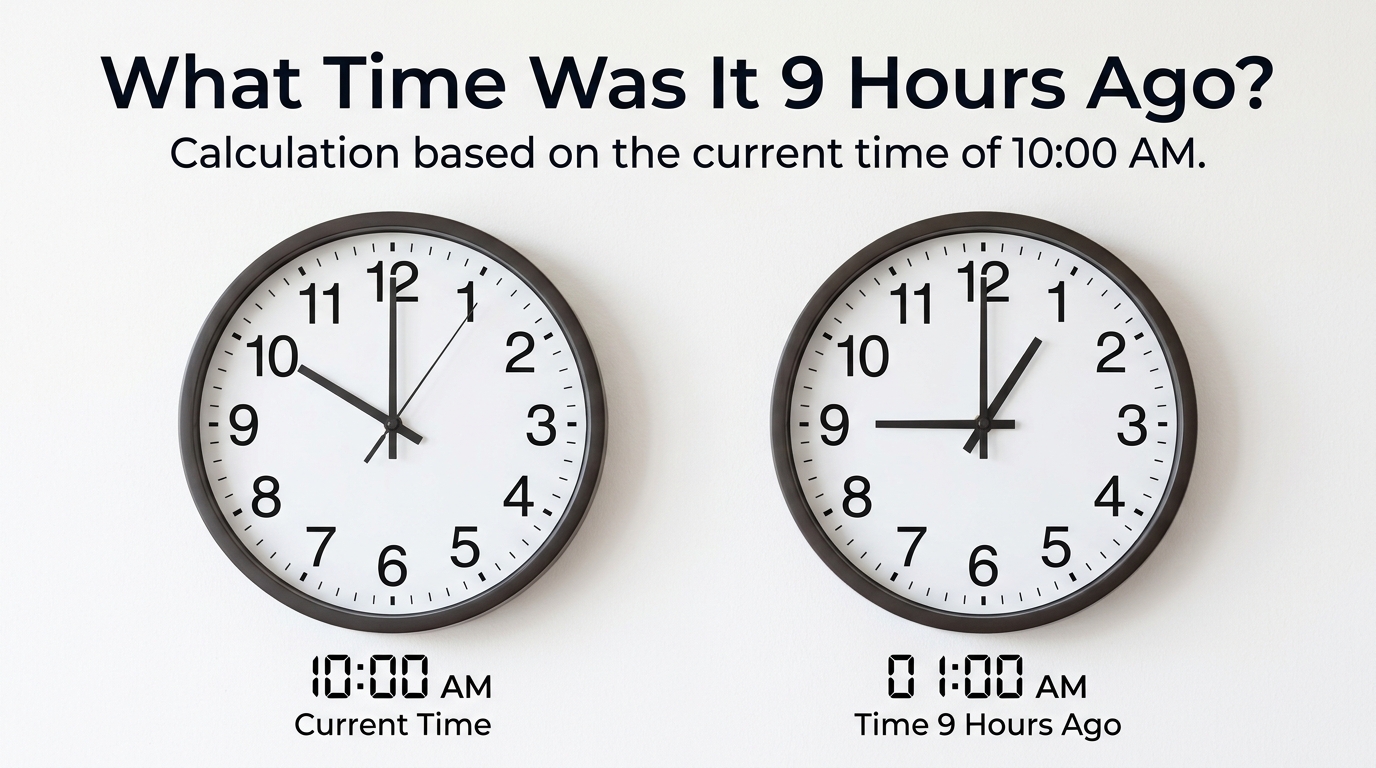
Time is a funny little thing. It sits quietly on the corner of your phone, ticking away like it has nowhere else to be, and then suddenly you look at a message and wonder, “What Time Was It 9 Hours Ago?” Maybe the question came because someone sent a late reply.
Maybe you noticed an old notification. Or maybe you were remembering a beautiful family moment, such as the first message announcing the arrival of a baby girl.
There is something strangely emotional about timestamps. A simple number beside a digital message can take us backwards in our minds.
Nine hours ago might have been breakfast, midnight, a busy afternoon, or the exact moment a family welcomed their newborn daughter into the world. The clock only sees numbers, but people attach stories to those numbers.
The good news is that finding the answer is not complicated. If you know your current time, you simply need to go backward by 9 hours.
This is a basic form of past time calculation, sometimes called a reverse time lookup. Still, things get a tiny bit interesting when the calculation crosses midnight or moves into a different date.
| Time Reference | Calculation |
|---|---|
| Current Time | Now |
| 1 Hour Ago | Current time 1 hour |
| 3 Hours Ago | Current time 3 hours |
| 6 Hours Ago | Current time 6 hours |
| 9 Hours Ago | Current time 9 hours |
| 12 Hours Ago | Current time 12 hours |
What Time Was It 9 Hours Ago From Now?
The easiest way to answer what time was it 9 hours ago from now is to take the current clock time and subtract 9 hours.
For example, if your clock says 3:00 PM, going backward nine hours gives you 6:00 AM. Nothing dramatic happened there; the date stays the same.
But suppose the current time is 4:00 AM. Nine hours earlier would be 7:00 PM on the previous day. That little jump across midnight is where people often get confused.
The basic rule is wonderfully simple:
Current time 9 hours = time 9 hours ago
So if it is 10:00 AM now:
- 10:00 AM minus 9 hours = 1:00 AM
- The result remains on the same day.
If it is 5:00 AM now:
- 5:00 AM minus 9 hours = 8:00 PM
- The result belongs to the previous day.
That is the whole trick, really. The clock doesn’t care about our confusion, it just keeps moving.
How to Calculate 9 Hours Ago
When someone asks how to calculate what time was 9 hours ago, there are several simple ways to do it.
The first method is ordinary time arithmetic. Look at the current hour and count backward nine times. This works nicely when the calculation stays within the same day.
The second method is converting hours into minutes. Since:
9 × 60 = 540 minutes
nine hours equals 540 minutes. You can subtract 540 minutes from the current time if you prefer working with minutes.
There are also smaller units:
- 9 hours = 540 minutes
- 9 hours = 32,400 seconds
- 9 hours = 32,400,000 milliseconds
Most people obviously don’t need milliseconds to figure out when breakfast happened, but the conversion shows how a simple human question can become a precise elapsed time computation.
A time calculator does the same basic job automatically. You enter the current clock time, choose the backward interval, and the calculator performs the reverse time calculation for you.
What Was 9 Hours Ago If It Is Morning?
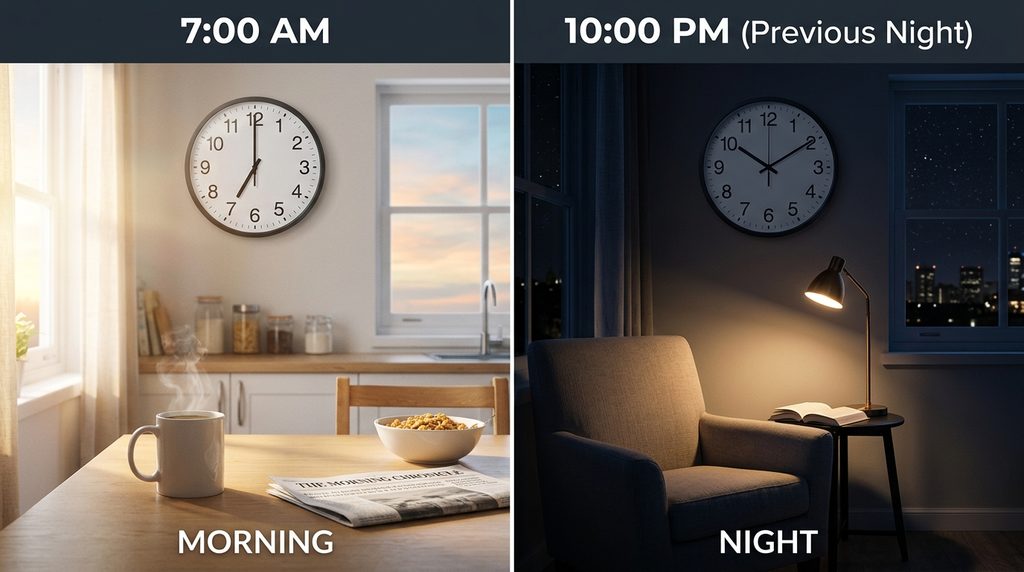
Morning calculations can be particularly interesting because nine hours is long enough to cross midnight.
Imagine the current clock time is 7:00 AM.
Going backward:
- 7:00 AM → 6:00 AM: 1 hour
- 6:00 AM → 5:00 AM: 2 hours
- 5:00 AM → 4:00 AM: 3 hours
- 4:00 AM → 3:00 AM: 4 hours
- 3:00 AM → 2:00 AM: 5 hours
- 2:00 AM → 1:00 AM: 6 hours
- 1:00 AM → midnight: 7 hours
- midnight → 11:00 PM: 8 hours
- 11:00 PM → 10:00 PM: 9 hours
Therefore, 9 hours ago from 7:00 AM was 10:00 PM the previous day.
This is known as date rollover or a midnight crossing. The clock goes backward, and eventually the calendar has to move backward too. Tiny detail, big source of mistakes.
What Time Was It 9 Hours Ago If It Is 11 PM?
This one is easier because moving backward nine hours does not cross into the previous day.
If it is 11:00 PM now:
11:00 PM 9 hours = 2:00 PM
So what time was 9 hours ago if it is 11 PM? The answer is 2 PM on the same day.
The 12 hour clock system can make this look slightly more complicated than it really is. You have to pay attention to whether the answer is AM or PM, especially when the calculation passes through noon or midnight.
For a quick mental method, simply walk backward from the current hour while keeping an eye on those two important boundaries: noon and midnight.
What Was 9 Hours Ago If It Is 8 AM?
If the current time is 8:00 AM, subtracting nine hours gives:
8:00 AM 9 hours = 11:00 PM yesterday
So the answer is 11:00 PM on the previous day.
This is one of the most useful examples because it demonstrates why you cannot simply subtract nine from the displayed hour and stop. If you tried 8 9, you would get 1, which isn’t a normal clock hour.
Instead, move through midnight.
Eight hours takes you from 8:00 AM to midnight, and the ninth hour takes you back to 11:00 PM. Simple once you see it, slightly sneaky the first time.
Why 9 Hours Ago Can Mean the Previous Day
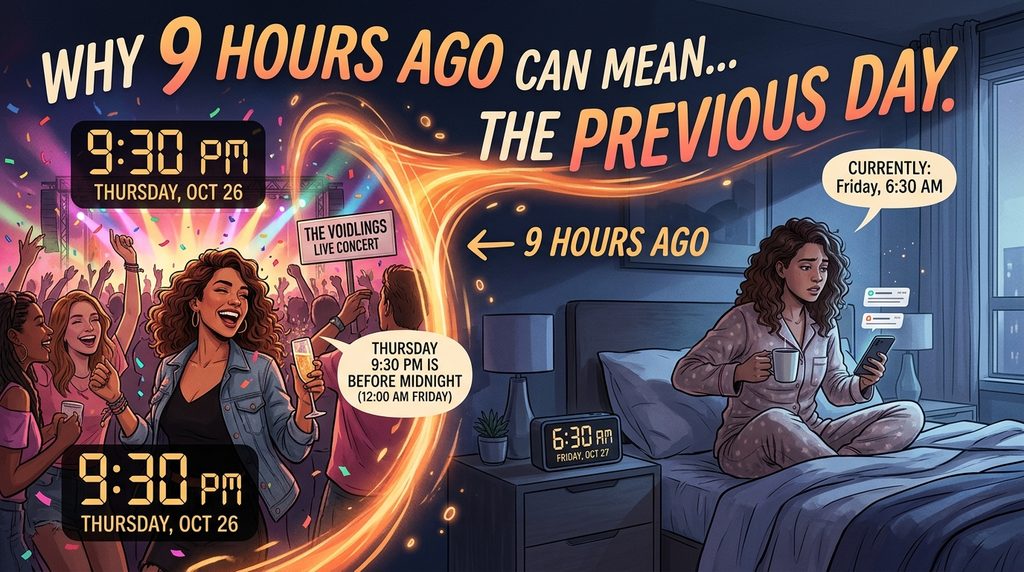
A 9 hour time difference is large enough to cross midnight depending on the starting point.
If the current time is between midnight and 8:59 AM, subtracting nine hours will usually take you into the previous day.
For example:
| Current Time | 9 Hours Earlier |
|---|---|
| 1:00 AM | 4:00 PM previous day |
| 3:00 AM | 6:00 PM previous day |
| 5:00 AM | 8:00 PM previous day |
| 7:00 AM | 10:00 PM previous day |
| 8:00 AM | 11:00 PM previous day |
| 10:00 AM | 1:00 AM same day |
| 12:00 PM | 3:00 AM same day |
| 3:00 PM | 6:00 AM same day |
| 6:00 PM | 9:00 AM same day |
| 9:00 PM | 12:00 PM same day |
| 11:00 PM | 2:00 PM same day |
The important part isn’t memorizing the table. It’s understanding the time subtraction behind it.
9 Hours Ago From Now and the Previous Day
The phrase 9 hours ago from now sounds like it should always refer to today’s clock, but that’s not necessarily true.
Imagine a family receives a message at 2:30 AM saying their baby girl has arrived safely. Someone reads the message at 11:30 AM and notices the timestamp says it was sent nine hours earlier.
The message wasn’t sent “earlier this morning” in the casual sense. It was sent at 2:30 AM, still on the same calendar day.
Now imagine the message was received at 6:30 AM and the timestamp says nine hours ago. That places the original message at 9:30 PM the night before.
The numbers are identical. The emotional story is different.
That’s why date and time should sometimes be considered together rather than looking at the clock alone.
Using a Time Calculator for 9 Hours Ago
An online time calculator can make this process almost instant.
A typical time calculator utility allows you to enter a starting time and then choose whether you want to add or subtract an interval. For this question, you would select subtraction and enter nine hours.
A useful hours from now calculator or time ago calculator can also handle the arithmetic automatically. These tools are particularly useful when:
- The calculation crosses midnight.
- You need to know the previous date.
- You are comparing several timestamps.
- You are working with a schedule.
- You are checking a delayed message.
- You are comparing times in different regions.
- You simply don’t want to do mental arithmetic before your morning tea.
Online calculators aren’t doing mysterious magic. They are applying straightforward time calculation rules behind the scenes.
Understanding 9 Hours in Minutes and Seconds

Sometimes a person doesn’t really need a clock answer. They need the actual length of the interval.
Nine hours contains:
9 hours = 540 minutes
And:
540 minutes = 32,400 seconds
And in even smaller units:
32,400 seconds = 32,400,000 milliseconds
This kind of hours-to-minutes conversion is useful in programming, scheduling, sports timing, work tracking, video editing, and other situations where time needs to be measured precisely.
For everyday conversations, though, “nine hours” is generally much friendlier than “thirty-two thousand four hundred seconds.” Imagine telling someone, “I haven’t slept for 32,400 seconds.” Technically correct, socially a little alarming.
Time Zones Can Change the Answer
Things become more interesting when the question involves different regions.
Suppose one person is in Pakistan using GMT+5, while another person is somewhere with a different time zone offset. Their clocks may show different local times even when they are experiencing the same moment.
This is why time zone conversion matters for international communication.
A message sent at a particular moment may display a different local clock time for someone in another country. The actual elapsed time hasn’t changed; only the local representation has.
For example, a family member might announce the birth of a daughter while traveling internationally. One relative sees the announcement at night, another sees it in the afternoon, and somebody else wakes up to it the next morning.
The message has one timestamp in absolute time, but several local interpretations.
This is where global time, international time, and local time become important. Geography quietly sits behind our digital clocks, doing its strange little dance.
9 Hours Ago, Messages, and Emotional Memory
There is a human side to all this that calculators don’t really explain.
A timestamp can become an emotional timestamp.
You might see “9 hours ago” next to a message and remember exactly what was happening then.
Perhaps you were waiting outside a hospital. Maybe a grandmother was holding a newborn baby girl for the first time. Perhaps a father sent a message saying, “She’s here,” and suddenly the entire family group chat became a river of congratulations.
Nine hours later, the clock only says the message is old.
The family knows better.
It marks a moment.
That is why digital messages, message timestamps, and emotional memory sometimes become connected. The time shown on a screen can help us reconstruct a personal story.
What Time Was 9 Hours Ago During a Baby Girl Celebration?
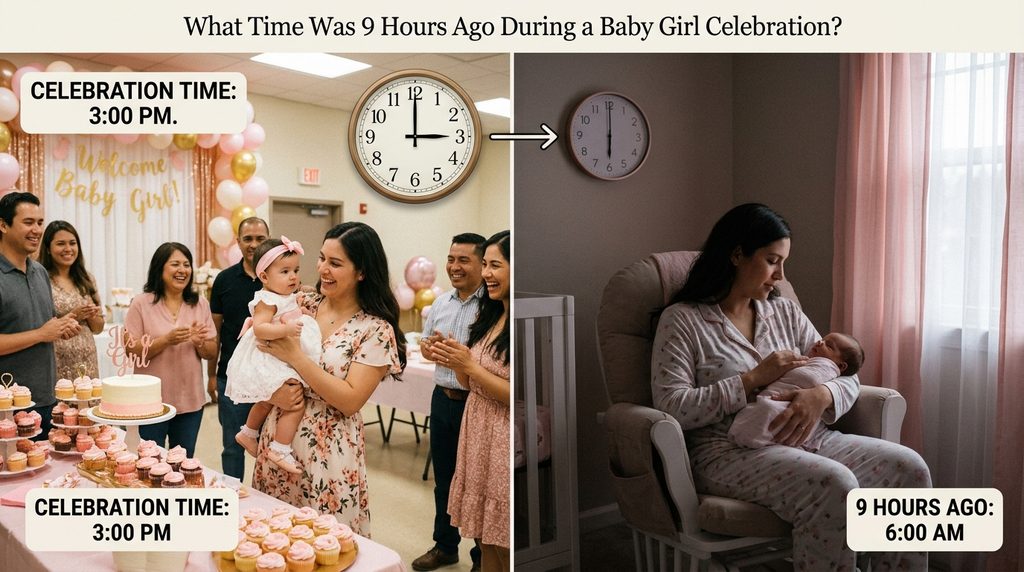
Imagine a newborn daughter arrives at 1:15 AM.
The grandparents receive the announcement at 1:20 AM. An uncle sees it nine hours later, at 10:20 AM, while drinking tea before starting his day.
If he asks, what time was it 9 hours ago, the answer takes him directly back to 1:20 AM.
That timestamp may now mean much more than a number.
It represents the moment someone became a parent. It represents the first family announcement. It may represent the beginning of a completely new chapter.
This is why a family timeline can become meaningful. Birth times, first photographs, first messages, and congratulations all become little markers in a family’s memory.
Heartfelt Baby Girl Wishes for a Timestamp That Matters
When a family welcomes a newborn baby girl, the best message doesn’t need to be complicated. It just needs to feel sincere.
Here are some ready to use baby girl wishes that work beautifully in family chats, cards, or personal messages:
- May your little daughter fill your home with laughter, tenderness, and a thousand tiny reasons to smile every day.
- Congratulations on the arrival of your precious baby girl. May her life be surrounded by love, kindness, and beautiful memories.
- A tiny daughter has arrived, and somehow the whole family feels a little bigger and happier. Many blessings to you all.
- Wishing your newborn baby girl a life full of gentle mornings, joyful discoveries, and people who love her deeply.
- Congratulations on welcoming your little princess. May this new chapter bring unforgettable happiness to your family.
- Your daughter may be tiny today, but the love she has brought into the family is already enormous. Warmest congratulations.
- May your baby girl grow surrounded by laughter, good people, meaningful traditions, and plenty of hugs.
- Congratulations on this beautiful birth of a daughter. May parenthood bring you countless moments that you’ll remember forever.
- Sending heartfelt newborn blessings to your family and wishing your little one a bright and peaceful life.
- A daughter arrives with tiny fingers and somehow rearranges the entire family universe. Congratulations on your beautiful little one.
What Time Was It 9 Hours Ago? Turning a Calculation Into a Memory
Sometimes the question what time was it 9 hours ago is really a question about something that happened then.
Maybe you sent a congratulations message.
Maybe someone announced a birth.
Maybe you were waiting for an important phone call.
Maybe you were awake at midnight thinking about someone who wasn’t replying.
Time calculation gives you the factual answer, while memory gives that answer its meaning. Both can exist together without competing.
That is one reason people search for a past time calculator even when the mathematics is simple. They aren’t always looking for arithmetic. They are trying to place an event on a timeline.
Cultural Traditions Around Welcoming a Daughter

Across different cultures, the arrival of a baby is often accompanied by family gatherings, blessings, prayers, gifts, meals, photographs, and messages. The exact traditions differ widely, but the emotional idea is familiar: a new person has joined the family.
In some families, grandparents are among the first people called. In others, close relatives gather around the parents and newborn. Some families prefer quiet celebrations, while others announce the arrival through a flood of digital messages.
A baby girl celebration might therefore look completely different from one family to another.
The common thread is usually affection.
A newborn doesn’t understand the congratulations, obviously. She doesn’t know that somebody calculated 9 hours ago to figure out when her birth announcement was sent. But one day, those old messages may become part of the family story.
How to Write a More Personal Newborn Message
Generic congratulations are lovely, but personal messages often stay in people’s memories longer.
Instead of simply writing “Congratulations on your baby girl,” mention something specific.
You could say:
- how happy the family sounds,
- how excited the grandparents are,
- how beautiful the new chapter feels,
- a family tradition you hope continues,
- or a small memory connected with the parents.
A good heartfelt newborn message doesn’t need fancy vocabulary. It needs a little truth.
For example, if you remember receiving the birth announcement nine hours after it was sent, you could mention that moment. “I woke up to the sweetest message this morning” feels more personal than something copied from a greeting-card shelf.
Small details are where sincerity hides.
Creative Ways to Deliver Baby Girl Congratulations
A message doesn’t have to arrive through a standard text.
You can send newborn wishes through:
- A handwritten card placed beside a baby gift.
- A short voice message from grandparents.
- A family group-chat message.
- A small photo album containing congratulations from relatives.
- A personalized digital card.
- A letter written for the child to read years later.
- A simple family video with short messages from loved ones.
- A keepsake box containing the birth announcement and early photographs.
One particularly meaningful idea is writing a letter addressed to the daughter herself. She may not read it for years, but someday she can discover what her family felt on the day she arrived.
That turns a moment into a memory.
Why Time Feels Different During Important Moments

People don’t experience time only through clocks.
Waiting for important news can make ten minutes feel enormous. A joyful family gathering can make several hours disappear almost suspiciously fast. A quiet night with a newborn can feel like both an instant and an entire lifetime.
This is time perception, and it is deeply connected to human experience.
The clock measures duration. Our minds attach meaning to it.
That is why “nine hours ago” can feel like a simple technical phrase in one situation and strangely emotional in another.
A timestamp may tell you when something happened, but memory tells you why it mattered.
Quick Reference: 9 Hours Ago
If you’re searching for a quick answer, remember these basic rules:
| Question | Method |
|---|---|
| What time was 9 hours ago? | Subtract 9 hours from the current time |
| How many minutes are 9 hours? | 540 minutes |
| How many seconds are 9 hours? | 32,400 seconds |
| Can 9 hours ago be yesterday? | Yes, if the calculation crosses midnight |
| Does the date always stay the same? | No |
| Does a time zone matter? | Yes, when comparing different regions |
| What tool can help? | A time calculator or time ago calculator |
| What is 9 hours before 8 AM? | 11 PM the previous day |
| What is 9 hours before 11 PM? | 2 PM the same day |
Frequently Asked Questions
What Time Was It 9 Hours Ago?
9 hours ago is calculated by subtracting 9 hours from the current time.
How Do I Calculate 9 Hours Ago?
Simply subtract 9 hours from the current time. If needed, adjust the date when crossing midnight.
What Time Was It 9 Hours Ago From Now?
The exact time depends on your current local time and time zone.
Can 9 Hours Ago Be on the Previous Day?
Yes. If the current time is before 9:00 AM, 9 hours ago will usually fall on the previous day.
How Can I Find the Exact Time 9 Hours Ago?
Use a time calculator by entering your current time and subtracting 9 hours for an accurate result.
Read This Blog:https://tevoqix.com/time-is-20-minutes-from-now/
Final Thoughts on 9 Hours Ago
So, what time was it 9 hours ago? The mathematical answer is wonderfully ordinary: take the current time and subtract nine hours.
But time itself is rarely ordinary.
Nine hours can separate a late-night message from a morning reply. It can separate the announcement of a newborn baby girl from the moment a relative finally wakes up and reads it. It can connect two parts of a family story that happen on opposite sides of midnight.
The clock gives us exact time. The calendar gives us the date. A calculator gives us the answer. But people give those moments meaning.
And perhaps that is why such a small question can feel surprisingly important.
If you’re using a time calculator utility, checking an old message timestamp, calculating a previous-day moment, or simply wondering what was 9 hours ago, the calculation only takes a few seconds. The memory behind it might last much, much longer.
When a family welcomes a daughter, every early moment can feel precious the first photograph, the first congratulations, the first family message, the first sleepy morning. Years later, a tiny timestamp may bring all of it back.
So calculate the hour, check the date, notice the time zone if needed and then remember the story that happened there.
Because clocks measure hours.
Families remember moments.
