

There is something oddly sweet about waiting for a little moment to arrive. A kettle starts humming, a cake sits quietly in the oven, someone says “I’ll be there in twenty,” and suddenly the clock feels like it has become the main character.
Even the arrival of a baby girl can make ordinary minutes feel precious, because families start counting every little moment differently. Twenty minutes before she arrives, everything feels normal; twenty minutes later, the whole room can feel changed forever, somehow.
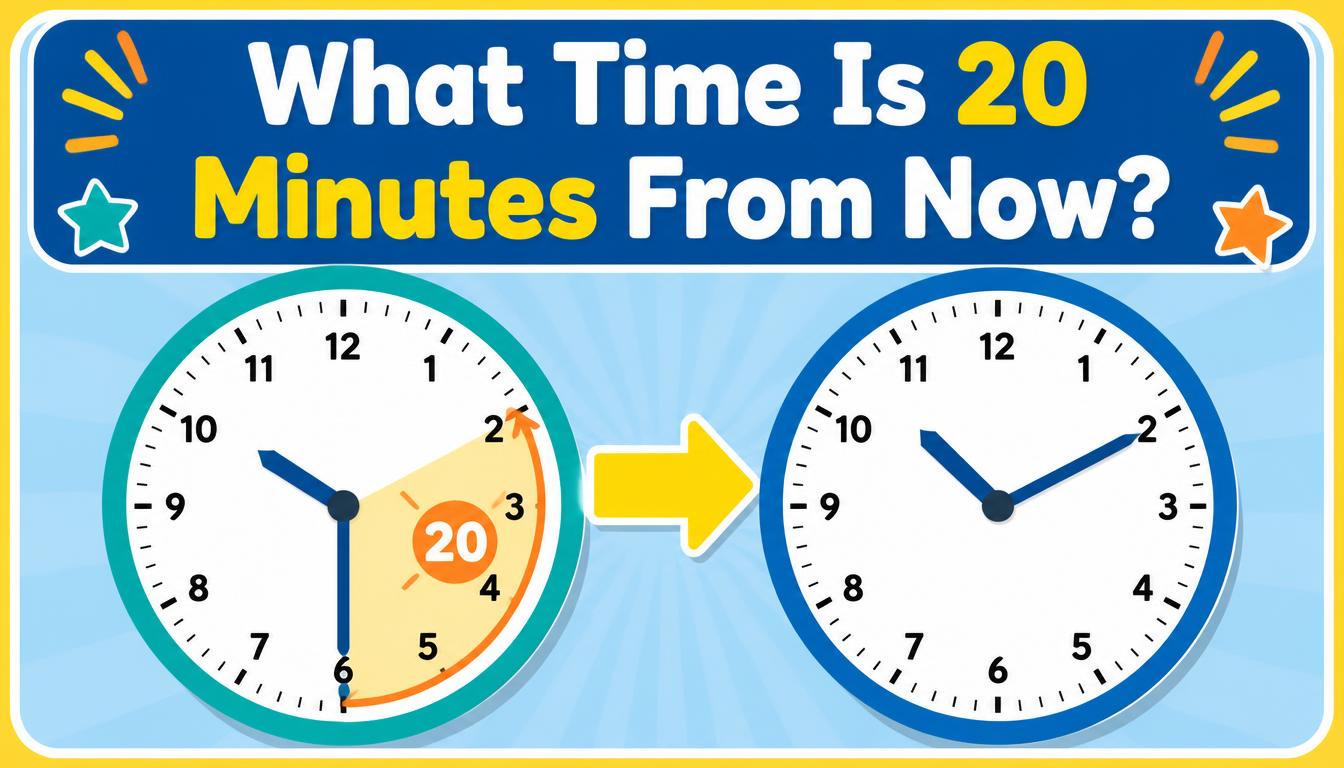
That is why knowing What Time Is 20 Minutes From Now is more useful than it sounds. It is a tiny piece of time calculation, but it helps with cooking, meetings, workouts, study sessions, appointments, travel plans, reminders, and hundreds of those little daily things we all forget sometimes.
If the current time is 7:39 PM, for example, adding 20 Minutes gives 7:59 PM. Simple enough, right? But clocks have their little traps.
If the starting time is 11:50 PM, twenty minutes later becomes 12:10 AM on the Next Day. Thats where understanding time arithmetic, AM/PM, and day rollover becomes handy.
| Time Calculation | Result |
|---|---|
| Current Time | Now |
| Add | 20 minutes |
| Future Time | Current time + 20 minutes |
| Total Minutes | 20 minutes |
| Total Seconds | 1,200 seconds |
What Time Is 20 Minutes From Now?
The basic idea is wonderfully simple: take the Current Time and add 20 minutes.
For example:
- 7:39 PM + 20 minutes = 7:59 PM
- 7:50 PM + 20 minutes = 8:10 PM
- 11:50 PM + 20 minutes = 12:10 AM
- 11:45 AM + 20 minutes = 12:05 PM
- 2:15 PM + 20 minutes = 2:35 PM
- 4:40 PM + 20 minutes = 5:00 PM
- 6:10 AM + 20 minutes = 6:30 AM
- 12:00 PM + 20 minutes = 12:20 PM
So, when somebody asks, “what time will it be in 20 minutes?” the answer depends entirely on the starting Clock Time. The calculation itself is easy, but the exact result changes every minute, which is why a Minutes From Now Calculator can be useful when you need the answer right away.
A good little rule is this: if the minutes on the clock are below 40, simply add 20. If adding 20 pushes the minute value past 59, move the hour forward by one. Thats the tiny bit of clock math that saves confusion.
How to Calculate 20 Minutes From Now Manually
You do not really need an app to perform this Future Time calculation. Your wall clock, Smartphone, Watch, or plain old brain can do it, provided nobody is talking to you while you’re trying to count.
Suppose the Current Time is 7:39 PM.
Start with:
7:39 PM + 20 minutes = 7:59 PM
No hour change happens because 39 + 20 equals 59.
Now imagine the time is 7:50 PM:
7:50 PM + 20 minutes = 8:10 PM
Here, 50 + 20 gives 70 minutes. Since an hour contains 60 minutes, remove 60 and carry one hour forward. The remaining 10 minutes become the new minute value.
This is called a small piece of Clock Calculation or Time Arithmetic, and once you get used to it, it becomes almost automatic.
What Happens When 20 Minutes Crosses an Hour?
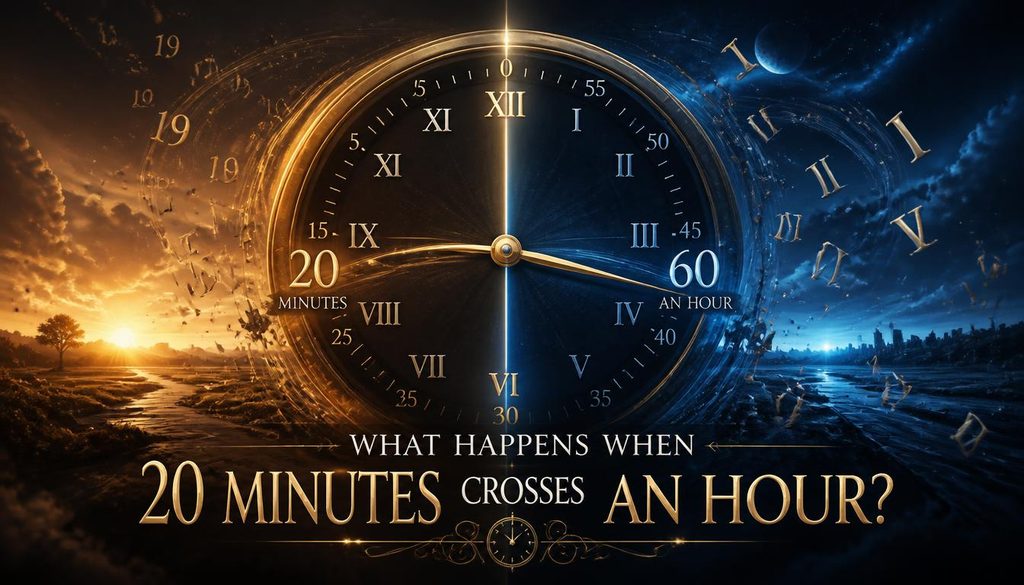
This is probably the most common place where people pause and think, “wait… what?”
Consider 7:50 PM. Adding twenty minutes does not give 7:70 PM because clocks do not work that way. Instead, 60 minutes complete one hour.
So:
7:50 PM + 20 minutes = 8:10 PM
The same thing happens with other times:
- 5:45 PM → 6:05 PM
- 6:50 AM → 7:10 AM
- 11:45 AM → 12:05 PM
- 11:50 PM → 12:10 AM
This is known as Hour Rollover. It sounds slightly more technical than it really is, but the idea is just carrying extra minutes into the next hour.
When the calculation passes midnight, you also have a Day Rollover. Thats important for a Date and Time Calculator, especially if you’re planning something late at night.
What Happens at Midnight?
Midnight is where a small twenty-minute calculation can quietly change the date.
Imagine it is 11:50 PM on Friday. Twenty minutes later, the time is 12:10 AM on Saturday.
The clock changes like this:
11:50 PM → 12:00 AM → 12:10 AM
So the answer isn’t only a new Clock Time. The Calendar Date changes too.
For example, if Friday were June 26, 2026, then twenty minutes after 11:50 PM would be 12:10 AM on Saturday, June 27, 2026.
This matters for appointments, flights, Airlines, online meetings, delivery services, and other systems where the date matters just as much as the hour. A tiny twenty-minute difference can quietly push an event into the next day, which is easy to miss.
What Time Is 20 Minutes From Now in GMT+5?
A Time Zone can make the question slightly more interesting because “now” is not identical everywhere.
For people using GMT+5, the Local Time is five hours ahead of Greenwich Mean Time. Pakistan Standard Time, for example, uses UTC+5, commonly written as GMT+5.
The calculation still works exactly the same:
Current time + 20 minutes = future time
The important thing is to begin with the correct Local Time Zone. If your phone says 7:39 PM in your location, then the result is 7:59 PM locally. Someone in another country may see a different clock reading for that same moment.
This is why international scheduling can become a little messy, especially when a meeting includes people in different time zones. A Time Zone Calculator or calendar application can remove much of that confusion, thankfully.
20 Minutes in Seconds, Milliseconds, and Hours

Twenty minutes sounds like a single little block of time, but it can be expressed using several different Time Conversion units.
Here are the basic conversions:
- 20 minutes in seconds = 1,200 seconds
- 20 minutes in milliseconds = 1,200,000 milliseconds
- 20 minutes in hours = 0.3333 hours approximately
- 20 minutes = one-third of an hour
The seconds calculation is straightforward:
20 × 60 = 1,200 seconds
For milliseconds:
1,200 × 1,000 = 1,200,000 milliseconds
And for hours:
20 ÷ 60 = 0.3333 hours approximately.
These conversions appear in Science, Engineering, programming, sports timing, and Digital Systems. Most people don’t need to think about milliseconds while waiting for their toast, obviously, but computers and technical systems certainly do.
What Time Was It 20 Minutes Ago?
The reverse question is just as common.
Instead of adding 20 minutes, you subtract 20 minutes from the Current Time.
For example:
- 7:39 PM → 7:19 PM
- 7:50 PM → 7:30 PM
- 8:10 PM → 7:50 PM
- 12:20 PM → 12:00 PM
- 12:05 PM → 11:45 AM
- 6:30 AM → 6:10 AM
So if you are wondering, “what time was it 20 minutes ago?” simply perform the opposite calculation.
A Minutes Ago Calculator can handle this automatically, but knowing the manual method is still useful. It is one of those tiny skills that seems boring until you actually need it.
What Time Is 20 Minutes From Now for Everyday Activities?
Twenty minutes is surprisingly useful. It is long enough to accomplish something, but short enough that it can disappear while you are staring at one video and wondering where the evening went.
Cooking and Baking
A recipe might tell you to cook something for twenty minutes. If you place the dish in the oven at 4:40 PM, your target time is 5:00 PM.
This is where a 20 Minute Timer or 20 Minute Countdown becomes useful. Instead of repeatedly checking the oven like a suspicious detective, you can set a timer and let it do the remembering.
Workout and Exercise
A twenty-minute interval can be used for walking, stretching, cycling, or another suitable Workout. If you start at 6:10 AM, twenty minutes later is 6:30 AM.
For interval-based exercise, a smartwatch or Digital Clock can make the timing easier, especially when your attention is somewhere other than the clock.
Study Session
A short Study Session can also be planned around twenty minutes. Starting at 2:15 PM means your first twenty-minute block ends at 2:35 PM.
Sometimes a short interval feels less intimidating than saying, “I have to study all afternoon.” Twenty minutes is a bite-sized piece of the day, and bites are easier to swallow, usually.
Online Meeting
If an Online Meeting begins at 11:45 AM and someone asks you to check back in twenty minutes, the time is 12:05 PM.
This can also help with a Reminder, appointment, or quick work break. Calendar tools and Scheduling Software often calculate these intervals automatically.
Travel Planning
During Travel Planning, twenty minutes can matter quite a lot. A transfer, boarding reminder, pickup window, or navigation estimate may depend on exact timing.
Navigation Apps use time calculations constantly, even when the person using them doesn’t see the arithmetic happening behind the screen.
Food Preparation
Bread dough resting for twenty minutes, tea cooling for twenty minutes, or a recipe asking for a short waiting period are everyday examples of Time Duration calculations.
If the process starts at 7:39 PM, the twenty-minute point arrives at 7:59 PM. Simple, but useful.
Presentation Timing
A presentation scheduled for twenty minutes needs a clear start and finish time. Beginning at 10:40 AM means the twenty-minute mark arrives at 11:00 AM.
That can help presenters plan slides, pauses, questions, and transitions without discovering at the end that one slide somehow ate half the meeting.
How Does a Minutes From Now Calculator Work?

A Time Calculator, Online Time Calculator, or Minutes From Now Calculator usually follows a very simple process behind its friendly little interface.
First, it gets the Current Timestamp or current clock reading. Then it adds the requested number of minutes. If necessary, it adjusts the hour, date, and AM/PM designation.
For twenty minutes, the logic is basically:
Current Time + 20 Minutes = Future Time
If the calculation crosses midnight, the Future Date changes as well.
Some advanced tools also work with seconds, milliseconds, different time zones, and timestamp formats. A Current Timestamp Calculator, Timestamp Calculator, or Future Date Calculator can therefore do much more than a simple kitchen timer.
The nice part is that the user doesn’t need to perform the underlying Automatic Time Calculation. The tool handles the little pieces of clock math in the background.
Examples of 20-Minute Calculations
Here are some practical examples you can use as a quick reference:
- 7:19 PM + 20 minutes = 7:39 PM
- 7:39 PM + 20 minutes = 7:59 PM
- 7:50 PM + 20 minutes = 8:10 PM
- 8:10 PM + 20 minutes = 8:30 PM
- 11:45 AM + 20 minutes = 12:05 PM
- 11:50 PM + 20 minutes = 12:10 AM
- 12:20 PM + 20 minutes = 12:40 PM
- 2:15 PM + 20 minutes = 2:35 PM
- 2:35 PM + 20 minutes = 2:55 PM
- 4:40 PM + 20 minutes = 5:00 PM
- 5:00 PM + 20 minutes = 5:20 PM
- 6:10 AM + 20 minutes = 6:30 AM
These examples also show why a Clock Calculator needs to understand more than simple addition. The moment minutes reach sixty, the hour changes, and at midnight the date changes too.
How Technology Calculates Future Time
Your Smartphone, computer, smartwatch, and other devices are constantly keeping track of time. Underneath the friendly display is a system that represents time using precise values, often including seconds and fractions of seconds.
A Digital Clock might show 7:39 PM, while an internal system may represent the same moment using a timestamp. When you ask a device to set a reminder twenty minutes later, it can perform the calculation using that internal representation.
This is especially important for Hospitals, Financial Institutions, Airlines, delivery services, and other organizations where exact timing matters. A missed minute in a casual coffee break is one thing; incorrect scheduling in a large digital system is a rather different headache.
Programming also relies heavily on Time Arithmetic. Software may add minutes, subtract minutes, compare timestamps, calculate elapsed durations, and convert between different representations of time.
Why Time Zones Matter for “20 Minutes From Now”
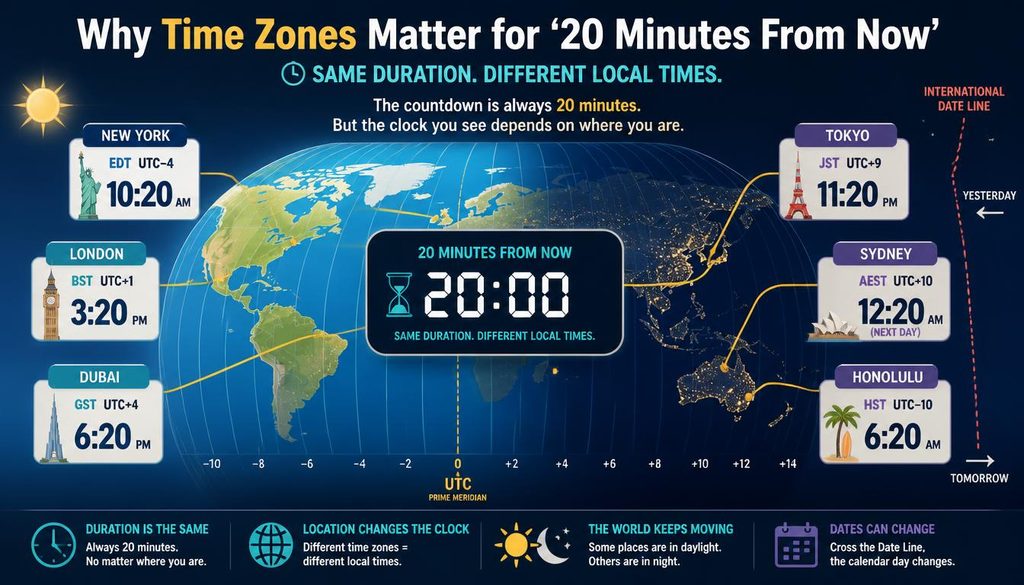
The phrase “from now” sounds universal, but it isn’t quite.
“Now” depends on where the person is and which clock is being used. Two people can be experiencing the same physical moment while their wall clocks display completely different times.
For example, a person working in a GMT+5 region might see 7:39 PM while another person elsewhere sees another local clock reading. Twenty minutes from each person’s local time will still be twenty minutes later, but the displayed clock numbers won’t necessarily match.
For international meetings, travel, remote work, and online events, always check the Time Zone, Current Date, and local clock before scheduling. It saves a surprising amount of “wait, what time did you mean?” conversation.
20 Minutes Is a Small Interval With a Big Personality
Twenty minutes is neither huge nor tiny. It lives in that strange middle ground where you can actually do something meaningful, yet still feel like you barely started.
You can make a coffee, review notes, walk around, prepare ingredients, answer a few messages, or simply sit quietly.
For a new parent welcoming a baby girl, twenty minutes might be the time between one family member calling another and everyone finally arriving to meet the newest little person. Thats the funny thing about time: the measurement stays objective, but the meaning changes completely.
A 20 Minute Countdown can therefore represent very different things to different people. For one person, it is a workout. For another, it is baking time. For somebody else, it is twenty precious minutes of waiting for a daughter to arrive.
Tips for Getting Exact Future Times
When you need an accurate answer, a few habits make Time Calculation much easier.
- Check the Current Time before calculating.
- Confirm your Local Time Zone.
- Decide whether you are using a 12-hour or 24-hour Clock Format.
- Watch for Hour Rollover when minutes pass 59.
- Watch for Day Rollover around midnight.
- Check the Current Date when the calculation crosses midnight.
- Use a Time Calculation Tool for repeated or complicated calculations.
- For international events, confirm the time zone before sharing the schedule.
- For precise digital work, use a timestamp rather than relying only on a displayed clock.
These steps sound almost comically simple, but they prevent the common little mistakes that happen when we’re rushing.
How to Use a 20 Minute Timer
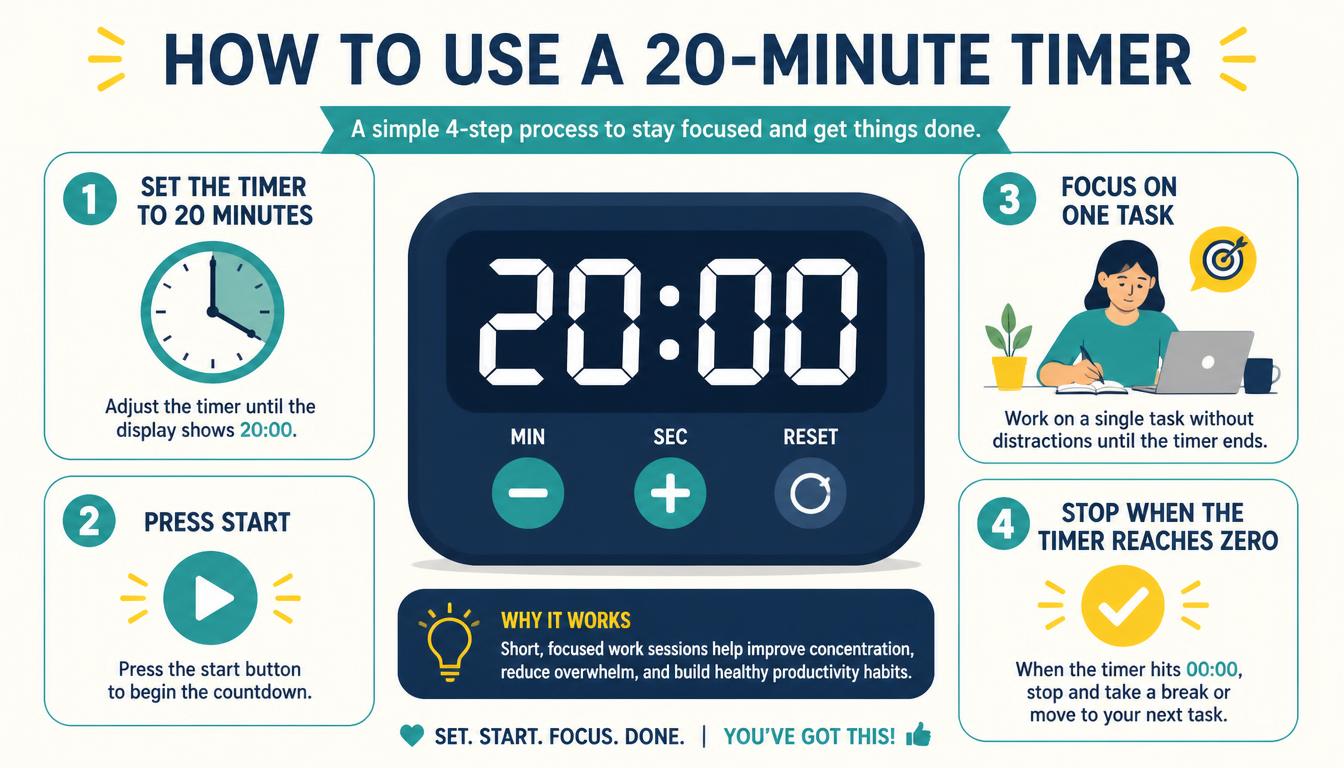
A 20 Minute Timer is ideal when you don’t actually need to know the future clock time, but simply need twenty minutes to pass.
For example, if you’re resting dough, taking a break, doing a study block, or waiting for something in the oven, set the timer for twenty minutes.
A timer counts down:
20:00 → 19:59 → 19:58 … → 00:00
A clock works differently. It tells you the actual time of day, while a countdown tells you how much time remains.
That distinction is small but important. A Clock Time Calculator answers “what time will it be?” A countdown answers “how long until the interval ends?”
A Simple Way to Remember the Calculation
If someone asks, “20 minutes from now is what time?” remember one sentence:
Take the current clock time and add 20 minutes.
If the minutes reach 60, move to the next hour.
If the calculation passes midnight, move to the next date.
That’s really the whole story.
For instance:
7:39 PM + 20 minutes = 7:59 PM
But:
11:50 PM + 20 minutes = 12:10 AM next day
Once you understand those two examples, most ordinary twenty-minute calculations become pretty easy.
Making Time Feel More Personal
There is also a softer side to all this clock math. We often treat time as numbers because numbers are convenient. Yet twenty minutes can mean a warm meal finishing in the oven, a parent waiting outside a delivery room, a child finishing homework, or friends preparing to meet.
When a family welcomes a daughter, people may say congratulations in many different ways. Some send flowers, some make a phone call, some bring food, and others send a simple message that somehow gets saved forever.
The wording varies across families and cultures, but the underlying feeling is often the same: a new person has joined the story.
That is why a question such as What Time Is 20 Minutes From Now can occasionally be connected to something much more human than clock arithmetic. Sometimes we are not really counting minutes. We’re counting down to a moment we care about.
Frequently Asked Questions
What Time Is 20 Minutes From Now?
It is the current time plus 20 minutes. Use a time calculator for an exact result.
How Do I Calculate 20 Minutes From Now?
Simply add 20 minutes to the current time. For example, 2:10 PM becomes 2:30 PM.
How Many Seconds Are in 20 Minutes?
There are 1,200 seconds in 20 minutes.
Is 20 Minutes From Now the Same Every Day?
No. The exact time depends on the current time when you make the calculation.
Can I Use a Calculator for 20 Minutes From Now?
Yes, a time calculator can quickly determine the exact time 20 minutes from the current time.
Read This Blog:
Final Thoughts on What Time Is 20 Minutes From Now
The question What Time Is 20 Minutes From Now looks almost too simple to deserve an article, but time has a sneaky way of becoming complicated when hours, dates, time zones, and midnight enter the room.
The basic calculation is still wonderfully small: take the Current Time, add 20 Minutes, and adjust the hour or date when needed.
For ordinary situations, your Smartphone, Watch, wall clock, or Online Time Calculator can give you the answer almost instantly. For more complicated scheduling, a Date and Time Calculator, Time Zone Calculator, or Timestamp Calculator can handle the details.
And maybe that’s the nicest thing about twenty minutes. It is measurable, predictable, and yet never quite feels the same. Twenty minutes before dinner is different from twenty minutes before a presentation.
Twenty minutes during a workout feels different from twenty minutes waiting for someone you love. And twenty minutes before welcoming a baby girl into a family? Well, that can feel like the whole world is holding its breath, just a little.
So whenever you need to calculate 20 minutes from now, start with your local clock, add those twenty minutes, and let the calendar take care of the rest. Then get on with whatever beautiful, ordinary, slightly chaotic thing comes next.
