


There is something strangely beautiful about looking backward at a clock. We normally watch time move toward tomorrow, toward the next appointment, the next school day, the next celebration.
But sometimes one simple question pulls us in the opposite direction: What Time Was It 17 Hours Ago?
Maybe you are checking when a message was sent, trying to understand a server record, remembering when something happened, or simply wondering where the day disappeared to. Time can feel slippery like that, almost as if the hours quietly walked out while nobody was watching.
And, in a completely different kind of time story, think about the arrival of a baby girl. A parent may remember the exact hour she was born for the rest of their life. Grandparents remember the phone call, the clock on the wall, and that tiny moment when an ordinary day suddenly became a family memory.
Whether we are looking backward at a newborn’s arrival or checking an old digital timestamp, the human desire is often the same: we want to know exactly when something happened.
So, if you are asking what time was it 17 hours ago, the basic answer is wonderfully simple: subtract 17 hours from the current time. Yet, once midnight, dates, and time zones enter the room, the little calculation can become less obvious.
| Time Reference | Result |
|---|---|
| 17 hours ago | Current time 17 hours |
| 12 hours ago | Same time yesterday |
| 17 hours | 7 hours before the same time yesterday |
What Time Was It 17 Hours Ago?
To find 17 hours ago, take the current clock time and move backward by 17 hours. This is a straightforward time calculation, but the answer depends entirely on the starting point.
For example, imagine the current time is 3:33 PM on Monday, June 15, 2026. Subtracting 17 hours gives:
3:33 PM − 17 hours = 10:33 PM on Sunday, June 14, 2026.
Notice what happened there. We didn’t merely change the hour; we crossed into the previous day. That small date change is where many people make mistakes when doing manual time subtraction.
Another example makes the same idea easier to see. If the starting time is 8:33 AM, moving backward 17 hours produces 3:33 PM on the previous day.
So, when someone searches what time was 17 hours ago, the correct answer cannot be separated from the starting time and date. A clock without a reference point is basically a sentence with half its words missing.
How to Calculate 17 Hours Ago
The easiest method is to think of the calculation as moving backward through a clock.
Suppose your current moment is 10:00 AM. Subtract 10 hours first:
10:00 AM 10 hours = 12:00 AM.
You still need to subtract 7 more hours:
12:00 AM 7 hours = 5:00 PM on the previous day.
Therefore:
10:00 AM minus 17 hours = 5:00 PM yesterday.
This is basic time arithmetic, but splitting a large subtraction into smaller pieces can make it much easier to follow. You can also subtract 17 hours all at once if you are comfortable working with the 12-hour clock.
The key rule is this:
Past time = current time time offset
Here, the time offset is 17 hours.
If the subtraction crosses midnight, the date calculation must also move backward. That means the answer may belong to yesterday, or even another calendar date if the starting point is unusual.
Why 17 Hours Ago Can Be on the Previous Day
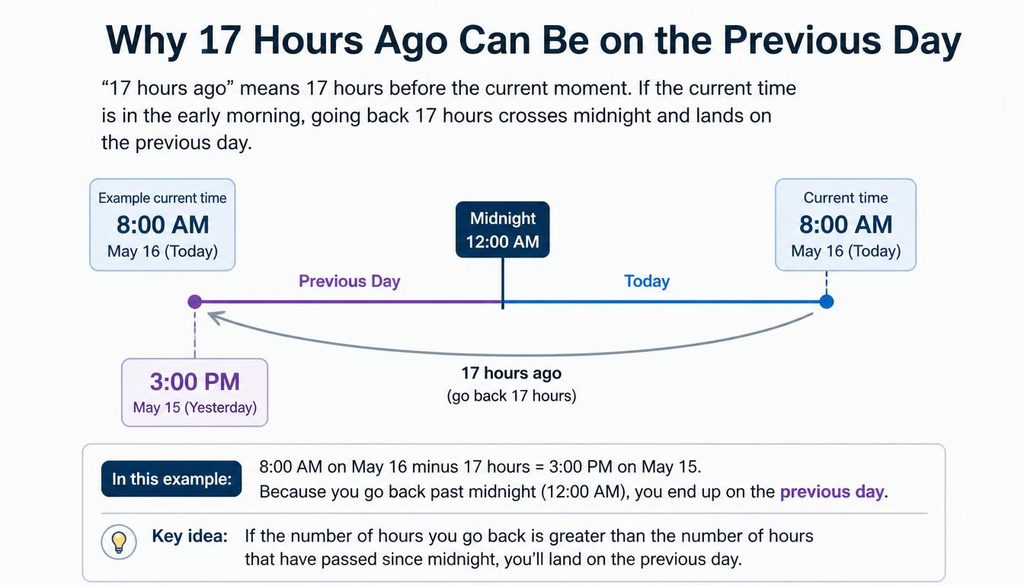
A day contains 24 hours, while our calculation only moves backward 17 hours. That sounds like it should always stay on the same date, but it doesn’t.
Imagine it is 8:00 AM today. Going back 17 hours takes you to 3:00 PM yesterday.
Why? Because from 8:00 AM back to 12:00 AM is 8 hours. Then seven more hours takes you into yesterday afternoon.
This is called a date rollover or day change. It is one of the most important things to remember when trying to calculate previous date and time.
The same thing happens when working with birthdays, appointments, delivery records, travel schedules, and old messages. A clock may show the correct hour, but if you ignore the date, your historical record can become misleading.
A Simple 17 Hour Time Calculation Table
Here is a quick reference for several common starting times. These examples assume the same local time zone throughout the calculation.
| Current Time | 17 Hours Earlier |
|---|---|
| 12:00 AM | 7:00 AM previous day |
| 3:00 AM | 10:00 AM previous day |
| 6:00 AM | 1:00 PM previous day |
| 8:33 AM | 3:33 PM previous day |
| 10:00 AM | 5:00 PM previous day |
| 12:00 PM | 7:00 PM previous day |
| 3:33 PM | 10:33 PM previous day |
| 6:00 PM | 1:00 AM same day |
| 10:00 PM | 5:00 AM same day |
| 11:59 PM | 6:59 AM same day |
The table shows why there is no universal answer to 17 hours ago from now. You always need the reference clock time first.
What Date Was It 17 Hours Ago?
If you want to know what date was 17 hours ago, you need both the current date and current time.
For example, if today is Monday, June 15, 2026, at 8:33 AM, then 17 hours earlier was:
Sunday, June 14, 2026, at 3:33 PM.
This is a classic previous day calculation. The clock moved backward 17 hours, and the calendar followed it backward as well.
But if the current time were 8:33 PM on Monday, June 15, then 17 hours earlier would be 3:33 AM on Monday itself. No date change would occur.
So the question what date was 17 hours ago is really asking for a combined date and time conversion, not just a clock calculation.
17 Hours Ago in a 24 Hour Clock
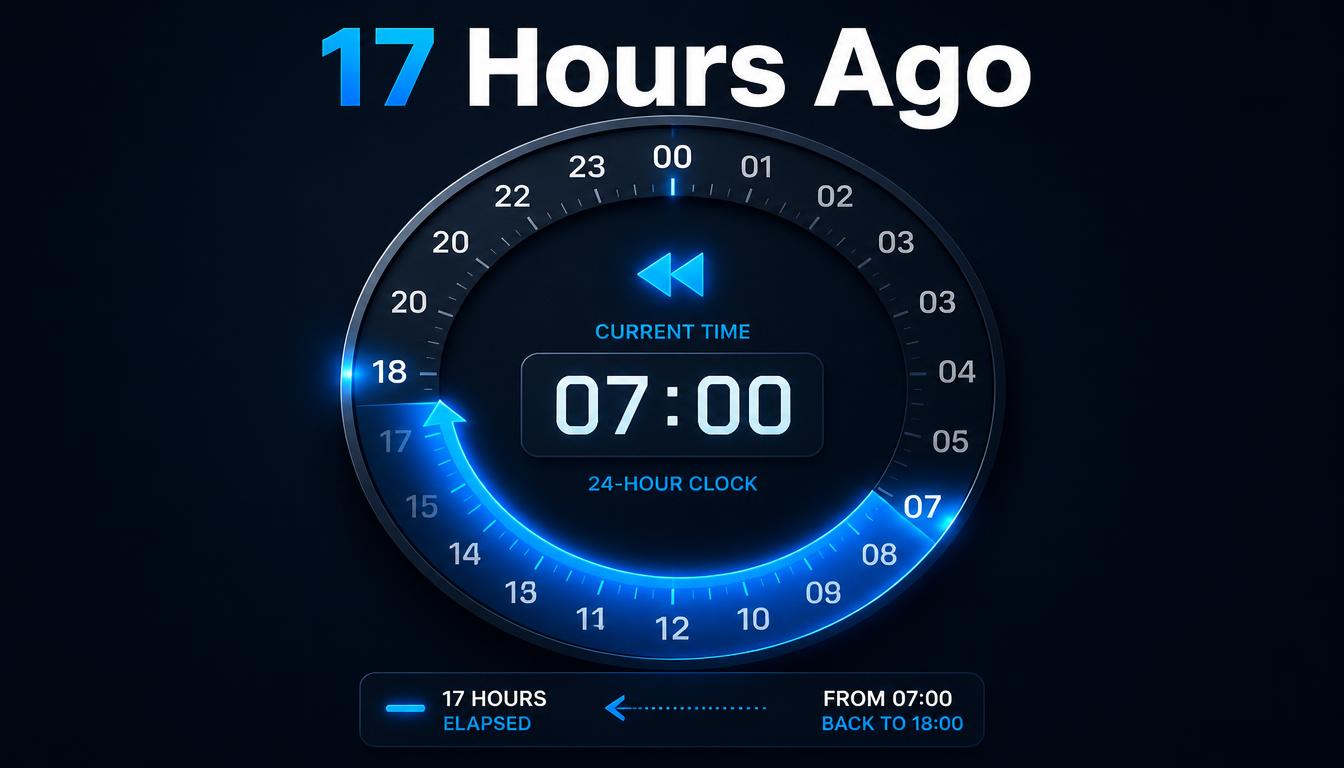
The 24-hour cycle can make time subtraction easier because you don’t have to switch mentally between AM and PM.
For example:
20:00 17 hours = 03:00.
If the calculation crosses midnight, you simply move into the previous calendar date.
Another example:
08:33 17 hours = 15:33 on the previous day.
That corresponds to:
3:33 PM on the previous day.
This is one reason programmers, engineers, analysts, and IT administrators often work with 24-hour timestamps. There is less ambiguity, especially when records span midnight.
What Does 17 Hours Equal in Other Time Units?
Sometimes you don’t actually need the clock time. You may only need the duration represented by 17 hours.
There are:
- 17 hours
- 1,020 minutes
- 61,200 seconds
- 61,200,000 milliseconds
The conversion is based on familiar units:
17 × 60 = 1,020 minutes
1,020 × 60 = 61,200 seconds
61,200 × 1,000 = 61,200,000 milliseconds
This kind of time unit conversion is particularly useful in programming, databases, scientific calculations, and technical systems.
One hour contains 60 minutes, 3,600 seconds, and 3,600,000 milliseconds. Once you know that, converting 17 hours becomes almost comically simple.
Using a Time Calculator for 17 Hours Ago
A time calculator, past time calculator, or hours ago calculator can perform the calculation automatically. These tools are helpful when the calculation involves dates, midnight, or multiple time zones.
A typical online time calculator asks for:
- Current date
- Current time
- Number of hours
- Direction of calculation
- Sometimes the relevant time zone
For this question, you would enter 17 hours as the amount to subtract.
A good time ago calculator should return both the clock time and the calendar date. That’s important because an answer such as “3:33 PM” isn’t complete if the calculation crossed into yesterday.
Tools such as an hours from now calculator, time difference calculator, or time and date calculator can also be useful for related calculations. The tool doesn’t magically understand your day; it simply performs the arithmetic consistently, which is exactly what we need sometimes.
What Time Was It 17 Hours Ago in GMT+5?

Time zones add another layer.
Suppose your local clock uses GMT+5. You can perform the 17-hour subtraction directly using that local clock. If the starting time is 8:33 AM in GMT+5, then:
8:33 AM 17 hours = 3:33 PM on the previous day.
The important point is that you should not change the time zone halfway through the calculation unless you specifically want a time zone conversion.
For international work, you might encounter GMT, UTC, Eastern Time, or Pacific Time. These standards can produce different displayed clock times for the same instant.
A timestamp represents an instant, while a local clock represents that instant according to a particular location’s rules. It sounds philosophical, but databases deal with this distinction all day long.
UTC and International Time Calculations
UTC is commonly used as a consistent reference for international systems. Airlines, financial institutions, software systems, international businesses, and online services may use UTC-based timestamps to avoid confusion.
Imagine a server records an event at 18:00 UTC. A person viewing that event in another location might see a different local clock time.
When calculating 17 hours ago, you first need to know whether your reference is:
- Local time
- UTC
- GMT
- Another regional time zone
You should also be aware of daylight saving adjustments in regions that use them. A simple 17-hour elapsed duration remains 17 hours, but the displayed local clock can be affected by a time-zone transition.
For historical records, this distinction matters quite a bit.
Real World Uses of 17-Hour Calculations
You might think this question is only useful when someone can’t remember what time they sent a message. Actually, 17 hours ago calculations appear in plenty of ordinary and technical situations.
Business Operations
Businesses often examine transactions, communications, customer interactions, and operational records. Knowing the exact time an event occurred can help employees understand what happened before or after another event.
Customer Support
A customer may say, “I contacted you yesterday.” A support representative can compare that statement with the actual timestamp. A time difference calculation can reveal whether the interaction happened 17 hours ago or considerably earlier.
Healthcare
Schedules can involve precise intervals. A healthcare worker may need to determine when a previous scheduled event occurred. Exact timing can matter, although professional medical instructions should always come from the appropriate healthcare provider rather than an ordinary calculator.
Logistics
Package scans, dispatch records, warehouse entries, and delivery events all rely heavily on timestamps. If a package was scanned 17 hours before another event, the elapsed interval can help reconstruct the sequence.
Cybersecurity
In cybersecurity, analysts may inspect system activity logs, online activity logs, and security records. A 17-hour interval can be important when investigating the sequence of technical events.
Remote Workers
Someone working remotely across countries might compare a meeting time with a coworker’s local clock. A time zone conversion can prevent the classic “I thought it was 9 AM for you” problem.
Aviation Networks
Aviation operations depend on carefully synchronized schedules and timestamps. International travel makes consistent time standards especially important because a flight can cross several time zones while the elapsed journey remains the same.
How Human Perception Makes 17 Hours Feel Strange
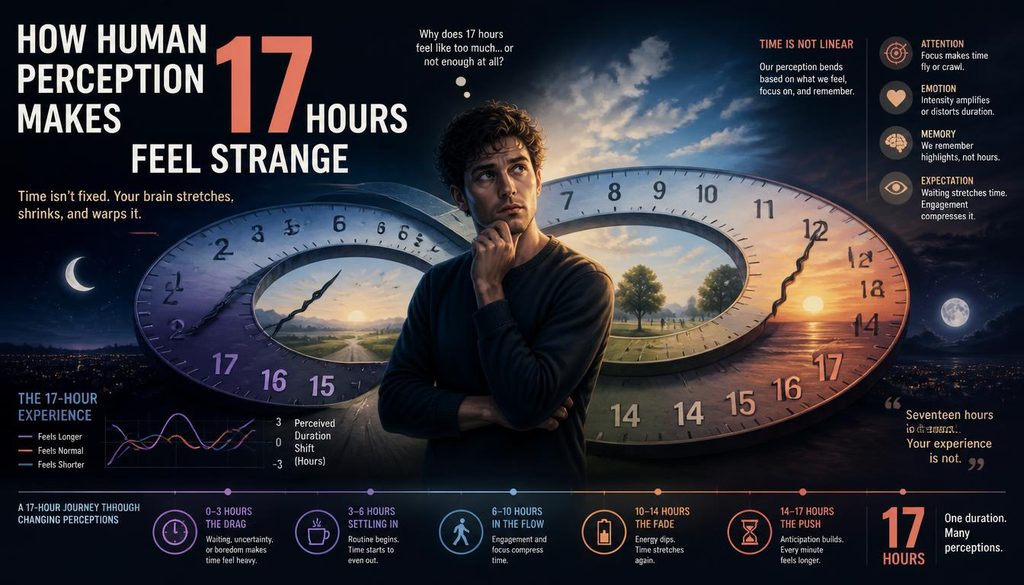
There is another interesting side to the question: human perception of time.
Seventeen hours can feel very long or strangely short depending on what happened during those hours. A busy day might disappear in what feels like ten minutes. Waiting for important news can make a single hour feel enormous.
This is the difference between subjective time and objective time.
Objective time can be measured by a clock. Seventeen hours remains 17 hours regardless of whether you were sleeping, traveling, studying, working, or celebrating.
But time perception is personal. Memory also changes how we remember a past moment. That’s why someone might confidently remember an event as happening “last night” even though a timestamp shows that it occurred nearly a full day earlier.
The clock does not become emotional, luckily. We do.
What About 18, 19, 20, 21, and 22 Hours Ago?
Once you understand 17 hours, nearby calculations become easy.
18 hours ago, 19 hours ago, 20 hours ago, 21 hours ago, and 22 hours ago all follow exactly the same principle:
Current time hour offset = past time
For example, if it is 10:00 AM:
- 17 hours ago = 5:00 PM yesterday
- 18 hours ago = 4:00 PM yesterday
- 19 hours ago = 3:00 PM yesterday
- 20 hours ago = 2:00 PM yesterday
- 21 hours ago = 1:00 PM yesterday
- 22 hours ago = 12:00 PM yesterday
The interesting thing is that these calculations become easier when you stop thinking of them as mysterious “hours ago” questions and start seeing them as ordinary subtraction.
What Is 17 Hours From Now?
Going backward and going forward are opposite operations.
For 17 hours from now, you add 17 hours instead of subtracting them.
So:
17 hours ago = current time − 17 hours
while:
17 hours from now = current time + 17 hours
This is the foundation of both past time calculation and future time calculation.
The same principle works for appointments, countdowns, deadlines, travel planning, and schedule tracking. Time itself doesn’t care whether you are looking backward or forward. The arithmetic does the same little dance in a different direction.
Common Mistakes When Calculating 17 Hours Ago

One common mistake is forgetting that 12:00 AM means midnight. Another is treating 12:00 PM as midnight, which sends the entire calculation wandering into the wrong part of the day.
Another problem is forgetting the date. If the result crosses midnight, the previous date must be included.
People also sometimes subtract 17 from the hour number without properly handling AM and PM. For example, treating 8 AM as simply “8” and subtracting 17 produces 9, which isn’t a useful clock reading. The better approach is to work through the 24-hour system or divide the subtraction around midnight.
A final mistake is ignoring the time zone. If you’re comparing an international timestamp, always confirm what clock standard produced it.
How to Find the Exact Time 17 Hours Ago
If you need an exact time, begin with an exact reference.
You need:
- The current date.
- The current clock time.
- The relevant time zone.
- The number of hours to subtract.
Then perform the temporal calculation.
For example:
Reference: Monday, June 15, 2026, 8:33 AM
Offset: 17 hours
Calculation: 8:33 AM 17 hours
Result: Sunday, June 14, 2026, 3:33 PM
That result contains everything needed for a useful historical timestamp.
If you are checking an important record, don’t rely on a vague phrase like “yesterday afternoon.” Record the date, time, and time zone whenever possible.
Why Exact Timestamps Matter
A timestamp can turn a vague memory into something concrete.
Imagine a programmer examining a database and seeing an unusual entry. The difference between “sometime yesterday” and “3:33 PM on June 14, GMT+5” is enormous.
The same applies to system activity logs, package scans, financial transactions, communications, security footage, and business records. Exact timestamps allow different events to be placed in sequence.
For analysts, database administrators, engineers, and IT professionals, accurate timekeeping can be the thread that connects an otherwise confusing collection of events.
A Quick Formula for 17 Hours Ago
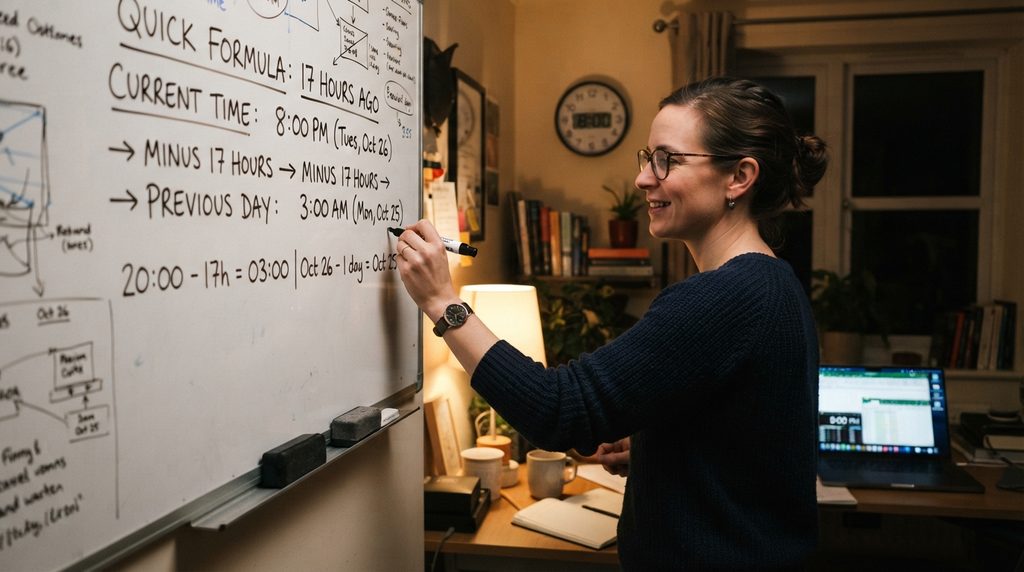
For everyday calculations, remember this simple formula:
Past time = current time 17 hours
If the subtraction passes through midnight, change the date to the previous day.
If you are working with minutes instead, 17 hours equals 1,020 minutes.
If you are working with seconds, it equals 61,200 seconds.
This makes it possible to use a time duration calculator, spreadsheet formula, programming function, or even basic mental arithmetic depending on what you are doing.
Making Time Calculations More Personal
There is a surprisingly human reason people search for questions like what time was it 17 hours ago. Often, the calculation is attached to a memory.
Maybe you are looking at an old photograph. Maybe a message arrived while you were asleep. Maybe you are reconstructing the timeline of a trip. Or maybe you are remembering the arrival of a baby girl and trying to identify the precise hour when your family’s story changed forever.
A parent’s memory may hold the emotion of that moment more strongly than the clock itself. A grandparent may remember waiting beside a hospital room, watching the minutes crawl. Someone else may remember a simple phone notification that brought the happiest news of their life.
The numbers are objective, but the reason we care about them is often deeply personal.
How to Use a 17 Hour Calculation in Everyday Life
If you regularly need to calculate previous times, keep a simple method handy.
First, identify the current reference time. Then decide whether you are using local time or UTC. Subtract the required number of hours. Finally, check whether the calculation crossed midnight.
For digital records, write the complete timestamp instead of only the clock time. For example, “June 14, 3:33 PM GMT+5” is far more useful than simply “3:33 PM.”
If you’re using a calculator tool, check that it understands AM/PM correctly and that its local time zone matches the location you’re actually using.
Frequently Asked Questions
What Time Was It 17 Hours Ago?
17 hours ago is calculated by subtracting 17 hours from the current time.
How Do I Calculate 17 Hours Ago?
Subtract 17 hours from the current time. If you cross midnight, the result will be on the previous day.
Is 17 Hours Ago Yesterday?
It can be yesterday or the day before, depending on the current time and when midnight is crossed.
How Many Minutes Are in 17 Hours?
There are 1,020 minutes in 17 hours, calculated as 17 × 60.
Can I Use a Calculator to Find 17 Hours Ago?
Yes, a time calculator can quickly determine the exact time and date from 17 hours ago.
Read This Blog:https://tevoqix.com/what-time-was-it-9-hours/
Final Thoughts on What Time Was It 17 Hours Ago?
The answer to What Time Was It 17 Hours Ago? is not one fixed clock reading. It depends on the exact current time, date, and time zone at the starting point.
The basic operation is easy:
Current time 17 hours = time 17 hours ago.
But good time calculation goes a little further. You also need to notice midnight, date changes, AM and PM, local clock conventions, and time-zone differences. Once those pieces are understood, even complicated-looking past time questions become quite manageable.
And perhaps that is the nicest thing about measuring time: the arithmetic is precise even when our memories aren’t. Seventeen hours is always 17 hours. Yet what those hours contain a conversation, a journey, a work shift, a family celebration, or the first unforgettable moment of welcoming a baby girl can make the same stretch of time feel completely different.
So whenever you ask what time was it 17 hours ago, start with the clock, check the date, respect the time zone, and let the calculation do its quiet little job. Sometimes a tiny subtraction is all it takes to find a moment that was almost forgotten.
