


There is something oddly satisfying about holding a large sheet of paper in your hands. It feels bigger than an ordinary page, but not so enormous that it becomes difficult to manage.
That is one reason the Format 24×36 remains useful for posters, artwork, presentation boards, signs, plans, and professional printing. And honestly, when you are preparing something important, the right sheet can make the whole design feel more complete.
A 24×36 paper size measures 24 inches by 36 inches, which converts to 60.96 × 91.44 cm. It is a familiar size in the world of commercial printing and is often discussed among US paper formats, especially when larger sheets are needed.
Whether you’re printing a family celebration poster, a welcome sign for a newborn baby girl, a photograph, architectural drawing, or a promotional display, these dimensions give you plenty of room to work with.
The interesting thing about paper is that dimensions are never just numbers. A sheet has an aspect ratio, an area, a perimeter, and even a diagonal length, and each of these measurements can matter depending on what you are creating.
So, lets unfold the whole story of the 24×36 format without making it feel like a dusty mathematics lesson.
| Format 24×36 | Details |
|---|---|
| Dimensions | 24 × 36 inches |
| In centimeters | 60.96 × 91.44 cm |
| Ratio | 2:3 |
| Orientation | Portrait or Landscape |
| Common Uses | Posters, prints, signs |
What Is Format 24×36?
The 24×36 format refers to a rectangular sheet measuring 24 inches in width and 36 inches in height when used in portrait orientation. Turn it sideways and you have a 36 inch wide sheet that is 24 inches tall. Same sheet, different mood, basically.
In exact measurements, the 24 × 36 inches sheet equals 60.96 × 91.44 cm. This makes it considerably larger than common office paper such as Letter size, while still being practical enough for many everyday professional printing projects.
The 24×36 paper size is commonly associated with posters, technical drawings, artwork, signs, photography, and large-format documents.
It can also work nicely for a family announcement or a welcome display when someone wants the arrival of a little daughter to feel like a proper celebration rather than just another message on a phone.
For designers, printers, and anyone ordering a custom print, knowing the exact dimensions avoids those annoying moments when a beautiful design gets cropped at the printer.
24×36 Paper Size in Inches and Centimeters
The simplest way to understand the 24×36 paper size in cm is to convert each inch into centimeters.
One inch equals 2.54 centimeters. Therefore:
- 24 inches × 2.54 = 60.96 cm
- 36 inches × 2.54 = 91.44 cm
So the full sheet dimensions are 60.96 × 91.44 cm.
In everyday printing conversations, you may hear people simply say “24 by 36 inches,” while others may ask for the metric dimensions. Both describe the same physical sheet, so there is no secret difference hiding between them.
The 24×36 paper size in inches is especially useful when working with US based printing specifications, while centimeters can be more convenient for international design software, sign makers, and print shops.
Keeping both measurements nearby is a small thing, but it saves time when everybody is using a different ruler, literally and sometimes otherwise.
24×36 Format Dimensions and Aspect Ratio

The 24×36 format dimensions have a simple relationship: 24 to 36.
When simplified, 24:36 becomes 2:3. That means the 24×36 aspect ratio is 2/3.
This ratio is important because it tells you how the width and height relate to one another. A design created at the same ratio can be enlarged or reduced more easily without changing its proportions.
For example, a photograph or poster designed in a 2:3 ratio can generally fit the sheet more naturally than an image with a very different shape. This is particularly useful when preparing a 24×36 poster size file because you want the artwork to occupy the available space without strange stretching.
A 2:3 ratio also has a pleasant visual balance. It gives you enough vertical space for headings, images, supporting text, and decorative elements without making everything look squashed together. Nice, simple, and surprisingly useful.
24×36 Area: How Much Surface Does It Cover?
The 24×36 area can be calculated with a very ordinary rectangle formula:
Area = width × height
So:
24 × 36 = 864 square inches
Therefore, the sheet has an 864 in² area.
When converted to metric units, the dimensions are 60.96 cm × 91.44 cm:
60.96 × 91.44 = 5,574.18 square centimeters
So the area is approximately 5,574.18 cm².
This large surface area explains why the format works well for posters and visual communication. You can use large typography, photographs, diagrams, illustrations, or multiple sections without everything fighting for a tiny corner of the page.
Imagine a newborn welcome poster with the baby’s name in large lettering, a photograph, a short blessing, and a few decorative details. On a smaller sheet, all of that might become crowded. On 24 × 36 inches, it has room to breathe.
24×36 Perimeter Calculation
The 24×36 perimeter is another useful measurement, particularly when framing the sheet or calculating how much border material might be required.
For a rectangle:
Perimeter = 2 × (width + height)
So:
2 × (24 + 36) = 120 inches
Therefore, the 120-inch perimeter surrounds the entire sheet.
In centimeters, 120 inches equals:
120 × 2.54 = 304.8 cm
So the 24×36 perimeter is 304.8 cm.
This may not matter much when you’re simply printing a poster, but it becomes handy when the paper needs a frame, trim, decorative border, mounting edge, or protective covering. The little details tend to matter once the sheet leaves the printer.
24×36 Diagonal Measurement

The diagonal of a rectangular sheet can be found using the Pythagorean theorem.
For a 24 × 36 inch sheet:
Diagonal = √(24² + 36²)
That gives approximately 43.27 inches.
In centimeters, the diagonal is approximately 109.9 cm.
So the 24×36 diagonal is:
- 43.27 inches
- 109.9 cm
This measurement can be surprisingly practical. If you’re checking whether a finished board can fit through a particular opening or whether a display can be carried inside a storage area, the diagonal may matter more than the width or height alone.
Common Uses of a 24×36 Paper Size
A 24 × 36 inch paper sheet can be used in many different ways because its proportions are flexible and its surface area is generous.
Common uses include:
- 24×36 poster size for events and advertisements
- Architectural and engineering drawings
- Photography and artwork
- Presentation boards
- Educational charts
- Restaurant or retail signs
- Wedding and celebration displays
- Welcome signs for a newborn baby
- Large calendars
- Commercial advertising
- Maps and diagrams
- Professional artwork
- Large-format printing projects
For a baby girl’s arrival, for example, a family might create a large welcome board with her name, birth date, a short blessing, and a photograph.
In another family, grandparents may prefer a simple printed message that can later be framed. There isn’t really one correct way to celebrate; the paper simply gives the idea enough room to exist.
24×36 Printing Format for Posters and Signs
The 24×36 printing format is particularly convenient for large visual materials. Because the sheet provides 864 square inches of surface area, text can remain readable from a distance while photographs and illustrations still have enough space.
Before sending a design to a print shop, check the document dimensions. A file that was created as 24 × 36 inches should normally be exported using the printer’s preferred settings, including resolution, bleed, margins, and color profile where required.
For photographs, illustrations, and detailed graphics, higher resolution is generally important because enlarging a small image too much can make it appear soft or pixelated. A printer may also ask whether the finished design requires trimming.
It sounds technical, but it is really just preparation. You don’t want to discover after printing that the baby’s name lost a letter because the text wandered into the trimming area. That sort of surprise is not the cute kind.
Common US Press Sheet Sizes
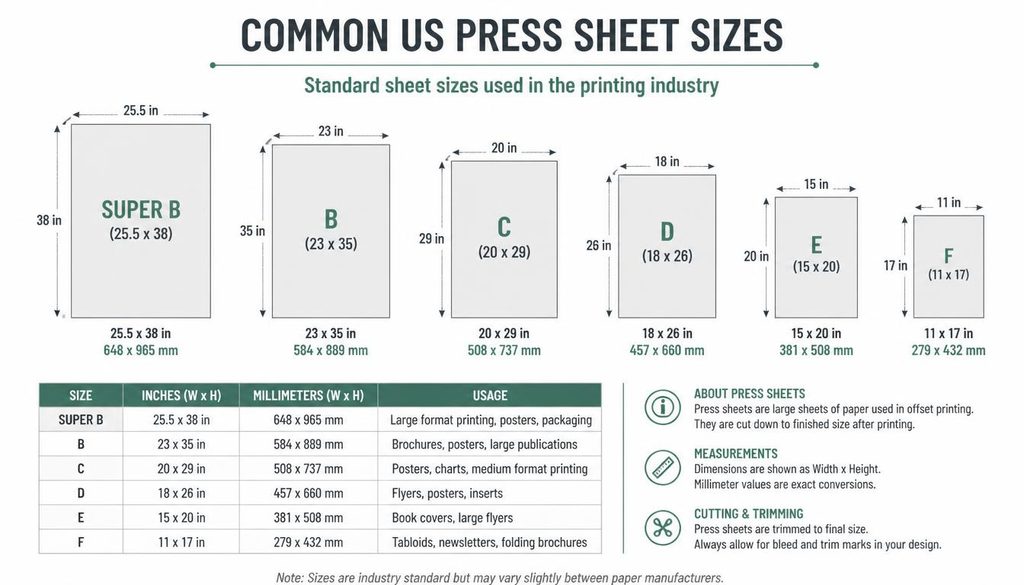
The Common US Press Sheet category includes several larger sheet dimensions used in commercial and professional printing. A press sheet is often selected according to the final product, printing equipment, layout, and how efficiently multiple pieces can be imposed on one sheet.
Some commonly referenced US press sheet sizes include:
| Press Sheet Size | Aspect Ratio |
|---|---|
| 38 × 50 inches | 19/25 |
| 35 × 45 inches | 7/9 |
| 28 × 40 inches | 7/10 |
| 26 × 40 inches | 13/20 |
| 25 × 38 inches | 25/38 |
| 24 × 36 inches | 2/3 |
| 23 × 35 inches | 23/35 |
| 23 × 29 inches | 23/29 |
| 20 × 26 inches | 10/13 |
| 19 × 25 inches | 19/25 |
| 17 × 22 inches | 17/22 |
| 12 × 18 inches | 2/3 |
| 11 × 17 inches | 11/17 |
These print sheet sizes show how varied commercial printing can be. A printer might select a particular sheet depending on the finished product and how many pieces can fit efficiently onto it.
The 24×36 sheet size sits comfortably among these larger formats and is recognizable to people working with posters, signs, artwork, and professional printing.
24×36 Sheet Size Compared With Smaller Formats
It can be difficult to visualize paper dimensions when you’re only looking at numbers on a screen. A quick comparison helps.
A Letter sheet measures 8.5 × 11 inches, while a 24 × 36 sheet is dramatically larger. The difference becomes obvious when you imagine placing several standard office pages across the larger sheet.
The 24×36 sheet dimensions are also different from ISO A-series sizes such as A3 and A4. The US printing world uses its own familiar dimensions, while international printing frequently relies on metric standards.
This is why checking the actual paper dimensions in inches and paper dimensions in centimeters is important before ordering.
A printer may understand “24×36” immediately, but a designer working with another country’s standard sizes may interpret a project differently if the dimensions aren’t clearly stated.
Designing a 24×36 Poster
A 24×36 print size gives designers enough room to establish a clear visual hierarchy. The most important information should normally be the easiest thing to see.
For a celebration poster, that might mean putting the baby’s name or the main welcome message prominently near the top. A photograph can occupy a large central section, while supporting information sits around it.
For a business poster, the company name, product, event details, and call to action can be organized in a similar way.
Don’t try to fill every inch simply because you have every inch available. Empty space is not wasted paper. Sometimes a little breathing room makes a design look much more professional, and yes, the blank corner is allowed to have a peaceful life.
A 24×36 Card for Special Celebrations

Although a 24×36 card is much larger than a typical greeting card, the format can be used creatively as a large keepsake or display board.
For example, when welcoming a daughter, relatives could sign around a central photograph. Each person might add a short blessing, memory, or hope for the child’s future. Years later, that oversized sheet becomes more than printed paper; it becomes a snapshot of who was there at the beginning.
Different cultures have their own ways of celebrating a new baby. Some families gather for meals, some offer prayers and blessings, while others exchange small gifts and handwritten messages.
The details vary widely, but the underlying idea is often similar: a new child has arrived, and everybody wants to say something kind.
A large sheet works beautifully for this because many people can contribute without the page becoming immediately crowded.
Choosing the Right 24×36 Print Size
When selecting a 24×36 print size, think about where the finished piece will be displayed.
For a wall poster, the 24 × 36 inch dimensions offer a strong presence. For a mounted board, check the available wall space first. For a framed piece, remember that the frame will add extra width and height.
If the design contains small text, consider how far away viewers will stand. A beautiful design is not very helpful if everybody has to walk up and squint at it.
Also check whether your printing company requires bleed. If artwork extends to the edge of the finished sheet, a printer may require additional artwork beyond the final trim line. Always follow the printer’s specifications because machines and production methods can differ.
24×36 Paper Size for Professional Printing
Professional printing depends on more than choosing a large sheet. You also need to consider file resolution, color mode, margins, bleed, paper stock, finish, and the final method of display.
For example, a photograph may look different when printed on glossy paper compared with matte stock. An invitation-style design may look better on a heavier material, while an engineering drawing might prioritize clarity and practical handling.
The 24×36 printing format gives you the physical canvas, but the final result depends on how the design and printing process work together.
This is where a good print shop can be valuable. If you’re unsure about resolution, trimming, paper weight, or finishing, asking before printing can save both money and frustration.
How to Prepare a 24×36 Design
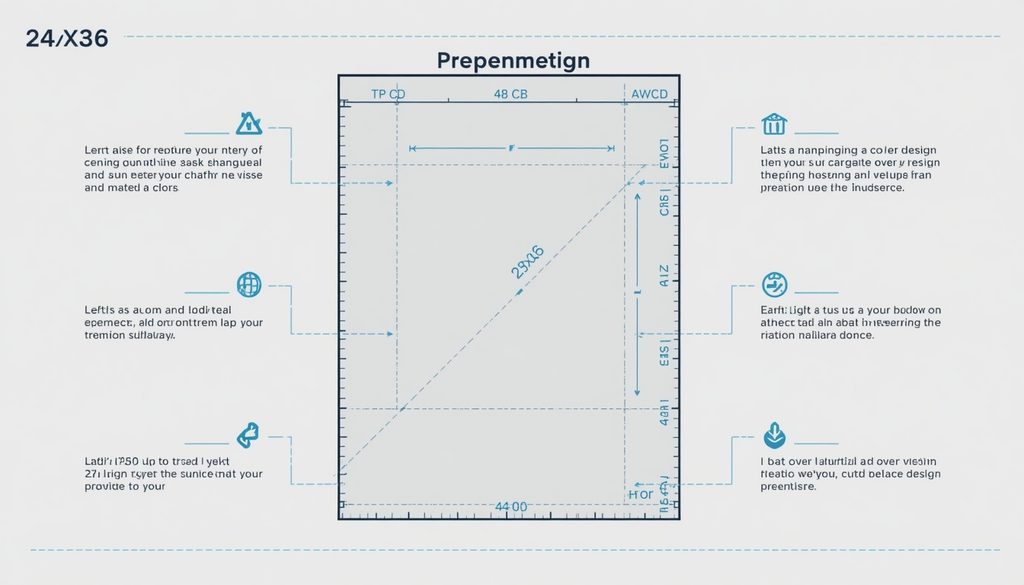
Before ordering a 24×36 print, use a simple checklist.
- Set the document to 24 × 36 inches.
- Confirm whether the design is portrait or landscape.
- Use the correct 2/3 aspect ratio.
- Keep important text away from trim edges.
- Use high-resolution images where possible.
- Confirm bleed requirements with the printer.
- Check spelling carefully.
- Review colors before exporting.
- Export in the file format requested by the printer.
- Ask for a proof when the project is especially important.
This might feel like a boring little checklist, but boring preparation is often what keeps exciting projects from going wrong.
Why Standard Paper Dimensions Still Matter
With digital design everywhere, it is tempting to think physical paper sizes no longer matter. They absolutely do.
Standard paper dimensions help designers, printers, manufacturers, and customers communicate clearly. When everyone understands what 24 × 36 inches means, there is less room for confusion.
The same principle applies to printing formats, commercial printing sizes, and professional printing paper. A shared measurement system makes the entire process smoother, from creating the design to cutting the final sheet.
And once you know the dimensions, you can start making smarter decisions about margins, photographs, typography, framing, and placement.
Frequently Asked Questions
24 x 36 ratio
The 24 x 36 dimensions have a 2:3 aspect ratio, which means the width is two-thirds of the height.
24×36 in cm
A 24 x 36 inch size equals approximately 60.96 x 91.44 cm.
what ratio is 24×36
The simplified ratio of 24:36 is 2:3, making it a common portrait or landscape format.
24×36 to cm
To convert 24 x 36 inches to centimeters, multiply each dimension by 2.54. The result is 60.96 x 91.44 cm.
24×36 in to cm
24 x 36 inches = 60.96 x 91.44 cm. This conversion uses the standard 1 inch = 2.54 cm.
Read This Blog:https://tevoqix.com/sizes-us-commercial-envelope-10-envelope/
Final Thoughts on Format 24×36
The Format 24×36 is more than a pair of numbers. It describes a generous rectangular canvas measuring 24 × 36 inches, or 60.96 × 91.44 cm, with a 2/3 aspect ratio.
Its total area is 864 square inches, or approximately 5,574.18 square centimeters. The perimeter is 120 inches, or 304.8 cm, while the diagonal measures about 43.27 inches, or 109.9 cm.
Those measurements make the format useful for posters, artwork, signs, technical documents, photography, celebrations, and many other projects.
Whether you’re working with a 24×36 paper size, comparing US press sheet sizes, or preparing a large poster for a very special family occasion, understanding the dimensions is the first step toward getting the result you imagined.
And perhaps that’s the nicest part of a large sheet of paper. It gives an idea room to breathe. A photograph gets more space, a message becomes easier to read, and a simple celebration can turn into something people remember.
So before sending your next design to the printer, check the 24×36 format dimensions, confirm the 24×36 area, review the 24×36 perimeter, and make sure your artwork matches the intended paper size. A few minutes of planning can turn a plain sheet into something genuinely meaningful.
