

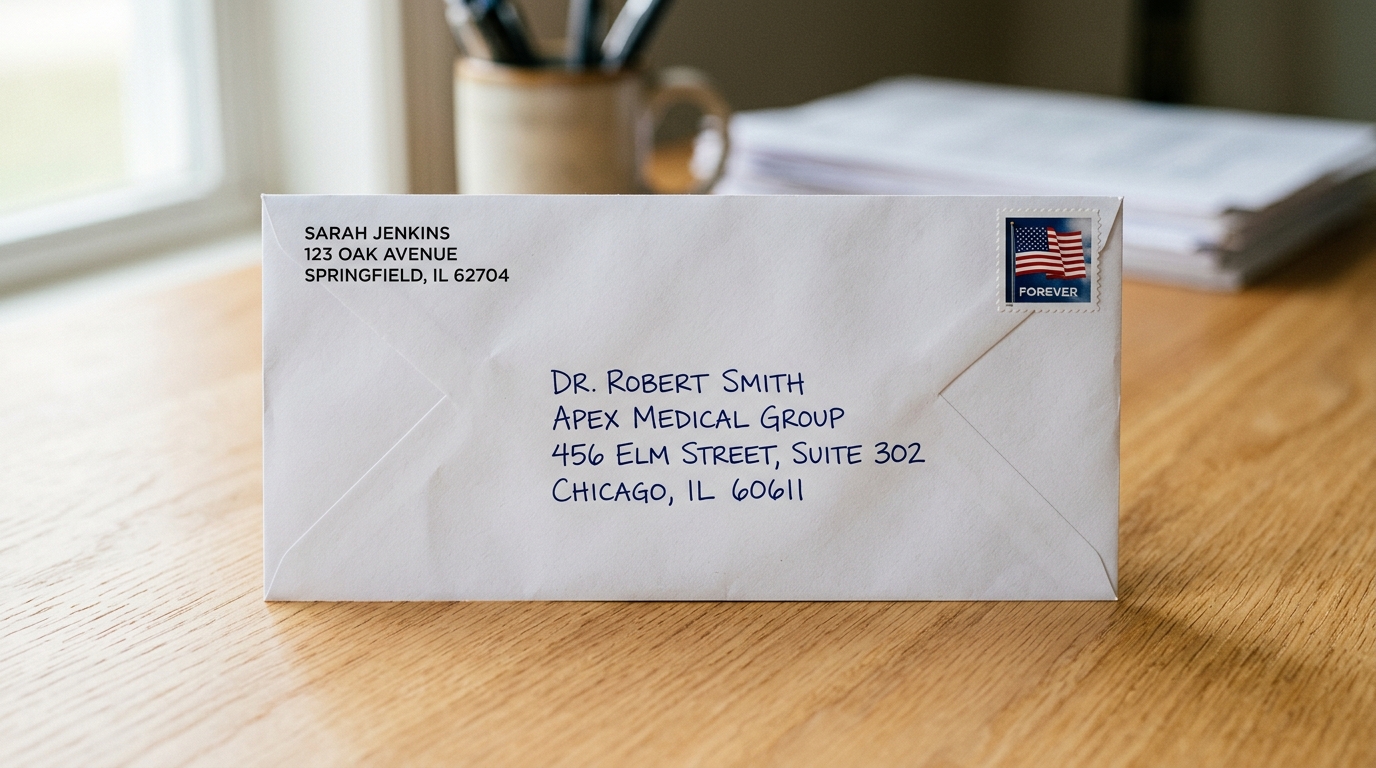
There is something oddly comforting about a good envelope. It is only a little piece of paper, really, but it can carry a wedding invitation, a business letter, a birthday card, or even a tiny note welcoming a new baby girl into the family.
When my first look at the 10 Envelope came through a stack of stationery, it seemed almost too ordinary to deserve much thought, but then I noticed how many letters, cards, and important papers actually depend on this one familiar shape. Funny how paper can do that.
For families celebrating the arrival of a baby girl, the envelope can become part of the moment too. A handwritten newborn blessing tucked inside a neatly addressed envelope feels more personal than a quick message on a screen.
And for offices, schools, businesses, and everyday mailing, the same envelope has a much more practical job to do. It needs to hold documents securely, pass through mailing systems, and still look tidy when it reaches someone’s hands.
That is where understanding the #10 Envelope becomes useful. Its dimensions are standardized, its proportions are easy to recognize, and its format works for a surprisingly wide range of correspondence.
Whether you are ordering stationery, preparing invitations, designing a letterhead, or simply wondering what the standard size actually is, this guide gives you the measurements without making the whole thing feel like a geometry lesson.
| Feature | Format 10 Envelope |
|---|---|
| Standard Size | 4 1/8 × 9 1/2 inches |
| Size in cm | 10.5 × 24.1 cm |
| Type | Business envelope |
| Common Use | Letters, invoices, and documents |
| Paper Fit | Letter-size paper folded into thirds |
What Is a 10 Envelope?
A 10 Envelope is one of the most widely used business envelopes in the United States. It belongs to the US Commercial Envelope family, a group of standardized envelope formats designed for everyday correspondence and mailing.
People often call it a business envelope, standard business envelope, or simply a number 10 envelope.
The usual Envelope size is 4.1 × 9.5 inches, which converts to approximately 10.41 × 24.13 cm. These measurements make it long and relatively narrow, a shape that works especially well for folded sheets of standard US letter paper. There is nothing fancy about it, and honestly thats part of why it has lasted so well.
The #10 Envelope is especially common for invoices, checks, letters, statements, notices, business correspondence, and direct mail. It also works nicely for personal letters when you want something a little more formal than a small greeting-card envelope.
10 Envelope Size in Inches and Centimeters
If you are creating a design or ordering custom envelopes, getting the measurements right matters more than people think. A tiny difference may not matter for a handwritten letter, but it can cause problems when you are preparing printed inserts or automated mailing pieces.
The standard 10 Envelope dimensions are:
| Measurement | Inches | Centimeters |
|---|---|---|
| Length | 9.5 in | 24.13 cm |
| Width | 4.1 in | 10.41 cm |
| Area | 38.95 in² | 251.29 cm² |
| Perimeter | 27.2 in | 69.09 cm |
| Diagonal | 10.35 in | 26.28 cm |
| Aspect ratio | 41/95 | approximately 0.432 |
So, when someone searches for 10 Envelope size in inches, the simple answer is 4.1 × 9.5 inches. For 10 Envelope size in cm, the answer is about 10.41 × 24.13 cm.
These figures describe the basic rectangular dimensions, although the actual usable interior space can be slightly different depending on the flap design, paper thickness, seams, and manufacturer. That little detail gets forgotten pretty often.
Understanding the #10 Envelope Dimensions
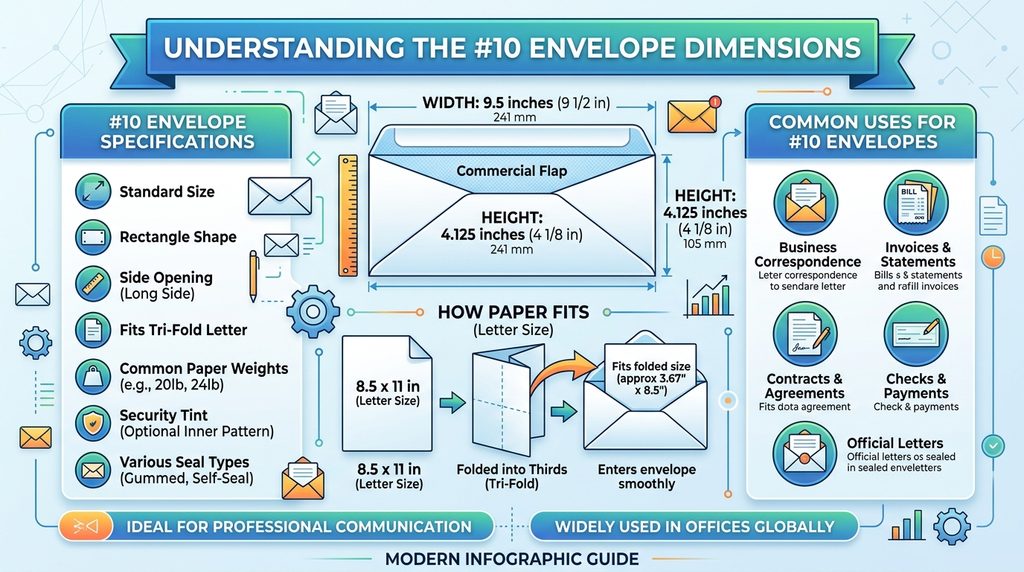
The #10 Envelope dimensions are more than two numbers printed on a specification sheet. They tell you how the envelope behaves when used for real documents.
The length is 9.5 inches, running from one short end to the other. The width is 4.1 inches. Together, these dimensions create the familiar long business-envelope appearance that you see in offices, mailrooms, schools, and households across the United States.
The relatively narrow width is intentional. A standard US letter sheet measures 8.5 × 11 inches and can be folded into thirds so that it fits comfortably inside a #10 envelope. This is one reason the envelope became such a useful format for ordinary correspondence. No complicated folding gymnastics required.
The 10 Envelope measurements also make it convenient for automated mailing equipment. Its proportions are recognizable and consistent, which helps businesses prepare large quantities of mail without having to invent a new format every time.
10 Envelope Format and Aspect Ratio
The 10 Envelope format can also be described mathematically through its aspect ratio. Based on the dimensions listed above, the length-to-width relationship is 41/95, or roughly 0.432 when width is compared with length.
This 41/95 aspect ratio is useful for designers because it gives them a quick idea of the envelope’s proportions. If you are making a digital template, a mailing graphic, or a print layout, knowing the ratio helps keep the shape from becoming strangely stretched.
The envelope has a rectangular Area of approximately 38.95 in², or 251.29 cm². Its calculated Perimeter is approximately 27.2 in, equal to about 69.09 cm.
Its Diagonal length is around 10.35 in, or 26.28 cm. You probably will never need to measure the diagonal before mailing a letter, but these calculations are useful when working with technical layouts, packaging studies, or print templates. Geometry has a sneaky way of becoming useful when you least expect it.
Why the 10 Envelope Became So Common
The popularity of the US Commercial Envelope is closely connected with the popularity of standard US letter paper. When businesses started handling large amounts of correspondence, they needed envelope formats that were practical, affordable, and compatible with ordinary sheets of paper.
The US Commercial Envelope series provides several sizes rather than forcing every document into one envelope. Number 10 became especially useful because it balances capacity with a compact mailing footprint.
Imagine an office sending hundreds of invoices. Nobody wants to fold paper into strange shapes, stuff oversized envelopes, or spend extra time figuring out whether every document fits. A standard commercial envelope solves the problem quietly, which is exactly what good stationery should do.
US Commercial Envelope Series Explained

The US Commercial Envelope series includes several numbered formats, each with its own dimensions. The numbers can seem random at first, but they are simply identifiers for established envelope formats.
Here are some commonly referenced formats:
| Envelope | Approximate Size |
|---|---|
| 16 Envelope | 6 × 12 in |
| 14 Envelope | 5 × 11.5 in |
| 12 Envelope | 4.8 × 11 in |
| 11 Envelope | 4.5 × 10.4 in |
| 10 Envelope | 4.1 × 9.5 in |
| 9 Envelope | 3.9 × 8.9 in |
| 8.625 Envelope | 3.6 × 8.6 in |
| 7.75 Monarch | 3.9 × 7.5 in |
| 7 Envelope | 3.7 × 6.8 in |
| 6.75 Envelope | 3.6 × 6.5 in |
| 6.25 Envelope | 3.5 × 6 in |
The 10 Envelope sits in the middle of this collection and is one of the formats people encounter most often.
By comparison, a #6.25 envelope is much shorter, while a #16 envelope gives you a considerably longer mailing space. Its useful to know the difference before ordering 500 pieces and discovering the wrong size later.
10 Envelope Size Comparison With Other Envelopes
An Envelope size comparison is helpful when choosing stationery because two envelopes can look similar online but feel very different in your hands.
The #10 envelope is longer than many greeting-card envelopes and narrower than larger document envelopes. It is primarily a correspondence format rather than a package style envelope.
A smaller envelope such as a 6.25 format may be better suited to compact cards or personal notes. Larger commercial envelopes can handle longer documents or larger folded materials. The correct choice depends on what you are putting inside, not simply on which envelope looks nicest in a product photograph.
For businesses, the standard #10 business envelope remains particularly practical because it matches common letter-folding methods. For personal stationery, however, people may choose a different format simply because it fits the style of the card better.
Paper Size and the 10 Envelope
The relationship between Paper size and envelope size is one of the easiest ways to understand why the #10 format is so popular.
A US Letter sheet is 8.5 × 11 inches. When folded appropriately, that sheet becomes compact enough to fit inside the standard commercial envelope. This makes the envelope a natural companion to business letters, official notices, invoices, forms, and printed correspondence.
The Envelope paper size itself should not be confused with the size of the paper inserted inside it. The envelope measures 4.1 × 9.5 inches externally, while the insert is normally a folded sheet. That distinction is small but important when preparing a Format card or printing a document.
If you are designing a letter or insert, always allow some breathing room around the edges. A design that technically fits may still be annoying to insert if every millimeter is being used. Paper likes a little personal space, apparently.
Designing a Format Card for a 10 Envelope

A Format card can work inside a #10 envelope when the card is designed around the available interior space rather than the outer envelope dimensions alone.
For example, a personal announcement, thank-you note, business response card, or small celebration insert can be designed to fold neatly and slide into the envelope. If the card is thick, remember that paper weight and folds reduce the practical capacity.
For a newborn celebration, a family might place a small printed announcement inside the envelope along with a handwritten note. Something simple like “Welcome, little one” can feel surprisingly meaningful when the message arrives as physical mail instead of a notification.
Different cultures also have their own ways of welcoming a baby. Some families gather relatives for a meal, some exchange blessings, some give symbolic gifts, and others focus on prayers or handwritten messages.
The stationery itself is not the tradition, of course, but it can become a lovely little vessel for whatever words the family wants to preserve.
10 Envelope Dimensions Chart for Quick Reference
When you need a fast measurement rather than a whole essay about paper, this Envelope dimensions chart is the useful bit.
| Specification | #10 Envelope |
|---|---|
| Standard name | 10 Envelope / #10 Envelope |
| Envelope format | US Commercial |
| Length | 9.5 inches |
| Width | 4.1 inches |
| Centimeters | 10.41 × 24.13 cm |
| Area | 38.95 in² / 251.29 cm² |
| Perimeter | 27.2 in / 69.09 cm |
| Diagonal | 10.35 in / 26.28 cm |
| Aspect ratio | 41/95 |
| Common use | Business and personal correspondence |
This is also a handy mini US envelope size chart when you are comparing common formats. Keep in mind that manufacturers can have small production tolerances, so a particular product may vary slightly.
Common Uses for a Standard #10 Envelope
The standard envelope size is used for far more than corporate letters. It can hold invoices, statements, checks, notices, folded forms, personal letters, event information, and everyday documents.
Schools use commercial envelopes for parent communications and administrative mail. Businesses use them for billing and correspondence. Nonprofit organizations use them for donor letters. Families may use them for invitations, announcements, thank-you cards, or handwritten notes.
That versatility is really the main attraction. A good envelope doesn’t need to announce itself loudly. It simply does the job.
Printing on a 10 Envelope
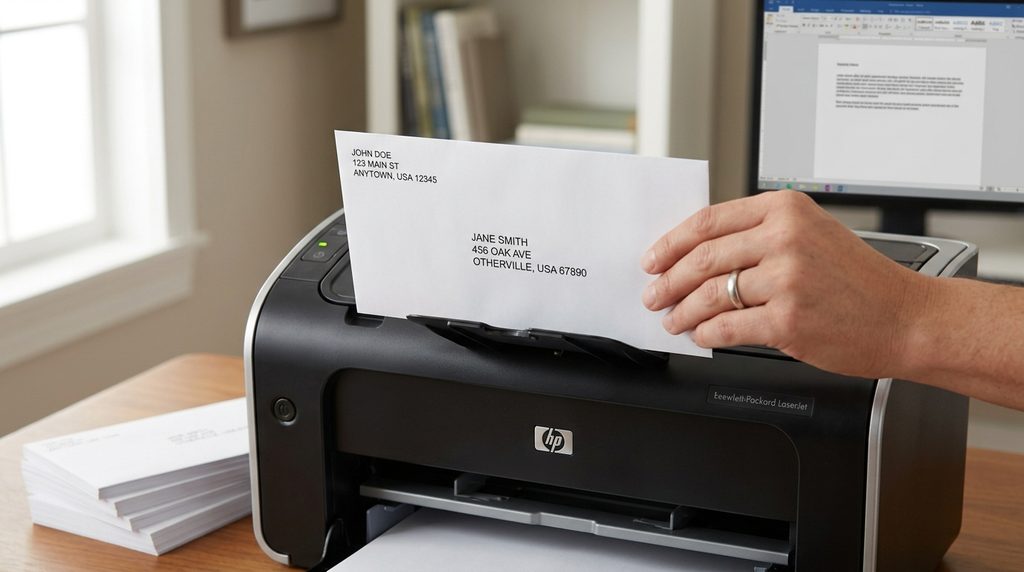
Printing directly onto a 10 Envelope requires a little planning. Before sending hundreds of envelopes through a printer, check whether the printer supports envelope feeding and confirm the correct orientation.
The flap location, paper thickness, printable margins, and printer settings can all affect the final result. Commercial printing services can handle this more efficiently when you need a large quantity, while home printers may be perfectly fine for a small batch.
For custom printing, create the artwork at the correct physical dimensions rather than designing it as an ordinary sheet of paper and hoping it magically fits. A little preparation here saves a surprising amount of wasted paper.
Choosing the Right Paper and Envelope Weight
Envelope dimensions are only half the story. Paper weight also matters.
A lightweight envelope is inexpensive and perfectly suitable for ordinary correspondence. Heavier paper can create a more premium impression for invitations, announcements, or special stationery. If you are sending a thick card, though, check postage requirements before mailing a large batch.
For a newborn announcement, heavier stationery can feel beautiful in the hand, but simple paper can be equally meaningful. The emotional value comes from the message and the person sending it, not from making the envelope unnecessarily fancy.
Envelope Size Chart: Inches vs. Centimeters
People working between metric and US measurements sometimes search for an envelope size chart inches or an envelope size chart cm because online stationery stores may list measurements differently.
For the #10 format, the conversion is straightforward:
4.1 × 9.5 inches = 10.41 × 24.13 cm
Remember that inches and centimeters are describing the same physical dimensions. They are not separate envelope formats. This sounds obvious, but when shopping across international websites, the terminology can get confusing real quick.
10 Envelope Format Guide for Designers
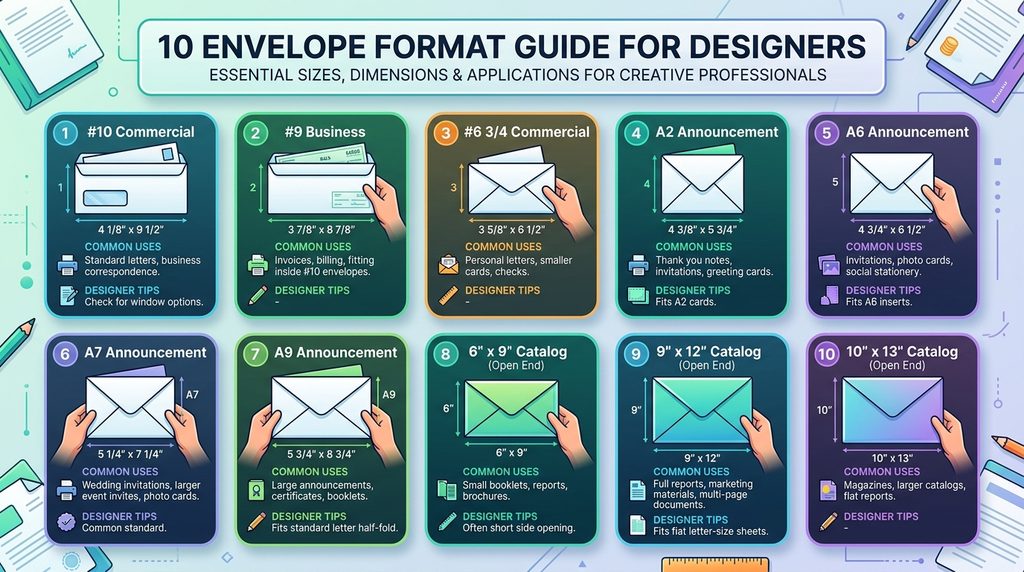
A practical Envelope format guide should begin with the finished envelope dimensions, then consider the insert, folding method, margins, printing area, and paper weight.
If you are creating a template, start with the envelope’s actual size and work inward. Decide where the recipient address, return address, logo, decorative elements, and postage area will sit. Keep important information away from edges, seams, and folds.
For professional work, obtain the printer or envelope manufacturer’s template whenever possible. Different manufacturers may use different flap constructions, and a generic template isn’t always a perfect match.
How to Make a Baby Girl Announcement Feel Personal
Although the #10 format is mostly associated with business mail, it can carry something wonderfully personal too. A family welcoming a daughter might send a small announcement to grandparents, relatives, friends, or loved ones who live far away.
Instead of relying only on a generic “Congratulations on your baby girl,” add one detail that belongs to this particular family. Mention the baby’s name, the date she arrived, a tiny family tradition, or the feeling everyone had when they first met her.
A grandparent’s handwritten sentence can be more memorable than a professionally printed paragraph. Even a slightly crooked line of handwriting has its own kind of charm, and thats something digital messages just can’t copy.
How to Write a Custom Message
Start with the relationship. A message to a grandparent should feel different from one to a business associate or distant friend.
Then add something specific. Perhaps the baby’s arrival brought everyone together after a long wait. Maybe an older sibling is excited. Maybe the family has chosen a name with special meaning.
One authentic detail can transform a standard greeting into a message that feels written for one person.
Keep the language natural. You don’t need to sound like a greeting-card company. Sometimes “We are so happy she is finally here” is much warmer than a sentence packed with dramatic adjectives.
Creative Ways to Deliver Your Wishes
A physical envelope gives you more possibilities than simply printing one message.
You can tuck a photograph inside, add a tiny keepsake card, include a handwritten blessing, or place several short notes from different family members together. For grandparents, a small collection of messages can become something they keep for years.
The #10 format is particularly useful when your message needs to travel with an ordinary folded letter. It isn’t designed to be a gift box, but within its modest limits, it can carry quite a lot of meaning.
Frequently Asked Questions
com10 envelope size
A COM10 envelope typically measures 4 1/8 × 9 1/2 inches, making it suitable for standard business mail.
envelope 10 size in cm
A number 10 envelope is approximately 10.5 × 24.1 cm, providing enough space for standard letters and documents.
envelope com 10
A COM10 envelope is a common business envelope designed to hold standard letter-size sheets folded into thirds.
com 10 envelope size
The standard COM10 envelope size is 4 1/8 × 9 1/2 inches (10.5 × 24.1 cm).
number 10 envelope size
A Number 10 envelope measures about 4 1/8 × 9 1/2 inches, one of the most widely used sizes for business correspondence.
Read This Blog:https://tevoqix.com/sizes-us-commercial-envelope-9-envelope/
Final Thoughts on the 10 Envelope
The 10 Envelope is a simple stationery format, but simplicity is often why something survives. With dimensions of 4.1 × 9.5 inches, or 10.41 × 24.13 cm, it fits neatly into the world of everyday American correspondence while remaining useful for personal notes and announcements.
Understanding the 10 Envelope size, #10 Envelope dimensions, 10 Envelope aspect ratio, and related measurements makes choosing stationery much easier.
You can compare commercial formats, prepare a print design, select suitable paper, and avoid ordering an envelope that is too small or too large.
And perhaps that is the nicest thing about envelopes: they are ordinary objects that become meaningful when someone decides what to put inside. A business letter, an invitation, a newborn blessing, a thank-you note, or a message celebrating a baby girl can all travel in the same familiar shape.
If you’re preparing a card or announcement, don’t worry about making every detail perfect. Choose the right Envelope format, write something honest, and let the message carry the moment. A little paper, a few thoughtful words, and suddenly something very ordinary becomes worth keeping.
