


A ring can be a tiny circle of metal, but somehow it carries a surprisingly large amount of meaning.
It may become an Engagement Ring handed over during a nervous proposal, a Wedding Ring worn through decades of ordinary mornings, or simply a Gold Ring bought because someone saw it and thought, “this feels like them.” Getting the size right matters, though sometimes the numbers make it feel like a little puzzle, not gonna lie.
That is where a Ring Size Conversion Chart becomes useful. Ring sizing systems are not identical everywhere.
A US Ring Size may be represented by a number, while a UK Ring Size commonly uses letters, and a European Ring Size is generally tied to the ring’s circumference. Japan has its own numbered system too.
So, if you’re shopping internationally or comparing a ring you already own with a different country’s chart, a little conversion knowledge saves plenty of confusion.
This guide explains Ring Size Conversion, measurements in millimeters and inches, international systems, ways to measure your finger, and the small details that can affect Ring Fit. It is designed to be practical, because a beautiful ring is much more enjoyable when it actually sits comfortably on your finger.
| Ring Size | US | UK | Inner Diameter |
|---|---|---|---|
| Small | 5 | J ½ | 15.7 mm |
| Medium | 6 | L ½ | 16.5 mm |
| Medium | 7 | N ½ | 17.3 mm |
| Large | 8 | P ½ | 18.2 mm |
| Large | 9 | R ½ | 19.0 mm |
| Large | 10 | T ½ | 19.8 mm |
Understanding Ring Size Conversion
The first thing to know is that there is no single worldwide numbering system. The US Ring Size, Canada Ring Size, and several other North American sizing practices generally use numerical sizes, while the UK Letter Size system uses letters and half sizes.
In much of continental Europe, the number often relates closely to the Inside Circumference measured in millimeters.
A useful international ring size chart therefore does more than place numbers next to each other. It connects different sizing traditions so you can understand the approximate equivalent of a ring size when purchasing from another country.
Small differences can still exist between manufacturers, so a conversion should be treated as a starting point rather than an absolute promise.
For example, someone wearing a US size 7 ring may encounter a different-looking number when shopping in Europe or Japan. The physical ring has not changed; only the measurement system has changed. That’s the slightly funny part of international sizing.
Ring Size Conversion Chart for Major International Systems
The following simplified chart gives commonly encountered equivalents. Individual jewellers can vary slightly, particularly around quarter and half sizes, so always check the seller’s own sizing information before ordering a valuable ring.
| US Size | Approx. Inside Diameter | Approx. Inside Circumference | UK Size | European Size | Japanese Size |
|---|---|---|---|---|---|
| US 6 | 16.5 mm | 51.8 mm | L½ | 52 | 12 |
| US 6½ | 16.9 mm | 53.1 mm | M½ | 53 | 13 |
| US 7 | 17.3 mm | 54.4 mm | N½ | 54 | 14 |
| US 9 | 18.9 mm | 59.5 mm | R½ | 60 | 19 |
| US 10 | 19.8 mm | 62.1 mm | T½ | 62 | 22 |
| US 12 | 21.4 mm | 67.2 mm | Y | 67 | 27 |
These measurements show why ring size in millimeters can sometimes be more useful than the size number alone. If you know the Inside Diameter or Inside Circumference, you have a physical measurement that can be compared across sizing systems.
Some published charts cover approximately US 1 16, UK A Z, EU 36.5 77.5, and Japan 1 27, although not every jeweller stocks every size. Quarter sizes and half sizes may also be available in certain markets.
How the US Ring Size System Works
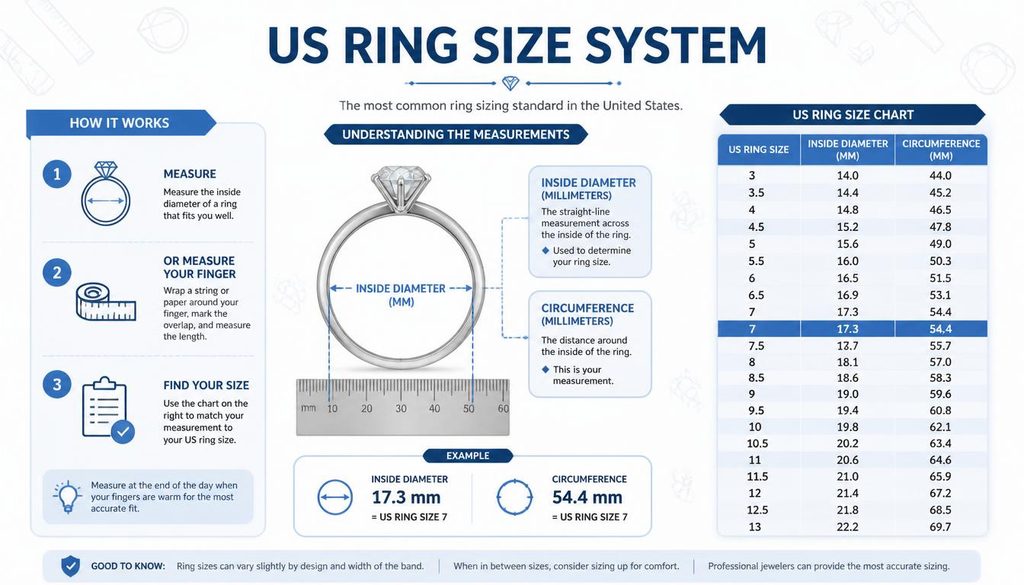
The US standard ring size system uses numerical sizes, generally increasing as the inside diameter and circumference become larger. Sizes can include whole, half, and sometimes quarter increments.
For instance, US 6, US 6½, and US 7 are three nearby sizes, but the difference can matter when a ring is fitted closely. A finger that comfortably accepts one size may find another noticeably snug, especially with a wider band.
The United States and Canada commonly use this numerical approach. Because many online jewellery stores sell internationally, their Ring Size Chart may display US, Canadian, UK, European, and Japanese equivalents side by side.
Still, don’t assume every numerical size from another country is automatically identical to a US number. That’s where the conversion chart earns its keep.
UK and Commonwealth Ring Sizes
The UK Ring Size system uses letters rather than the familiar US numbers. It is also used, with some regional variations, in places associated with Commonwealth Ring Size conventions, including markets such as Australia and sometimes Ireland.
A ring might therefore be labelled UK L½, UK N½, UK R½, or UK T½ instead of US 6, 7, 9, or 10. It looks completely different at first glance, but each label corresponds to a physical ring measurement.
When shopping from the United Kingdom, Australia, or another market using letter-based sizing, don’t try to guess the equivalent by moving through the alphabet. Use an international ring size conversion table or the jeweller’s official chart. Alphabet logic is not really the friend you need here.
European Ring Size and ISO Ring Size
The European Ring Size system is especially interesting because the number often represents the approximate Inside Circumference of the ring in millimeters. A European size 54, for example, corresponds to an inside circumference of roughly 54 mm.
This makes European sizing closely connected to physical Ring Measurement. The ISO Ring Size standard also provides an internationally recognized approach based on millimeter measurements.
That does not mean every retailer’s chart will look exactly the same. Some charts round values, some display half sizes, and some use their own conversion conventions. If an expensive ring is involved, compare the exact millimeter measurement supplied by the manufacturer rather than relying on a random chart found online.
Japanese Ring Size and JIS Ring Size
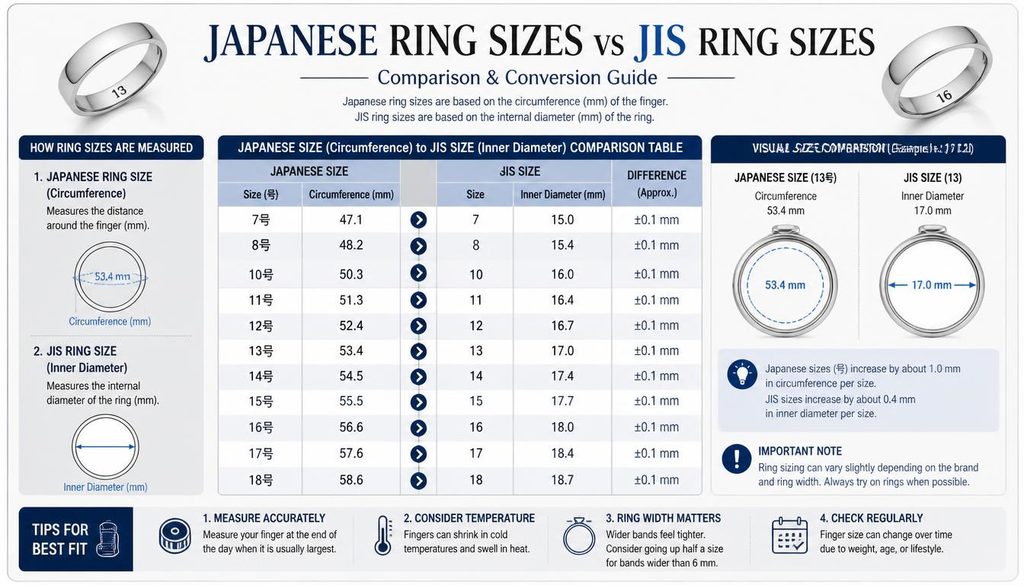
The Japanese Ring Size system uses numerical values, but those numbers should not simply be treated as US sizes with another label. Japan has its own sizing convention, and JIS Ring Size references can be useful when shopping from Japanese jewellers.
For example, a Japanese size 14 may correspond approximately to a US size 7, depending on the conversion chart being used. A Japanese size 19 is around the range of US 9, while Japanese size 27 is considerably larger.
If you’re comparing US to Japanese ring size, always look at the diameter or circumference as a second check. Numbers by themselves can be sneaky little things.
Ring Measurement in Millimeters and Inches
Physical measurement is the foundation of reliable sizing. Two of the most useful measurements are Inside Diameter and Inside Circumference.
Inside Diameter measures straight across the inside of the ring from one inner edge to the opposite inner edge. Inside Circumference measures around the entire inner boundary.
You may see these values expressed as Ring Measurement in Millimeters or Ring Measurement in Inches. Millimeters are generally more precise for jewellery because ring dimensions are small.
For reference:
- 16.5 mm inside diameter is approximately 51.8 mm inside circumference.
- 17.3 mm inside diameter is approximately 54.4 mm inside circumference.
- 18.9 mm inside diameter is approximately 59.5 mm inside circumference.
- 19.8 mm inside diameter is approximately 62.1 mm inside circumference.
These numbers are physical measurements, not merely labels. That’s why they can help when a seller uses an unfamiliar sizing system.
How to Measure Ring Size at Home
Learning how to measure ring size at home can be helpful when visiting a jeweller isn’t convenient. The simplest method is to measure a ring that already fits well, but you can also measure the finger itself.
For an existing ring, place it on a ruler and measure the inside ring diameter across the widest internal point. Avoid measuring from the outside edges because the metal thickness will make the result larger than the actual opening.
For a finger measurement, a proper Ring Sizer is the most dependable home option. A reusable sizer can be adjusted around the finger until it feels secure without squeezing. This is generally better than guessing with string, because string can stretch or be pulled too tightly.
If you use paper or string, wrap it around the finger, mark where the ends meet, then measure that length in millimeters. The result represents approximate finger circumference. From there, compare it with a trusted ring measurement chart.
The goal is not merely finding a number. You are looking for a correct ring size that can slide over the knuckle while still sitting securely.
Why Ring Width Changes the Fit
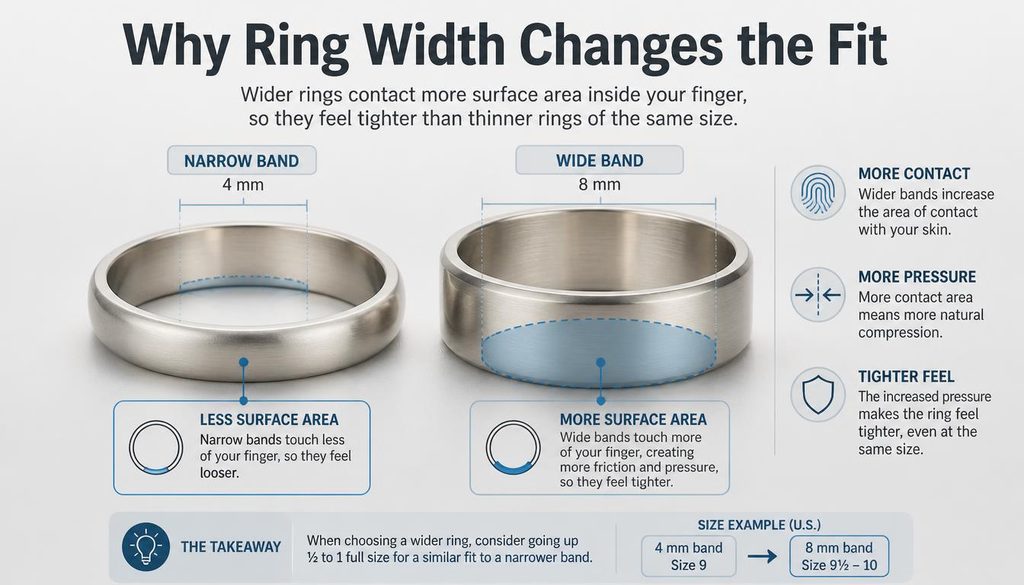
A narrow band and a wide band can feel different even when they have the same nominal size. This is why Ring Width, Band Width, and ring width sizing deserve attention.
A 6 mm band, for example, covers more of your finger than a very narrow band. Some people prefer a slightly different size for wider designs because the larger contact area can make the ring feel tighter.
A Comfort Fit ring can also feel different from a traditional fit. Its interior edges may be rounded, allowing the ring to move over the knuckle more smoothly.
If you’re purchasing an especially wide wedding band, ask the jeweller whether they recommend adjusting the size. Their recommendation should be based on the specific design, not simply a generic rule.
Finger Swelling, Temperature, and Time of Day
Your finger does not stay exactly the same size all day. Finger swelling, temperature, physical activity, and other everyday factors can change how a ring feels.
Hands may be somewhat different after exercise, in hot weather, or after eating a salty meal. Cold temperatures can temporarily make fingers smaller. Even the dominant hand ring size may differ slightly from the corresponding finger on the other hand.
For a more dependable accurate ring measurement, measure at a comfortable room temperature when your hands are neither unusually cold nor hot. Measuring more than once during the day can also reveal whether your size changes noticeably.
This sounds overly careful until you order a ring that fits beautifully in the morning and suddenly feels like it has developed an attitude by evening.
Common Ring Sizes and What They Mean
People often search for the most common ring size or average ring size, but averages should not be used to determine an individual’s size. Finger dimensions vary considerably, and a supposedly common size may be completely wrong for you.
Common searches include US size 6 ring, US size 6.5 ring, US size 7 ring, US size 9 ring, and US size 10 ring. These sizes cover different finger circumferences and are frequently displayed in online jewellery catalogues.
Women’s ring sizes and men’s ring sizes are often discussed separately in shopping guides, but the sizing system itself does not belong to a particular gender. The correct size depends on the person’s finger, the ring design, and the desired fit.
Choosing a Ring Size for an Engagement or Wedding Ring
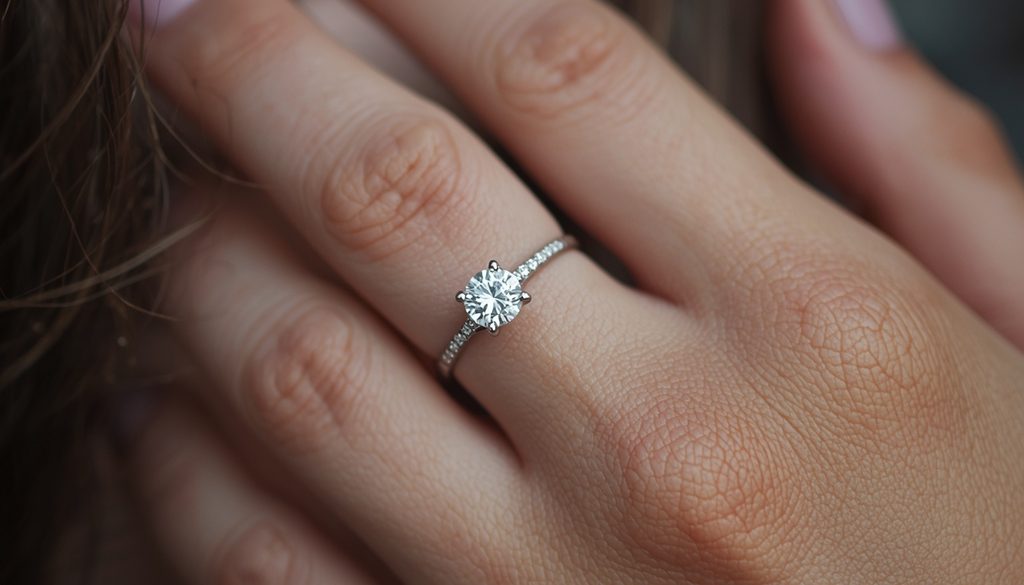
Ring sizing for engagement rings deserves extra care because these rings often have sentimental and financial value. A surprise proposal can make measurement even trickier.
If the ring is intended as a surprise, people sometimes borrow an existing ring that the recipient wears on the same finger. Measuring its inside diameter can provide useful information, but it isn’t foolproof because fingers can differ and rings worn on different hands may not fit identically.
For a Wedding Ring, the situation is usually easier because the wearer can be measured directly. If the engagement ring and wedding band will sit together, consider the combined effect of their widths.
A jeweller can also discuss whether the setting, metal, and band construction make future adjustment practical.
Gold, Platinum, and Made to Order Rings
Gold Ring Sizing and Platinum Ring Sizing can involve different considerations depending on the design. Some simple bands are relatively straightforward to adjust, while intricate designs may have restrictions.
An Eternity Band can be especially challenging because stones may extend around the entire circumference, leaving limited space for conventional resizing. If you’re buying an eternity-style design, ask about sizing before placing the order.
For a Made-to-Order Ring, confirm the size carefully before production begins. A Made-to-Order Ring may have different exchange or resizing conditions from an ordinary stocked item.
Also review the seller’s Ring Warranty, resizing policy, and Ring Exchange terms. A cheap conversion mistake can become a surprisingly expensive lesson when international shipping is involved.
What to Do If Your Ring Size Falls Between Sizes
Sometimes your measurement lands between two standard sizes. This is where things become less mathematical and more about actual Ring Fit.
A thin ring may behave differently from a wide ring. A Comfort Fit Ring may slide more easily than a flat interior band. Your knuckle size may also influence the choice.
If you’re between sizes, don’t automatically choose larger or smaller without considering the ring design. Ask the jeweller how that particular model is intended to fit. This is especially important for an engagement ring, platinum band, or wide design.
A professional can also measure both your finger and knuckle, then assess how the ring should pass over the joint while remaining comfortable during normal movement.
International Ring Size Conversion: Quick Buying Checklist

Before ordering from another country, take a moment and check these details:
- Confirm whether the seller uses US Ring Size, UK Letter Size, European Size, or Japanese Size.
- Look for the seller’s own Ring Size Chart.
- Check the Inside Diameter in millimeters when available.
- Compare the Inside Circumference if the European system is being used.
- Consider the Ring Width and band construction.
- Check whether half or quarter sizes are available.
- Ask about Ring Resizing before ordering.
- Read the Ring Exchange policy.
- Check whether a Ring Warranty covers sizing problems.
- For a valuable ring, have the final measurement confirmed by a professional.
These little checks take a few minutes. Fixing a wrong size after an international purchase can take much longer.
A Simple Way to Think About Ring Size Conversion
Think of every sizing system as a different language describing the same physical circle.
The US system might say “7.” The UK system might use a letter such as N½. A European chart might show approximately 54. A Japanese chart may use another number. None of those labels changes the ring itself.
The real object underneath the labels is its inside diameter, inside circumference, and resulting finger fit.
Once you understand that, ring size conversion stops feeling mysterious. You are simply translating one measurement system into another.
Frequently Asked Questions
How Do I Use a Ring Size Conversion Chart?
Compare your ring size with the chart to find the equivalent size in US, UK, and other sizing systems.
How Do I Measure My Ring Size?
Measure the inside diameter or circumference of your finger or an existing ring, then match it with the chart.
What Is a US Ring Size?
A US ring size is a standard measurement used to determine how well a ring will fit your finger.
How Do I Convert UK Ring Size to US?
Use the Ring Size Conversion Chart to match your UK letter size with its corresponding US numerical size.
Can Ring Sizes Be Measured in Millimeters?
Yes, ring sizes can be compared using inner diameter or finger circumference measurements in millimeters.
Read This Blog:https://tevoqix.com/sizes-common-us-press-sheet-24×36/
Final Thoughts on Finding the Right Ring Size
A good Ring Size Conversion Chart is useful, but the best result comes from combining conversion information with an actual measurement. If possible, use a professional Ring Sizer or have an existing well-fitting ring measured accurately. When shopping internationally, compare millimeter measurements instead of trusting a number alone.
Remember that fingers change slightly with temperature, time of day, activity, and swelling. Ring width can also influence comfort. A size that looks perfect on a chart may still feel different when placed on a real finger, and that little difference matters.
Whether you’re choosing an Engagement Ring, Wedding Ring, everyday silver band, Gold Ring, or Platinum Ring, the right fit allows the piece to become part of daily life instead of something you constantly notice for the wrong reason.
And perhaps that is the nicest way to think about ring sizing. The perfect ring size isn’t really about chasing one magic number. It is about finding the small circle that sits naturally, comfortably, and securely, ready to carry whatever meaning you give it.
