


If you have ever looked at a calendar and wondered where the next twelve weeks will take you, you’re certainly not alone. Sometimes we need to plan a holiday, prepare for an important event, set a personal goal, or simply satisfy that little curiosity about the future.
Twelve weeks might feel like a long stretch when you’re waiting for something exciting, yet it can pass surprisingly quickly once ordinary life gets moving.
So, what date is 12 weeks from today? If today is October 9, 2026, the answer is Friday, January 1, 2027. That date marks the beginning of a new calendar year, which makes this particular twelve-week calculation especially memorable.
Understanding future dates doesn’t require complicated mathematics or a special talent for numbers. With a calendar, a simple calculation, or an online date calculator, you can work out the exact day with very little effort. Let’s explore the result, how to calculate it, and a few useful details about this twelve-week period.
| Calculation | Result |
|---|---|
| Today’s Date | October 9, 2026 |
| 12 Weeks From Today | January 1, 2027 |
| Total Days | 84 Days |
| Day of the Week | Friday |
| Total Weeks | 12 Weeks |
What Date Is 12 Weeks From Today?
The answer depends on the date you start counting from. Using October 9, 2026, as the starting point, adding twelve complete weeks brings you to January 1, 2027.
DATE IN 12 WEEKS
Friday, January 1, 2027
Starting date
October 9, 2026
Time interval
12 weeks, or 84 days
Target date
January 1, 2027
This is a straightforward example of adding 12 weeks to a date. Each week contains seven days, so twelve weeks equal 84 days. Once those days are added to October 9, the result falls on the first day of January.
There’s something rather convenient about the outcome. Instead of landing on an ordinary weekday in the middle of a month, your calculation ends at the start of a brand-new year. If you’re making resolutions, organizing a project, or setting a deadline, January 1 gives you a clear point to work toward.
Remember that the answer changes whenever the starting date changes. A date calculator should always use the correct current date or the specific date you enter.
What Day of the Week Will It Be in 12 Weeks?
When people search for a future date, they often want to know the weekday as well. This is useful because knowing that an event happens on a Friday can make scheduling much easier.
Starting from Friday, October 9, 2026, the weekday remains Friday after twelve weeks.
Why? Every complete week contains seven days, and adding seven days brings you back to the same weekday. Add another seven, and you’re still on that weekday. Continue for twelve weeks, and the pattern stays consistent.
Here are a few milestones along the way:
- Friday, October 9, 2026 — starting date.
- Friday, October 16, 2026 — one week later.
- Friday, October 23, 2026 — two weeks later.
- Friday, November 6, 2026 — four weeks later.
- Friday, November 27, 2026 — seven weeks later.
- Friday, December 25, 2026 — eleven weeks later.
- Friday, January 1, 2027 — twelve weeks later.
Notice that Christmas Day, December 25, falls exactly eleven weeks after October 9. One more week takes you into the new year.
This consistency is handy for recurring appointments, weekly classes, work schedules, and regular fitness sessions. If a meeting occurs on a Friday and repeats every twelve weeks, the next meeting will also fall on a Friday, assuming the interval is exactly twelve weeks.
How to Calculate the Date 12 Weeks From Now

You don’t need to depend entirely on an online tool. Learning a basic calendar date calculation can help you work out future dates whenever you need them.
There are three easy methods, and each has its own advantages.
Method 1: Convert Weeks Into Days
This is probably the quickest method if you enjoy simple arithmetic.
One week contains seven days. Therefore:
12 × 7 = 84 days.
Now you have converted the time interval into a number that can be added to your starting date. For October 9, 2026, adding 84 days gives January 1, 2027.
This approach is particularly useful when using a digital calendar or spreadsheet. You can enter a starting date and add 84 days to find the target date. Just make sure you are adding days rather than counting the starting date as day one, which can produce an off-by-one error.
Method 2: Count Forward on a Calendar
A paper calendar is still a perfectly good tool, and sometimes seeing the weeks laid out makes the answer easier to understand.
Start at October 9, then move forward one week at a time. Each move should take you to the same weekday in the following week.
After four weeks, you’ll reach November 6. After eight weeks, you’ll reach December 4. After twelve weeks, you’ll arrive at January 1.
Counting complete weeks is often less confusing than counting all 84 individual days. It’s also a useful way to check whether a date produced by a calculator makes sense.
Method 3: Use an Online Date Calculator
An online weeks from today calculator is helpful when you need a quick answer or want to compare several dates.
Most tools follow a similar process:
- Choose the starting date.
- Enter 12 in the weeks field.
- Select the option to calculate a future date.
- Review the resulting date and weekday.
- Confirm that the tool used the intended starting date.
Some calculators also allow you to work backward, convert weeks into days, or compare two calendar dates.
For occasional use, a simple calendar may be enough. If you’re managing several deadlines or planning months ahead, a dedicated future date calculator can save time and reduce mistakes.
What Is 12 Weeks From October 9, 2026?
Let’s look more closely at the specific calculation behind our answer.
The starting date is October 9, 2026. Twelve weeks contain 84 days, and the calculation moves forward through the remaining days of October, all of November and December, and into January.
Here’s the breakdown:
| Calendar period | Days counted |
|---|---|
| October 10–31 | 22 days |
| November 1–30 | 30 days |
| December 1–31 | 31 days |
| January 1 | 1 day |
| Total | 84 days |
The calculation is:
22 + 30 + 31 + 1 = 84 days.
Therefore, 12 weeks from October 9, 2026, is Friday, January 1, 2027.
One small detail matters here: October 9 is the starting date, not the first of the 84 days being added. The next day, October 10, is one day after the starting date. This distinction keeps the calculation accurate.
It’s easy to get confused when counting dates manually, especially around the end of a month. Different months have different lengths, so moving forward by a fixed number of days is not always the same as moving forward by a fixed number of months.
How Many Days Are in 12 Weeks?
Twelve weeks equal 84 days. This conversion is the foundation of the entire calculation.
The formula is simple:
12 weeks × 7 days per week = 84 days.
That means a twelve-week period includes exactly twelve complete seven-day intervals. It doesn’t matter whether those weeks cross into another month, another season, or another calendar year. The number of days stays the same.
An 84-day period can be useful for a wide variety of everyday plans. For example, you might use it to create a study timetable, follow an exercise program, organize a home improvement project, or establish a new habit.
Consider someone who decides to practice a language for twelve weeks. Rather than thinking vaguely about three months of effort, they can create an 84-day schedule and divide it into manageable stages.
The same approach works for business planning. A small business owner might set an 84-day goal to update a website, improve customer service, or introduce a new product. Breaking the period into weekly milestones can make the work feel more manageable.
Of course, the number of days doesn’t guarantee that a project will be completed. It simply provides a clear time frame for planning and reviewing progress.
How Many Hours, Minutes, and Seconds Are in 12 Weeks?
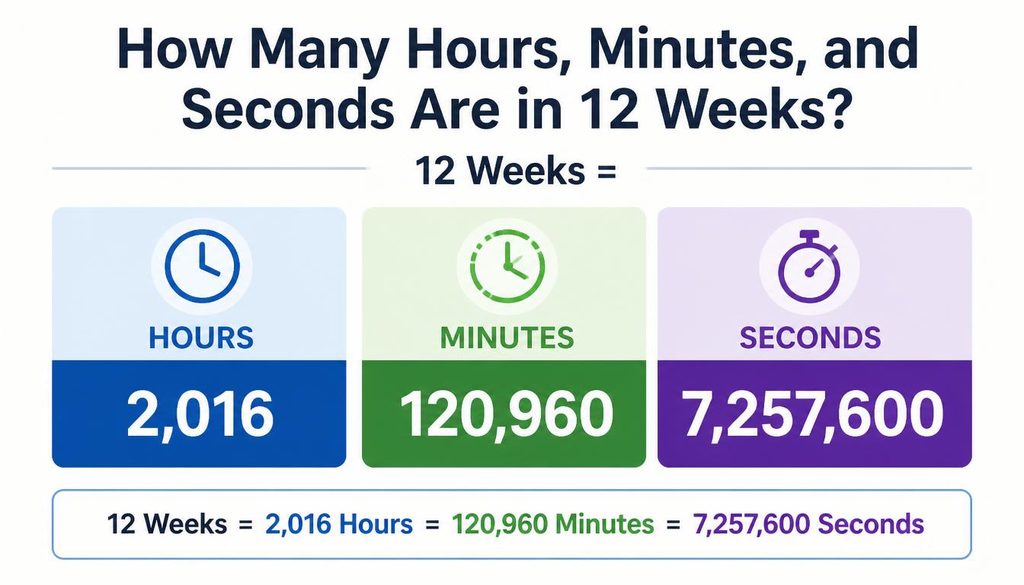
Weeks can be converted into smaller units of time, which is useful for schedules, time calculations, and educational purposes.
Because twelve weeks contain 84 days, the conversions are straightforward.
| Time unit | Total in 12 weeks |
|---|---|
| Weeks | 12 |
| Days | 84 |
| Hours | 2,016 |
| Minutes | 120,960 |
| Seconds | 7,257,600 |
Here’s how each number is calculated.
Converting 12 Weeks Into Hours
Each day contains 24 hours. Multiply 84 days by 24:
84 × 24 = 2,016 hours.
So, twelve weeks contain 2,016 hours under the standard calendar-time calculation.
Converting 12 Weeks Into Minutes
Each hour contains 60 minutes. Multiply 2,016 by 60:
2,016 × 60 = 120,960 minutes.
This is a useful example of time duration conversion, particularly when you need to express a long period in smaller units.
Converting 12 Weeks Into Seconds
Each minute contains 60 seconds. Therefore:
120,960 × 60 = 7,257,600 seconds.
That is more than seven million seconds in a single twelve-week interval. It sounds enormous when written as a number, although most of those seconds pass unnoticed while we work, sleep, eat, learn, and spend time with the people we care about.
These calculations use standard units of time. If you’re measuring actual elapsed hours across daylight-saving changes or time-zone changes, local clock readings may require additional consideration. The calendar-date calculation itself remains based on the selected starting date and the 84-day interval.
Is 12 Weeks the Same as 3 Months?
Not exactly. Twelve weeks equal 84 days, while three calendar months can contain different numbers of days depending on which months are involved.
Some months have 30 days, others have 31, and February has 28 days in a common year or 29 in a leap year.
For instance, a three-month period from October 9, 2026, to January 9, 2027, reaches January 9. However, twelve weeks from October 9 reaches January 1.
That difference is eight days.
This is why the phrases “three months from today” and “12 weeks from today” shouldn’t automatically be treated as interchangeable. They describe different ways of measuring time.
Use weeks when you need a fixed interval, such as an 84-day program or a twelve-week appointment cycle. Use calendar months when a deadline is defined by a monthly date, such as rent due on the ninth day of each month.
For practical planning, this small distinction can prevent misunderstandings. A project scheduled for twelve weeks might have a different deadline from one scheduled for three calendar months, even if the two periods sound almost identical in casual conversation.
How to Use a Weeks-From-Today Calculator
A 12 week date calculator can help you find the exact future date without counting manually. It is particularly useful if you need to calculate several intervals from different starting dates.
Most calculators ask for a starting date and the number of weeks you want to add. Some offer additional options for counting backward or calculating the number of days between two dates.
Follow these steps to get a reliable result:
- Enter the starting date, such as October 9, 2026.
- Select the future-date option.
- Enter 12 weeks.
- Run the calculation.
- Check the displayed date and weekday.
- Verify that the result represents a full 84-day interval.
If your calculator gives January 1, 2027, it agrees with our example.
A date tool can be especially convenient when you’re calculating future appointments, exam dates, travel plans, project milestones, or personal goals. It can also help when the starting date falls near the end of a month or year, when manual calculations become a little less intuitive.
However, it’s still worth checking your input before relying on the result. A calculator cannot know whether you intended to use today’s date, a date from last week, or a date in another year unless you specify it correctly.
What Date Was 12 Weeks Ago?

Working backward uses the same principle as calculating a future date, except you subtract 84 days instead of adding them.
If the reference date is October 9, 2026, moving backward by twelve weeks takes you to Friday, July 17, 2026.
The calculation is:
October 9, 2026 − 84 days = July 17, 2026.
This is helpful when reviewing past events, calculating how long ago something happened, or checking the beginning of a twelve-week period.
For example, someone who started a course on July 17 could look at October 9 as the date marking twelve completed weeks later. Likewise, a business might use the same interval to compare sales figures from one period with those of another.
The key is to distinguish between a duration and a calendar date. Twelve weeks always represent 84 days, but the corresponding start and end dates depend on the date you choose.
If you’re using a calculator, look for an option such as “weeks ago” or enter a negative number of weeks, if the tool supports it.
Future Dates From October 5 to October 13, 2026
Sometimes you want to compare nearby starting dates rather than calculate only one result. The following examples show how a one-day change in the starting date also shifts the target date by one day.
| Starting date | Date 12 weeks later | Weekday |
|---|---|---|
| October 5, 2026 | December 28, 2026 | Monday |
| October 6, 2026 | December 29, 2026 | Tuesday |
| October 7, 2026 | December 30, 2026 | Wednesday |
| October 8, 2026 | December 31, 2026 | Thursday |
| October 9, 2026 | January 1, 2027 | Friday |
| October 10, 2026 | January 2, 2027 | Saturday |
| October 11, 2026 | January 3, 2027 | Sunday |
| October 12, 2026 | January 4, 2027 | Monday |
| October 13, 2026 | January 5, 2027 | Tuesday |
These examples demonstrate an important feature of calendar date calculation: adding the same number of days to consecutive starting dates produces consecutive target dates.
They also show how a twelve-week period can cross the boundary between one year and the next without complicating the underlying arithmetic. You simply continue counting forward.
Why Knowing the Date 12 Weeks Ahead Can Be Useful
A future date may seem like a small piece of information, but it can provide a useful anchor for all sorts of plans. Once you know your deadline, it’s easier to decide what needs to happen between now and then.
Personal Goals and Habit Building
Twelve weeks is long enough to establish a routine and observe how it develops. You might choose to read more often, practice drawing, learn a language, or follow a consistent exercise schedule.
Marking the end date on a calendar gives you a visible target. You can also divide the period into smaller stages and review your progress at the end of each week.
Education and Exam Preparation
Students can use an 84-day period to plan revision, complete assignments, or prepare for an examination. Working backward from the exam date helps identify when each topic should be reviewed.
Instead of leaving everything until the final few days, a student can spread the workload over twelve weeks. It’s not a magic solution, of course, but a little structure often makes a demanding task feel less overwhelming.
Business and Project Planning
For a business, twelve weeks can serve as a planning cycle. A team may use it to launch a service, review performance, complete a marketing campaign, or prepare a progress report.
A clearly defined target date also makes it easier to assign responsibilities. Everyone can see when the work should be finished and how much time remains.
Travel and Special Events
If you’re planning a holiday, family gathering, or celebration, calculating the date twelve weeks ahead can help you establish a preparation timeline.
You can use the time to compare prices, arrange transportation, confirm availability, and complete any necessary bookings. Starting early won’t remove every last-minute surprise, but it can make the process considerably smoother.
Personal and Family Scheduling
Appointments, reunions, and recurring commitments can be easier to manage when you know the exact date in advance. If an event occurs every twelve weeks, the same weekday will recur each time.
The important part is to write down the date clearly and confirm any arrangements with the people involved.
Common Mistakes When Calculating 12 Weeks From Today
Even a simple calculation can go wrong if the starting point or counting method is unclear. Fortunately, most mistakes are easy to avoid.
Counting the starting date as the first day. When adding 84 days, the starting date represents day zero for the purpose of the calculation. The following day is one day later. Counting the starting date as day one can shift the answer by a day.
Confusing weeks with months. Twelve weeks always equal 84 days, but three calendar months do not always equal 84 days. Choose the interval that matches your actual deadline.
Using the wrong starting date. A future-date calculation is only as accurate as its starting point. Check whether you’re using today’s date or a specific date you selected earlier.
Forgetting the year boundary. When the calculation moves from December into January, remember to update the year. In our example, the answer is January 1, 2027, not January 1, 2026.
Relying on an unverified result. If the date is important for a legal deadline, medical appointment, flight, or official submission, confirm it against the relevant organization’s instructions. Some deadlines have special rules that aren’t captured by simply adding twelve weeks.
A few seconds of checking can prevent a surprisingly inconvenient scheduling error.
Frequently Asked Questions
12 weeks from now
12 weeks from now is January 1, 2027, based on today’s date of October 9, 2026.
how long is 12 weeks
12 weeks equals 84 days or approximately 2 months and 3 weeks.
what day is 12 weeks from today
12 weeks from today falls on Friday, January 1, 2027.
when is 12 weeks from today
12 weeks from today is January 1, 2027, exactly 84 days from October 9, 2026.
what is the date 12 weeks from today
The date 12 weeks from today is January 1, 2027.
Read This Blog:https://tevoqix.com/weeks-from-8-weeks-from-today/
Conclusion: Make Your Future Date Easy to Remember
So, what date is 12 weeks from today? With October 9, 2026, as the reference date, the answer is Friday, January 1, 2027. That’s 84 days, 2,016 hours, 120,960 minutes, or 7,257,600 seconds into the future.
The calculation itself is simple, but the date can represent something much bigger: a goal you’ve been working toward, a trip you’ve been anticipating, a deadline you want to meet, or the beginning of a fresh year.
To make your own date calculations more personal and useful, try marking the target date on your calendar, setting a reminder a week beforehand, and breaking any larger plans into smaller weekly steps.
If the date concerns an official deadline or appointment, verify the requirements with the appropriate organization rather than relying on arithmetic alone.
And if you have a favorite way of planning ahead, or a memorable event you’re counting down to, share your experience in the comments. Sometimes a date on the calendar is more than a number; it’s a little promise to yourself about what you hope to accomplish next.
