


There is something strangely intimate about asking, “What Time Was It 15 Hours Ago?” It sounds like a simple question for a clock, but sometimes it is really a question about a moment we are trying to find again.
Maybe a message arrived late at night, a journey started before sunrise, or a conversation happened yesterday and now you are trying to place it somewhere on the timeline of your life. Time is mathematical, yes, but human beings rarely experience it like a neat spreadsheet.
The good news is that finding 15 hours ago is usually straightforward. You take the current time, move backward by 15 hours, and adjust the calendar if you cross midnight.
That is the basic time calculation. Yet small details such as AM and PM, your local time zone, and the previous day can turn an easy calculation into a surprisingly confusing little puzzle.
This guide explains how to calculate 15 hours ago, how backward time calculation works, why midnight matters, and how online tools can make the answer almost instant.
Along the way, we will also look at the more human side of time: memory, events, messages, journeys, and those odd emotional timestamps that stay in our minds long after the clock has moved on.
| Time Period | Result |
|---|---|
| 15 hours ago | Current time − 15 hours |
| 12 hours ago | Current time − 12 hours |
| 10 hours ago | Current time − 10 hours |
| 5 hours ago | Current time − 5 hours |
| 1 hour ago | Current time − 1 hour |
What Time Was It 15 Hours Ago From Now?
The simplest answer is this: 15 hours ago means exactly 15 hours before the current time.
If your current clock time is 8:00 AM, subtracting 15 hours gives you 5:00 PM on the previous day. If the current time is 8:00 PM, subtracting 15 hours gives you 5:00 AM on the same day.
That little distinction is where many people get caught. The number of hours is always 15, but the calendar date can change depending on where you begin. Time does not politely stay inside today’s square on the calendar, unfortunately.
A simple time calculation formula is:
Current date and time − 15 hours = exact time 15 hours ago
For example, imagine the current time is 5:27 PM.
- 5:27 PM minus 12 hours = 5:27 AM
- Subtract another 3 hours = 2:27 AM
- Therefore, 15 hours ago was 2:27 AM
If that calculation crosses midnight, the answer belongs to the previous day. This is called day rollover, and it is one of the most important details in past-time calculations.
How to Calculate 15 Hours Ago Manually
You don’t need a special time calculation tool to perform the calculation. A clock, a little mental math, and a reasonably cooperative brain are enough.
Suppose the current time is 8:27 AM. You want to know what time it was 15 hours earlier.
First, subtract 8 hours to reach midnight:
8:27 AM − 8 hours = 12:27 AM.
Then subtract the remaining 7 hours:
12:27 AM − 7 hours = 5:27 PM on the previous day.
So, if the current time is 8:27 AM today, the answer is 5:27 PM yesterday.
Another example makes the pattern clearer. Suppose it is 9:00 PM right now. Subtract 15 hours:
9:00 PM − 12 hours = 9:00 AM.
Subtract 3 more hours:
9:00 AM − 3 hours = 6:00 AM.
So 15 hours ago was 6:00 AM today.
Notice something important: sometimes subtracting 15 hours changes the date, and sometimes it does not. The answer depends entirely on the starting clock time.
What Time Was It 15 Hours Ago If It Is Morning?

Morning calculations often create the most obvious date rollover.
Imagine it is 09:00 AM today. To calculate the past time:
09:00 AM − 9 hours = 12:00 AM.
There are still 6 hours left to subtract.
12:00 AM − 6 hours = 06:00 PM yesterday.
Therefore:
09:00 AM today → 06:00 PM yesterday
The same method works for 06:00 AM:
06:00 AM − 6 hours = 12:00 AM
12:00 AM − 9 hours = 03:00 PM yesterday
So 15 hours before 06:00 AM is 03:00 PM on the previous day.
And if the current time is 02:00 AM, then 15 hours earlier is 11:00 AM yesterday.
This is why saying simply “15 hours ago was yesterday” isn’t always enough. You need the exact time and, when necessary, the date too.
What Time Was It 15 Hours Ago If It Is Afternoon?
Afternoon calculations are usually easier because the answer may remain on the same calendar day.
Take 03:00 PM as the current time.
Subtract 15 hours:
03:00 PM − 12 hours = 03:00 AM
03:00 AM − 3 hours = 12:00 AM
Therefore, 15 hours ago was 12:00 AM today.
Now consider 05:00 PM.
05:00 PM − 15 hours = 02:00 AM.
So the result remains on the same day.
This gives us a useful mental shortcut: when the current time is around mid-afternoon or evening, subtracting 15 hours often lands in the early morning. When the current time is early morning, the calculation usually rolls back into yesterday.
It’s basically clock arithmetic, except the clock has decided to make midnight a trapdoor.
What Time Was It 15 Hours Ago at Night?
Night-time calculations can be pleasantly simple.
Suppose it is 11:00 PM.
Subtract 12 hours:
11:00 PM − 12 hours = 11:00 AM.
Then subtract another 3 hours:
11:00 AM − 3 hours = 08:00 AM.
So 15 hours ago was 08:00 AM today.
For 08:00 PM, the answer is 05:00 AM today.
For 09:00 PM, the answer is 06:00 AM today.
This means evening times generally take you backward into the same day’s morning. The 15-hour duration is large enough to cross several parts of the day, but not necessarily the calendar boundary.
A Simple 15-Hour Time Calculation Table

Here is a quick reference for common starting times. These examples use the same minutes throughout so the time difference computation is easy to see.
| Current Time | 15 Hours Ago |
|---|---|
| 12:00 AM | 09:00 AM previous day |
| 02:00 AM | 11:00 AM previous day |
| 06:00 AM | 03:00 PM previous day |
| 08:00 AM | 05:00 PM previous day |
| 09:00 AM | 06:00 PM previous day |
| 11:00 AM | 08:00 PM previous day |
| 12:00 PM | 09:00 PM previous day |
| 03:00 PM | 12:00 AM same day |
| 05:00 PM | 02:00 AM same day |
| 08:00 PM | 05:00 AM same day |
| 09:00 PM | 06:00 AM same day |
| 11:00 PM | 08:00 AM same day |
The table shows the key idea beautifully: 15 hours before now can belong to either today or yesterday. The starting time decides which one.
What Does 15 Hours Ago Mean in Minutes and Seconds?
Sometimes a calculator or digital system needs more than ordinary hours.
Fifteen hours contains:
- 900 minutes
- 54,000 seconds
- 54,000,000 milliseconds
So another form of the calculation is:
Current time − 900 minutes = time 15 hours ago
Or:
Current time − 54,000 seconds = time 15 hours ago
This matters in digital systems, programming, databases, scheduling applications, and other situations where time is represented numerically rather than as something displayed on a friendly little clock.
For humans, “15 hours” is perfectly understandable. For a computer, converting the duration into seconds or milliseconds can make the calculation more precise and easier to process.
How AM/PM Conversion Affects the Answer
The 12-hour clock can be a little mischievous because the same hour numbers appear twice each day.
For example:
12:00 AM means midnight.
12:00 PM means noon.
That distinction is critical during AM/PM conversion.
If it is 12:00 AM and you subtract 15 hours, you arrive at 9:00 AM on the previous day.
If it is 12:00 PM and you subtract 15 hours, you arrive at 9:00 PM on the previous day.
The hour number looks similar, but the result is very different.
When using 12-hour clock conversion, always identify whether the starting point is AM or PM before doing the subtraction. Otherwise, the calculation can quietly wander into the wrong day, like a shopping trolley with one broken wheel.
What If 15 Hours Ago Crosses Midnight?
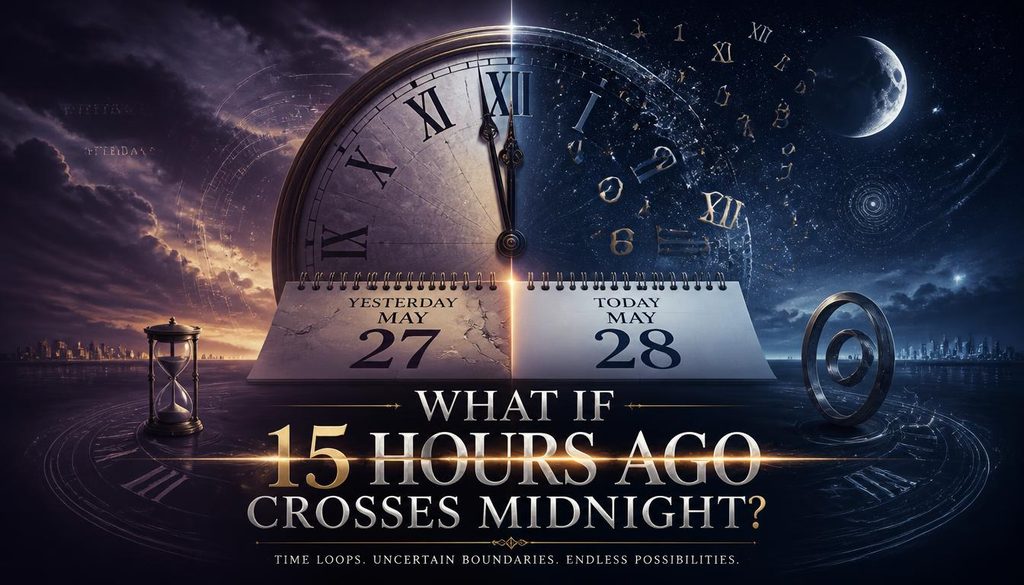
Crossing midnight is the main reason people make mistakes with past time calculation.
Suppose today is Sunday, June 14, 2026, and the current time is 8:00 AM.
Going backward 15 hours takes you to:
Saturday, June 13, 2026, at 5:00 PM
The time subtraction itself is easy. The important part is remembering the calendar date adjustment.
This is called a midnight crossing or day rollover. Any calculation that moves backward through 12:00 AM needs to account for the previous calendar date.
A useful strategy is to break the calculation into chunks:
8 hours backward → midnight
7 more hours backward → previous afternoon
That is often easier than trying to mentally subtract 15 all at once.
How a Time Calculation Tool Finds 15 Hours Ago
An online time calculation tool does essentially the same thing you would do manually, only faster and with less opportunity for a sleepy arithmetic mistake.
A typical hours ago calculator receives a current date and time, subtracts the requested number of hours, and then adjusts the calendar date when necessary.
A simplified version of the process is:
- Read the current date and time.
- Convert the requested duration into a usable unit.
- Perform backward time calculation.
- Check whether midnight was crossed.
- Adjust the date if needed.
- Display the resulting exact time.
A time shifting calculator may also allow you to move forward or backward by minutes, hours, days, or other intervals.
This is particularly useful when you are checking historical timestamps, scheduling events, reviewing logs, or trying to figure out when something happened.
Using an X Hours Ago Calculator Online
An X hours ago calculator is useful when you don’t want to perform the arithmetic yourself.
You simply enter the current date and time, select 15 hours, and choose the backward direction. The calculator then returns the corresponding past timestamp.
Tools such as an hours from now calculator tool/function, date and time calculator, or online time difference calculator can handle these calculations automatically.
Some calculators also support:
- Multiple time zones
- AM/PM conversion
- Date rollover
- Minutes and seconds
- Future and past calculations
- UTC conversion
- Local-time adjustments
A tool like Inch Calculator, for example, is one type of online resource people may encounter when searching for practical calculation utilities, although the important thing here is understanding the underlying calculation rather than relying blindly on any particular website.
What Time Was It 15 Hours Ago in Pakistan?

If you are calculating what time was it 15 hours ago in Pakistan, the relevant standard is Pakistan Standard Time, commonly expressed as PKT or GMT+5.
Pakistan uses UTC+5, so a calculation based on Pakistan’s local time zone should use that offset rather than automatically assuming UTC.
For example, if the local time in Pakistan is 8:00 AM, then:
8:00 AM PKT − 15 hours = 5:00 PM PKT on the previous day
The subtraction remains exactly the same. The time-zone information simply establishes which clock you are starting from.
This becomes more important in global contexts, especially when someone in Pakistan is communicating with a person in another country. A timestamp may be 10:00 PM in one location and a completely different clock time elsewhere.
UTC, GMT+5, and Local Time
UTC is commonly used as a global reference point. Pakistan Standard Time is five hours ahead of UTC.
So if a system gives you a UTC timestamp and you want Pakistan time, you apply the appropriate time conversion.
For example:
UTC 12:00 PM → Pakistan 05:00 PM
If you then ask what that Pakistan time was 15 hours ago, you perform the backward calculation from the converted local time.
A proper time zone difference calculator can be useful when dealing with international meetings, travel, remote teams, online events, and global messages.
The trick is to avoid mixing UTC and local time halfway through the calculation. That is where innocent-looking numbers become absolute chaos.
Real-Life Reasons to Calculate 15 Hours Ago
The question isn’t always academic. People calculate past time for surprisingly ordinary reasons.
You may want to know when a message was sent, when a package was dispatched, when a person left home, or when a social-media post appeared.
A traveler might remember arriving somewhere “about 15 hours ago” and use that information to reconstruct a journey. Someone working remotely may need to determine when a colleague sent a message in another region.
In healthcare, transportation, logistics, business records, and digital services, exact timestamps can matter considerably.
Even everyday situations benefit from knowing how to calculate elapsed hours. You might say, “I started this task 15 hours ago,” but when someone asks what time that actually was, suddenly your memory starts negotiating with the clock.
Human Time Perception Is Not Always Accurate

There is an interesting psychological side to all this.
Human beings do not experience time like computers. Human time perception changes depending on attention, emotion, stress, boredom, and memory.
Ten minutes waiting for important news can feel enormous. Two hours spent laughing with friends can disappear almost suspiciously fast.
That is why people sometimes struggle with time confusion when reconstructing an event. They remember the event clearly but cannot remember exactly when it happened.
Cognitive science describes memory as something more complicated than a perfect recording. We often remember events through context, emotions, people, and other surrounding details rather than through exact timestamps.
So when someone asks, “What time was it 15 hours ago?” they may actually be trying to rebuild an event from fragments.
Emotional Timestamps and Memory
A timestamp can become meaningful when it is attached to an emotional event.
Maybe a message arrived at 2:27 AM. Maybe somebody called at 5:27 PM with news that changed the rest of your week. Perhaps you remember sitting somewhere at 8:27 AM, drinking tea, waiting for an answer.
Those numbers become more than numbers.
This is a kind of emotional timestamping, where memory attaches significance to a particular point in time. We remember not only what happened but also where the event sits inside our personal timeline.
A simple mathematical calculation can therefore become strangely emotional. You subtract 15 hours and suddenly you have found the approximate doorway back to a particular memory.
Why People Search “What Was 15 Hours Ago?”
Searches such as what was 15 hours ago, when was 15 hours ago from now, and what time was it exactly 15 hours ago often come from practical curiosity.
Someone might have seen a post marked “15 hours ago” and want to know the actual clock time. Another person may be checking an event schedule or trying to understand a timestamp.
The phrase “15 hours ago” is relative. It does not identify a fixed moment until you know the reference point.
That means 15 hours ago from now changes continuously. At 8:00 AM, it refers to one moment. At 8:01 AM, it refers to another. Tomorrow, the answer will be different again.
Time keeps moving while we are busy asking where it went. Bit rude, honestly.
How to Find the Exact Time 15 Hours Ago

If you need an exact time calculation 15 hours ago, follow this simple process:
Start with your current local date and time.
Then subtract 15 hours.
If the result passes midnight, move the date back by one day.
Finally, verify your AM/PM designation and local time zone.
For example:
Current time: 5:27 PM
Subtract 15 hours: 2:27 AM
Therefore:
5:27 PM today → 2:27 AM today
But:
Current time: 8:27 AM
Subtract 15 hours: 5:27 PM previous day
Therefore:
8:27 AM today → 5:27 PM yesterday
The arithmetic is identical. Only the starting position on the clock changes.
15 Hours Ago in Everyday Conversations
People don’t always use exact language when describing time.
Someone might say, “I saw him about 15 hours ago,” while another person says, “That happened last night.” Both descriptions may refer to nearly the same event, but one uses elapsed time and the other uses a calendar-based description.
This difference matters because “last night” depends on context. Fifteen hours is mathematically fixed, while everyday expressions are flexible.
A person may say “yesterday morning” even when an event technically happened shortly after midnight. Human language is wonderfully imprecise in ways calculators absolutely hate.
When 15 Hours Ago Means Yesterday
There is a simple rule worth remembering.
If your current time is before 3:00 PM, subtracting 15 hours generally takes you into the previous calendar day.
At exactly 3:00 PM, 15 hours earlier is midnight.
After 3:00 PM, the answer generally remains on the same calendar date.
For example:
- 12:00 PM → 9:00 PM yesterday
- 02:00 PM → 11:00 PM yesterday
- 03:00 PM → 12:00 AM today
- 05:00 PM → 2:00 AM today
- 11:00 PM → 8:00 AM today
This little mental rule makes calculate 15 hours ago much quicker.
Time Calculation Beyond 15 Hours

Once you understand 15 hours, the same method works for almost any duration.
To calculate 5 hours ago, subtract 5.
To calculate 24 hours ago, move back one full day.
To calculate 36 hours ago, move back one day and then another 12 hours.
To calculate 900 minutes ago, recognize that 900 minutes equals 15 hours.
This is the heart of time calculation & conversion: different units can describe the same duration.
Hours, minutes, seconds, and milliseconds are simply different measuring tools for the same flowing thing we call time.
A Useful Mental Model for Backward Time Calculation
Imagine the clock as a circular road and midnight as a major junction.
If you travel backward 15 hours, you are moving counterclockwise around that road. If you pass midnight, you enter the previous calendar date.
This mental picture can make subtracting hours easier than treating the numbers as ordinary arithmetic.
For example, starting at 6:00 AM:
Move backward 6 hours → midnight.
Then continue backward 9 hours → 3:00 PM yesterday.
So the answer is 3:00 PM previous day.
The method is simple, visual, and less likely to cause the classic “wait, is that AM or PM?” moment.
When a Time Calculator Is Better Than Mental Math
For simple questions, manual time arithmetic is perfectly fine. But a calculator becomes more useful when several variables are involved.
Use a time calculation tool when you need to account for:
- Different time zones
- Exact dates
- Seconds or milliseconds
- Multiple time intervals
- International schedules
- Calendar rollover
- Large durations
- Historical timestamps
A good time calculator online can reduce human error, especially when the calculation involves several steps.
Still, knowing the underlying arithmetic is valuable. A tool should make the process easier, not turn the answer into mysterious digital soup.
The Deeper Meaning of Looking Back 15 Hours

There is a slightly philosophical quality to asking about the past.
Fifteen hours isn’t a huge slice of human history. It is less than one day. Yet within those hours, an ordinary life can contain work, meals, arguments, laughter, sleep, travel, messages, decisions, and surprises.
The past is not always distant. Sometimes it is only 15 hours behind us.
A person can wake up in the morning and discover that something important happened the previous evening. A message from yesterday may suddenly make sense today. A journey that began before sunrise may still feel like “just now.”
This is where time perception and emotional experience overlap. Mathematical time is consistent. Human experience isn’t.
How to Use a 15-Hour Calculation in Real Life
If you are checking a message or event, write down the current timestamp first.
For example:
Current: Sunday, June 14, 2026, 8:27 AM
Then calculate backward:
15 hours earlier: Saturday, June 13, 2026, 5:27 PM
This approach preserves both the time and the date, which is important when reconstructing conversations, journeys, appointments, or other events.
If someone tells you something happened “15 hours ago,” don’t immediately assume they mean yesterday. First identify their reference time.
Context is everything.
Common Mistakes When Calculating 15 Hours Ago
One common mistake is subtracting 15 from the hour number without thinking about AM and PM.
For example, treating 5:00 AM as though it were simply “5 minus 15” produces nonsense unless you account for the 12-hour clock.
Another mistake is forgetting the date when crossing midnight.
A third is mixing UTC with local time.
And a fourth is assuming that “15 hours ago” always means yesterday. It doesn’t. Depending on the current time, it can refer to earlier today or the previous day.
The safest method is to break the calculation into smaller pieces and write down the intermediate result.
Frequently Asked Questions
What Time Was It 15 Hours Ago?
15 hours ago means subtracting 15 hours from the current time to find the exact earlier time.
How Do I Calculate 15 Hours Ago?
Subtract 15 hours from the current time. If you cross midnight, the result will be on the previous day.
What Day Was It 15 Hours Ago?
The day may be today or yesterday, depending on your current time.
Is 15 Hours Ago Always the Previous Day?
No. If the current time is late enough, 15 hours ago can still be on the same calendar day.
How Can I Find the Exact Time 15 Hours Ago?
Use a time calculator by entering the current time and subtracting 15 hours for an accurate result.
Read This Blog:https://tevoqix.com/12-hours-from-now/
Final Thoughts on What Time Was It 15 Hours Ago
The question What Time Was It 15 Hours Ago looks tiny, almost too ordinary to deserve much attention. Yet it opens into a surprisingly useful corner of everyday mathematics.
It teaches us about time shifting, time conversion, calendar dates, midnight, time zones, and the difference between a mathematical timestamp and the way humans remember events.
The core calculation is simple:
Current date and time − 15 hours = time 15 hours ago
If the subtraction crosses midnight, adjust the date to the previous day. If you are working internationally, make sure your local time zone, UTC offset, or GMT+5 setting is correct.
And perhaps there is one more lesson hidden inside the calculation. Fifteen hours ago was not merely a number on a timeline.
It was a real moment when somebody was sleeping, somebody was traveling, somebody was waiting for a message, somebody was making tea, somebody was beginning a difficult conversation, and somebody somewhere was probably wondering why the clock was moving so slowly.
