


Have you ever looked at your phone early in the morning and wondered what time it was fifteen hours earlier? It seems like a tiny question, but time has a funny way of crossing midnight and making simple calculations a little confusing.
You might be checking when you sent an important message, remembering the time of a phone call, reviewing a work schedule, or trying to figure out when something happened yesterday. Whatever the reason, knowing how to calculate an earlier time can save you a bit of confusion.
The good news is that you don’t need a complicated formula or a special math skill to solve it. With a basic understanding of hours, minutes, and calendar dates, you can work out the answer in seconds.
A reliable What Time Was It 15 Hours Ago Calculator makes the process even easier, especially when the calculation crosses from one day into another.
For example, if the current time is 6:25 AM Pacific Daylight Time (PDT), then fifteen hours earlier was 3:25 PM on Monday, October 12, 2026.
This example shows why the date matters just as much as the clock. Subtracting hours doesn’t always leave you on the same calendar day, and that small detail can make all the difference.
Let’s explore how the calculation works, how to find the correct date, and how you can use the result in everyday situations without second-guessing yourself.
| Time Now | 15 Hours Ago |
|---|---|
| 6:00 AM | 3:00 PM (Previous Day) |
| 9:00 AM | 6:00 PM (Previous Day) |
| 12:00 PM | 9:00 PM (Previous Day) |
| 3:00 PM | 12:00 AM |
| 6:00 PM | 3:00 AM |
| 9:00 PM | 6:00 AM |
| 12:00 AM | 9:00 AM (Previous Day) |
What Time Was It 15 Hours Ago? Quick Answer
The answer to What Time Was It 15 Hours Ago depends on your current local time and time zone. There isn’t one universal clock time that applies to everyone because people in different locations may be experiencing different hours of the day.
Using our example, the calculation looks like this:
- Current time: 6:25 AM PDT
- Time to subtract: 15 hours
- Previous time: 3:25 PM
- Previous date: Monday, October 12, 2026
- Time zone: Pacific Daylight Time (PDT)
If the current time is 6:25 AM on Tuesday, October 13, 2026, subtracting fifteen hours takes you back to 3:25 PM on Monday, October 12.
The easiest way to understand this result is to move backward in two stages. First, subtract six hours to reach midnight. You then have nine more hours to subtract, taking you back to 3:00 PM. Since the starting time includes an extra 25 minutes past the hour, the final result is 3:25 PM.
That little midnight crossing is what often confuses people. Once you understand it, the calculation becomes much more straightforward.
How to Calculate 15 Hours Ago
Working out the time 15 hours ago is simply a matter of subtracting a duration from the current clock time. You can do this mentally, on paper, with your phone, or by using an online time calculator.
Here is a simple method you can follow.
Start With the Current Time
Look at your phone, computer, watch, or another reliable clock. Write down the current hour and minute, along with the date if you need the full result.
For example, imagine the clock reads 6:25 AM on Tuesday. The starting point is 6:25 AM, and the goal is to find the time fifteen hours earlier.
Subtract the Hours
Because fifteen hours is longer than the time elapsed since midnight in this example, the calculation will cross into the previous day.
You can subtract six hours from 6:25 AM to reach 12:25 AM. Then subtract the remaining nine hours, which takes you to 3:25 PM on the previous afternoon.
The resulting time is 3:25 PM on Monday.
Check the Date
Whenever your calculation moves past midnight, the calendar date changes. If the current time is early in the morning and you subtract fifteen hours, the answer will generally fall on the previous calendar day.
However, if the current time is later in the afternoon or evening, the result may fall on the same date. Always check the clock and date together rather than assuming that every calculation leads to yesterday.
Confirm AM or PM
Finally, make sure you have identified whether the result belongs to the morning or afternoon. A calculation can be mathematically correct but still misleading if AM and PM are mixed up.
Forgetting this small detail can turn a perfectly good answer into the wrong appointment time, so it’s worth checking twice.
What Date Was It 15 Hours Ago?
The question “What date was it 15 hours ago?” is closely connected to the time calculation itself. When you subtract fifteen hours, you may move into the previous calendar day, depending on your starting point.
Consider these examples:
- If the current time is 6:25 AM on Tuesday, October 13, 2026, the answer is 3:25 PM on Monday, October 12, 2026.
- If the current time is 10:00 AM on Tuesday, the answer is 7:00 PM on Monday.
- If the current time is 8:00 PM on Tuesday, the answer is 5:00 AM on Tuesday.
Notice the difference in the final example. Subtracting fifteen hours from 8:00 PM doesn’t take you into Monday because fifteen hours before that time is still early Tuesday morning.
This is why a previous day calculation should always depend on the exact starting time. The number of hours alone doesn’t tell you the final date.
If you are checking a message, a delivery update, or an event that happened fifteen hours ago, include the date in your notes whenever possible. It can help avoid confusion when an event occurred near midnight.
Understanding the 15-Hour Time Difference
Fifteen hours might sound like a long stretch, but breaking it into smaller units makes it easier to understand. Time conversions are useful when you want to compare durations or record an event in a different format.
Here are the basic conversions:
| Measurement | Equivalent |
|---|---|
| Hours | 15 |
| Minutes | 900 |
| Seconds | 54,000 |
| Milliseconds | 54,000,000 |
These values come from straightforward multiplication.
There are 60 minutes in an hour, so fifteen hours equals 15 × 60, or 900 minutes. Each minute contains 60 seconds, giving you 900 × 60, or 54,000 seconds. Multiply that number by 1,000 to convert seconds into milliseconds, and the result is 54,000,000 milliseconds.
Although milliseconds are rarely needed for everyday scheduling, they can be useful in software systems, technical logs, and digital timestamp calculations.
The same duration remains fifteen hours regardless of whether you express it in hours, minutes, seconds, or milliseconds. Only the unit changes.
How the 12-Hour and 24-Hour Clock Affect the Result
Time calculations can become confusing when you switch between the 12-hour and 24-hour clock formats. Both systems represent the same moment, but they write the time differently.
The 12-hour clock uses AM and PM. The 24-hour clock represents the day from 00:00 to 23:59 without adding those labels.
For example:
| 12-Hour Format | 24-Hour Format |
|---|---|
| 12:00 AM | 00:00 |
| 3:25 AM | 03:25 |
| 12:00 PM | 12:00 |
| 3:25 PM | 15:25 |
| 8:30 PM | 20:30 |
| 11:45 PM | 23:45 |
In our example, the resulting time of 3:25 PM becomes 15:25 in the 24-hour format.
Using the 24-hour clock can make time subtraction easier because you don’t need to keep switching between AM and PM while working through the calculation. Still, you must handle midnight correctly, since the clock resets to 00:00 at the beginning of a new day.
For people who work with international schedules, travel itineraries, or computer timestamps, understanding both formats is particularly helpful.
When Does Subtracting 15 Hours Change the Date?
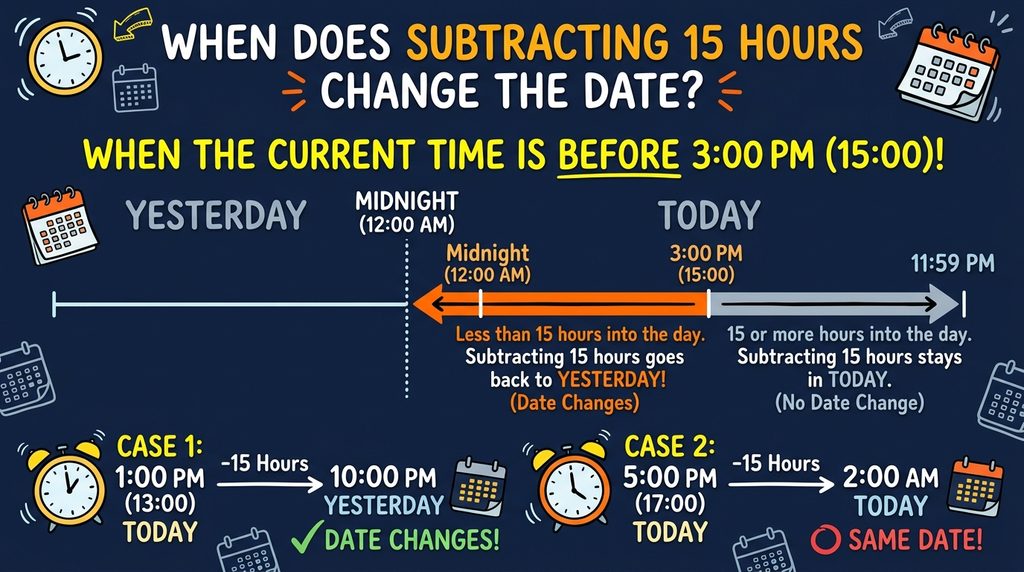
The calendar date changes when the calculation crosses midnight. This is one of the most important ideas behind calculating time in the past.
Imagine the day as a circular clock. After 11:59 PM comes 12:00 AM, and the calendar moves forward to a new day. When you travel backward across that point in a time calculation, the calendar moves to the previous day.
Here are a few examples to make the idea clearer:
- 6:00 AM minus 15 hours: 3:00 PM on the previous day.
- 12:00 PM minus 15 hours: 9:00 PM on the previous day.
- 6:00 PM minus 15 hours: 3:00 AM on the same day.
- 11:00 PM minus 15 hours: 8:00 AM on the same day.
The first two examples cross midnight, while the last two do not. The result depends on how many hours have passed since midnight at the starting point.
If your starting time is earlier than 3:00 PM, subtracting fifteen hours takes you into the previous calendar day. At exactly 3:00 PM, the result is midnight at the start of that same calendar date. After 3:00 PM, the result falls later in the same morning.
This is a handy rule to remember when you need a quick mental estimate.
Everyday Reasons to Calculate 15 Hours Ago
Finding an earlier time isn’t only a math exercise. It can be useful in many ordinary situations, from checking digital records to organizing your day.
Checking Messages and Calls
You might notice a message marked “15 hours ago” and want to know when it was sent. By subtracting the duration from the current time, you can estimate the original timestamp.
Keep in mind that an app’s displayed time may be rounded or affected by the time zone settings on your device. If the exact minute matters, check the full timestamp rather than relying solely on a relative-time label.
Tracking Work and Appointments
Some people need to review shift schedules, work logs, or appointment reminders. Calculating fifteen hours backward can help establish when a previous activity began or ended.
For work records, use the official timestamp whenever one is available. A mental calculation is useful for checking your understanding, but it should not replace the original record when accuracy is important.
Reviewing Travel Times
Travelers sometimes need to calculate when they left a location or how much time has passed since an event. A fifteen-hour difference can cross both midnight and a time-zone boundary during international travel.
If the start and end locations use different time zones, convert both timestamps to a consistent reference before comparing them. Otherwise, a correct subtraction may appear incorrect because the local clocks show different times.
Understanding Online Activity
Social platforms, websites, and applications often display relative timestamps such as “15 hours ago.” These labels are convenient, but they don’t always tell you the precise original date and minute.
A time calculator can help you estimate the likely timestamp. Just remember that rounding rules and delayed updates may create a small difference between the displayed estimate and the actual event time.
Organizing Personal Plans
Perhaps you are trying to remember when you started a task, prepared something, or received an update. Subtracting fifteen hours provides a quick reference point.
Writing down the date along with the time is a simple habit that makes these calculations more useful, particularly when your activities extend across two calendar days.
Using a What Time Was It 15 Hours Ago Calculator
A What Time Was It 15 Hours Ago Calculator is a convenient option when you want a fast result without manually counting backward. Most time calculators allow you to enter a starting date and time, choose the number of hours to subtract, and view the earlier result.
The process is generally simple:
- Enter the current date.
- Enter the current time, including the correct AM or PM setting.
- Select a backward calculation or subtraction option.
- Enter 15 hours as the duration.
- Review the resulting time and calendar date.
Some tools also let you calculate minutes or seconds, compare two timestamps, or move forward from the current time. These additional features can be useful if your calculation involves more than one unit.
A good calculator should account for midnight and the date change automatically. If you are working with an event in another region, make sure the selected time zone is correct as well.
For example, subtracting fifteen hours from 6:25 AM PDT gives 3:25 PM PDT on the previous date. A calculator using a different time zone may display another local clock time for the same instant, so the time-zone setting matters.
For quick everyday checks, however, the calculation is usually all you need.
Common Mistakes When Calculating 15 Hours Ago

Even a simple time subtraction can produce an incorrect answer if you overlook one small detail. Here are a few mistakes worth avoiding.
Forgetting to Change the Date
When you subtract hours across midnight, the calendar date may change. If you write down only the resulting clock time, you could accidentally assign the event to the wrong day.
Always include the date whenever the calculation crosses midnight or when you are reviewing a past event.
Mixing Up AM and PM
A result of 3:25 AM is twelve hours away from 3:25 PM on a standard 12-hour clock. The numbers look nearly identical, but the times are very different.
Double-check the AM or PM label before using the result for a schedule or record.
Using the Wrong Starting Time
Your device may display a local time that differs from the time used by an online service. If you start with an incorrect or outdated clock reading, your result will also be wrong.
Use a reliable clock and confirm the time zone when precision matters.
Ignoring Time-Zone Changes
Daylight saving time can affect local clock calculations around the dates when clocks change. A simple subtraction of fifteen hours works directly when you are counting elapsed hours from a fixed instant, but local wall-clock timestamps can behave differently across a clock change.
For events near a daylight-saving transition, use a time-zone-aware calculator and provide the correct date and location.
Confusing Hours Ago With Hours From Now
These phrases describe opposite directions. “Fifteen hours ago” means moving backward from the starting time, while “fifteen hours from now” means moving forward.
Checking the direction before calculating helps prevent an otherwise avoidable mistake.
What Is the Difference Between 15 Hours Ago and 15 Hours From Now?
The difference is simply the direction of the calculation.
When you calculate fifteen hours ago, you subtract fifteen hours from the starting time. When you calculate fifteen hours from now, you add fifteen hours.
For example, if it is 6:25 AM on Tuesday, October 13, 2026:
- Fifteen hours ago was 3:25 PM on Monday, October 12, 2026.
- Fifteen hours from now will be 9:25 PM on Tuesday, October 13, 2026.
The first calculation moves backward into the previous day. The second moves forward into the evening of the same day.
An Hours From Now Calculator is helpful for future appointments, reminders, and deadlines, while an hours-ago calculator is better suited to reviewing past events. A general time calculator can usually handle both tasks.
Quick Mental Tricks for Time Subtraction
You don’t need to write down every step each time. A few mental shortcuts can make the process faster, especially when you are dealing with whole hours.
One helpful method is to subtract twelve hours first. On a 12-hour clock, subtracting twelve hours keeps the same clock reading but changes AM to PM or PM to AM, while the calendar date may also change depending on the starting point.
Then subtract the remaining three hours.
For example, starting from 6:25 AM:
- Subtract twelve hours to get 6:25 PM on the previous day.
- Subtract another three hours to get 3:25 PM on the previous day.
This approach can be easier than subtracting fifteen hours all at once, though you still need to track the date correctly.
Another method is to move backward to midnight and then continue subtracting. This is particularly useful when the starting time is early in the morning.
Choose whichever approach feels natural to you. The best method is the one that helps you reach the correct answer without mixing up the date or clock format.
How to Make Time Calculations More Accurate
If you regularly calculate earlier times, a few small habits can make your results more dependable. First, always start with the correct current time. Second, note the date when the calculation might cross midnight. Third, pay attention to your time zone, especially when working with international meetings or digital records.
It can also help to use the 24-hour clock for complicated calculations. For example, writing 15:25 instead of 3:25 PM makes it easier to compare timestamps in schedules, spreadsheets, and technical logs.
When exact timing matters, use the original timestamp or a reliable calculator rather than relying only on memory. A quick mental calculation is excellent for everyday questions, but official records deserve a little extra care.
Frequently Asked Questions
15 hours ago
15 hours ago refers to the time exactly 15 hours before the current time.
what time was it 15 hours ago
To find the time, subtract 15 hours from the current local time.
15 hours ago from now
15 hours ago from now means counting backward 15 hours from the present moment.
how long ago was 15 hours ago
It was exactly 15 hours ago, which is equal to 900 minutes.
how long ago was 15 hours
15 hours is a duration of 900 minutes or 54,000 seconds.
Read This Blog:https://tevoqix.com/time-was-it-12-hours-ago/
Conclusion
So, what time was it 15 hours ago? The answer depends on the current clock time, date, and time zone. In our example, when the clock reads 6:25 AM PDT on Tuesday, October 13, 2026, the time fifteen hours earlier was 3:25 PM PDT on Monday, October 12, 2026.
The calculation itself is simple: subtract fifteen hours, check whether midnight was crossed, and confirm the date and AM/PM designation. You can do it mentally, write it down, or use a time calculator whenever you want a quick answer.
Remember that fifteen hours is equal to 900 minutes, 54,000 seconds, and 54,000,000 milliseconds. Those conversions may be useful when you’re working with schedules, timestamps, or digital records.
Once you become comfortable with time subtraction, questions about earlier hours stop feeling like little puzzles. And the next time someone asks when something happened fifteen hours ago, you’ll know exactly how to work it out.
