


Have you ever looked at a clock and wondered what time it was eleven hours earlier? Maybe you are checking when a message arrived, working out the start of a shift, reviewing a meeting schedule, or trying to understand when an online event took place.
It sounds like a tiny calculation, but crossing midnight can make the answer a little confusing, especially when the date changes along with the time.
The good news is that calculating an earlier time is much easier than it first appears. You only need the current time, the number of hours you want to subtract, and a little attention to the AM and PM format. With a simple calculation, you can determine the exact time and even find the previous calendar date when necessary.
In this guide, we will explore What Time Was It 11 Hours Ago, how to calculate the answer manually, how to handle midnight, and how online calculators make the process quicker. We will also cover useful time conversions, common mistakes, and practical examples you can apply in everyday life.
| Time Calculation | Result |
|---|---|
| Current Time | Your local current time |
| Hours to Subtract | 11 Hours |
| Calculation | Current time − 11 hours |
| Example | 8:00 PM → 9:00 AM |
| Date Change | May fall on the previous day |
| Purpose | Find the time 11 hours ago |
What Time Was It 11 Hours Ago?
The answer depends on your current local time and time zone. To find the time eleven hours ago, subtract 11 hours from the current time. If the calculation crosses midnight, the answer will fall on the previous calendar day.
For example, using the reference time of 5:51 AM PDT on Tuesday, October 13, 2026, subtracting eleven hours gives the following result.
REFERENCE CALCULATION
6:51 PM
Monday, October 12, 2026
Current reference time
5:51 AM, Tuesday, October 13
Time to subtract
11 hours = 660 minutes
Result
6:51 PM on the previous day
This example shows why the date matters just as much as the clock. Although the current time is early Tuesday morning, eleven hours earlier was Monday evening. The minutes remain unchanged because we are subtracting whole hours rather than minutes.
Remember that this is a reference calculation, not a claim about your current local clock. For an accurate result at any moment, use your actual current time and time zone.
How to Calculate Time 11 Hours Ago
The easiest way to calculate an earlier time is to subtract the elapsed hours from the current time. There is no complicated mathematics involved, but the method you use can depend on whether the calculation stays on the same day.
The Simple Time Subtraction Formula
The basic formula is:
\[ \text{Previous Time}=\text{Current Time}-11\text{ hours} \]
For example, suppose your clock reads 8:30 PM. Subtracting eleven hours gives 9:30 AM on the same calendar day.
Here is the calculation in simple steps:
- Start with the current time: 8:30 PM.
- Convert the time into a 24-hour format: 20:30.
- Subtract eleven hours: 20:30 − 11:00 = 09:30.
- Convert the result back into a 12-hour clock: 9:30 AM.
That’s all there is to it. The main thing to remember is that the minutes stay the same when subtracting an exact number of hours. If the starting time were 8:47 PM, the answer would be 9:47 AM.
Calculate 11 Hours Ago Using a 12-Hour Clock
Most people use a 12-hour clock that displays AM and PM. This format is familiar, but subtracting hours can occasionally become confusing when the calculation passes noon or midnight.
Consider a current time of 10:15 PM. Going backward eleven hours gives 11:15 AM on the same day. You move from late evening into the morning, but you do not cross midnight.
Now imagine the current time is 7:20 AM. Subtracting eleven hours takes you back to 8:20 PM on the previous day.
The easiest trick is to move backward one hour at a time until you reach the desired point. You can also convert the time to a 24-hour clock first, which makes arithmetic more straightforward.
What Time Was It 11 Hours Ago Today?

Whether the answer falls today or yesterday depends on the current hour. When you subtract eleven hours from an early-morning time, you will usually land on the previous evening. When you subtract eleven hours from an evening time, you may remain on the same calendar date.
Here are some useful examples.
| Current time | Time 11 hours ago | Date relationship |
|---|---|---|
| 5:00 AM Tuesday | 6:00 PM Monday | Previous day |
| 8:00 AM Tuesday | 9:00 PM Monday | Previous day |
| 12:00 PM Tuesday | 1:00 AM Tuesday | Same day |
| 4:00 PM Tuesday | 5:00 AM Tuesday | Same day |
| 8:00 PM Tuesday | 9:00 AM Tuesday | Same day |
| 11:30 PM Tuesday | 12:30 PM Tuesday | Same day |
Notice the pattern: subtracting eleven hours does not automatically mean going back to yesterday. It depends on the starting time.
For anyone checking messages, recording work hours, or planning an event, this distinction can prevent small but frustrating scheduling mistakes.
Understanding the 11-Hour Time Difference
An eleven-hour period is longer than a typical work shift in some settings, but shorter than half a day. It can represent the gap between an evening activity and the following morning, or the time between two events on the same day.
Understanding the duration in different units is useful when dealing with digital systems, spreadsheets, and time-tracking applications.
How Many Minutes Are in 11 Hours?
One hour contains 60 minutes. Therefore:
\[ 11\times60=660\text{ minutes} \]
So, 11 hours equals 660 minutes.
This conversion can be helpful if a scheduling tool requests a duration in minutes instead of hours. For example, a task that began eleven hours ago has an elapsed duration of 660 minutes, assuming the entire period has passed without interruption.
How Many Seconds Are in 11 Hours?
One hour contains 3,600 seconds. Multiply that number by eleven:
\[ 11\times3,600=39,600\text{ seconds} \]
That means eleven hours equals 39,600 seconds.
Seconds are useful in software calculations, timestamps, countdown systems, and technical applications where precision matters. Although nobody wants to count all those seconds manually, the conversion is surprisingly simple.
How Many Milliseconds Are in 11 Hours?
A millisecond is one-thousandth of a second. To convert eleven hours into milliseconds, multiply the number of seconds by 1,000.
\[ 39,600\times1,000=39,600,000 \]
Therefore, 11 hours equals 39,600,000 milliseconds.
This value can appear in programming environments, performance logs, automated processes, and other digital systems. It may look like a huge number, but it represents the same eleven-hour duration as 660 minutes.
How to Calculate 11 Hours Across Midnight
Crossing midnight is probably the most confusing part of calculating a past time. Your clock resets from 11:59 PM to 12:00 AM, and the calendar date changes at the same moment.
Imagine it is 6:00 AM on Wednesday. You want to find the time eleven hours earlier.
Start at 6:00 AM and move backward six hours to midnight. You arrive at 12:00 AM on Wednesday. Continue moving backward for another five hours, and the result becomes 7:00 PM on Tuesday.
The complete calculation is:
\[ 6{:}00\text{ AM}-11\text{ hours}=7{:}00\text{ PM} \]
The result belongs to the previous day, Tuesday.
A Quick Method for Previous-Day Calculations
When the current time is earlier than 11:00 AM, subtracting eleven hours generally takes you into the previous calendar day.
For example:
- 1:00 AM becomes 2:00 PM yesterday.
- 3:00 AM becomes 4:00 PM yesterday.
- 5:00 AM becomes 6:00 PM yesterday.
- 9:00 AM becomes 10:00 PM yesterday.
- 10:30 AM becomes 11:30 PM yesterday.
The minutes remain unchanged in these examples because only whole hours are being subtracted.
If the current time is exactly 11:00 AM, subtracting eleven hours gives midnight at the start of the same calendar date. That is a useful boundary to remember.
Using an 11 Hours Ago Time Calculator
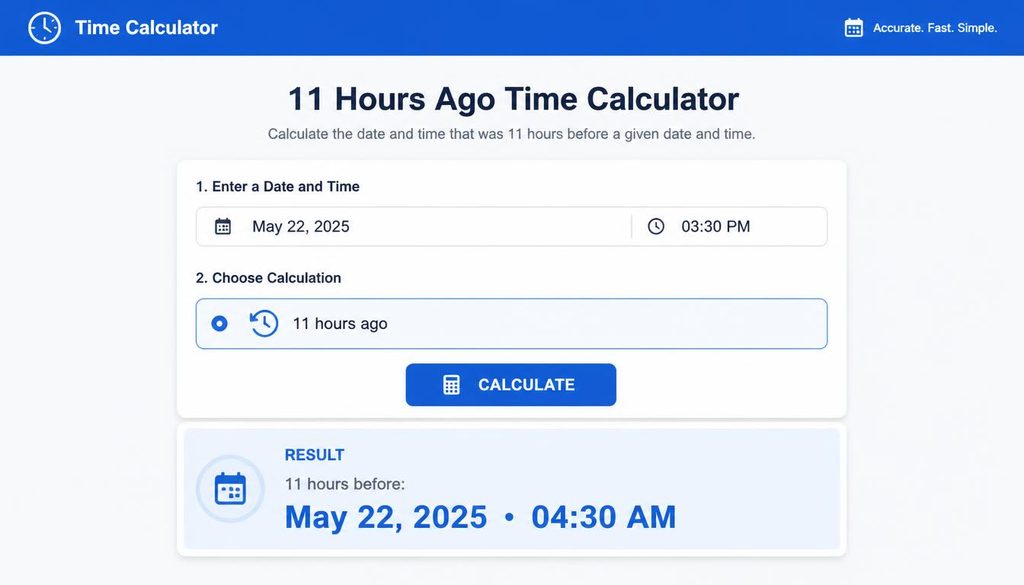
A time calculator can save effort when you need to perform calculations repeatedly or work with several dates. Rather than manually moving backward on a clock, enter the current time and choose the number of hours to subtract.
Many online tools allow users to calculate past or future times, convert time units, and determine the date associated with a particular result.
An 11 hours ago time calculator is especially useful when:
- You need to find the start of a previous work shift.
- You are checking the approximate time a message was sent.
- You are reviewing a digital activity log.
- You want to calculate a time across midnight.
- You need to compare two events separated by several hours.
Some calculators also support a 24-hour clock, different time zones, and calculations involving minutes or seconds. Those features become valuable when accuracy is important.
How to Find the Time 11 Hours Ago Using a Calculator
Follow these straightforward steps:
- Open a reliable time calculator online.
- Enter the current local time, including the correct AM or PM designation.
- Select the subtraction option rather than addition.
- Enter 11 hours as the duration.
- Review the resulting time and date.
- Confirm that the calculator is using the correct time zone.
If the calculator accepts only minutes, enter 660 instead of 11. If it asks for seconds, enter 39,600.
Always double-check the date when the calculation crosses midnight. A correct clock time paired with the wrong calendar date can still cause confusion.
Why Time Zones Matter When Calculating 11 Hours Ago
The relationship between two times depends on the time zone used for the calculation. A clock reading in Pacific Daylight Time may differ from a clock reading in Pakistan, Europe, or another region.
For example, the reference result of 6:51 PM on Monday, October 12, 2026, is based on subtracting eleven hours from 5:51 AM PDT on Tuesday, October 13, 2026.
If you use a different current time zone, you must start with the local time in that zone or convert both timestamps to a common reference before comparing them.
What Does PDT Mean?
PDT stands for Pacific Daylight Time, a time designation used in parts of North America during daylight saving time. It is UTC−7.
Time-zone abbreviations can be confusing because some regions change their clocks seasonally, while others do not. If you are calculating time for a meeting, flight, online event, or international conversation, use the location’s applicable time zone and date.
For computer records, timestamps in Coordinated Universal Time (UTC) can be useful because they provide a common reference. You can then convert the result to the local time zone for everyday use.
Common Mistakes When Calculating Time Backward
Even a simple calculation can produce the wrong answer if you overlook a small detail. These are some mistakes worth avoiding.
Forgetting to Change the Date
If the calculation crosses midnight, the previous time may belong to yesterday. Writing only the clock time can be misleading when you are reviewing events on different dates.
Mixing Up AM and PM
A result of 8:00 AM is very different from 8:00 PM. Converting to a 24-hour clock before doing the calculation can reduce confusion, especially when the starting time is close to midnight.
Subtracting Eleven Minutes Instead of Eleven Hours
Hours and minutes are separate units. Eleven hours equals 660 minutes, not 11 minutes. Always check the unit selected in your calculator before accepting the answer.
Ignoring Time Zones
If the original timestamp and the current time refer to different regions, the arithmetic alone may not give the intended local result. Confirm the time zone before calculating the elapsed period.
Forgetting Daylight Saving Changes
When calculating timestamps across a daylight saving transition, the local clock may move forward or backward. In such cases, an elapsed duration of eleven hours may not correspond to simply subtracting eleven from the displayed local hour.
Use the actual timestamps and applicable time-zone rules when precision matters.
Practical Uses for Calculating 11 Hours Ago

Finding an earlier time is useful in many ordinary situations. You may not think about time subtraction very often, but it quietly supports all sorts of daily activities.
Work Shifts and Attendance
Employees and managers may need to determine when a shift started or how much time has passed since a recorded event. Subtracting eleven hours can provide a quick estimate, although official attendance records should be checked for breaks, date changes, and workplace rules.
Messages and Online Activity
Suppose you see a post marked as having been shared eleven hours ago. You can estimate the posting time by subtracting eleven hours from the current timestamp. Remember that some platforms round elapsed times or display them using their own time-zone settings.
Travel Planning
Travelers may calculate earlier times when reviewing departures, arrivals, reservations, or transport schedules. If an event occurs near midnight, the previous date becomes particularly important.
Study and Productivity Tracking
Students can use time subtraction to review study sessions, estimate when they started an activity, or organize a daily schedule. A simple calculation is often enough, provided the starting time is accurate.
Personal Reminders
If you are trying to remember when you cooked something, began a project, or received an important update, calculating an earlier time can help establish a useful timeline. For important records, however, rely on actual timestamps rather than memory alone.
Time 11 Hours Ago vs. 11 Hours From Now
These calculations may sound similar, but they work in opposite directions.
Eleven hours ago means moving backward from the current time. Eleven hours from now means moving forward.
For example, if the current time is 8:00 AM on Tuesday:
- Eleven hours ago was 9:00 PM on Monday.
- Eleven hours from now will be 7:00 PM on Tuesday.
The two results can fall on different calendar dates, depending on the starting time. An hours-from-now calculator is useful for planning future events, while a past-time calculator helps you reconstruct an earlier point.
Understanding the direction of the calculation is the first step toward getting the correct result.
Frequently Asked Questions
11 hours ago
11 hours ago means subtracting 11 hours from the current time to find the exact past time.
11 hours ago from now
To calculate 11 hours ago from now, subtract 11 hours from your current local time. The result may fall on the previous day.
what was 11 hours ago
The time 11 hours ago depends on your current time and time zone. Subtract 11 hours to determine the exact result.
when was 11 hours ago
11 hours ago was earlier today or yesterday, depending on the current time. Check the date as well if the calculation crosses midnight.
how long was 11 hours ago
11 hours ago refers to a point in time exactly 11 hours before now. The duration is 660 minutes or 39,600 seconds.
Read This Blog:https://tevoqix.com/hours-from-15-hours-ago/
Conclusion
Calculating What Time Was It 11 Hours Ago is a straightforward process once you understand time subtraction and how the calendar changes around midnight. Subtract eleven hours from the current time, keep track of AM and PM, and adjust the date whenever your calculation moves into the previous day.
The duration itself never changes: eleven hours equals 660 minutes, 39,600 seconds, and 39,600,000 milliseconds. What changes is the clock reading and, sometimes, the calendar date or time-zone context.
For quick everyday calculations, a simple mental method is usually enough. For travel plans, digital records, or events involving different time zones, a reliable calculator can provide additional confidence.
The next time you need to work backward from the present moment, you will know exactly where to begin. If you have a useful time-calculation trick or an example that once confused you, share it in the comments. Your experience might make someone else’s next calculation a little easier.
