

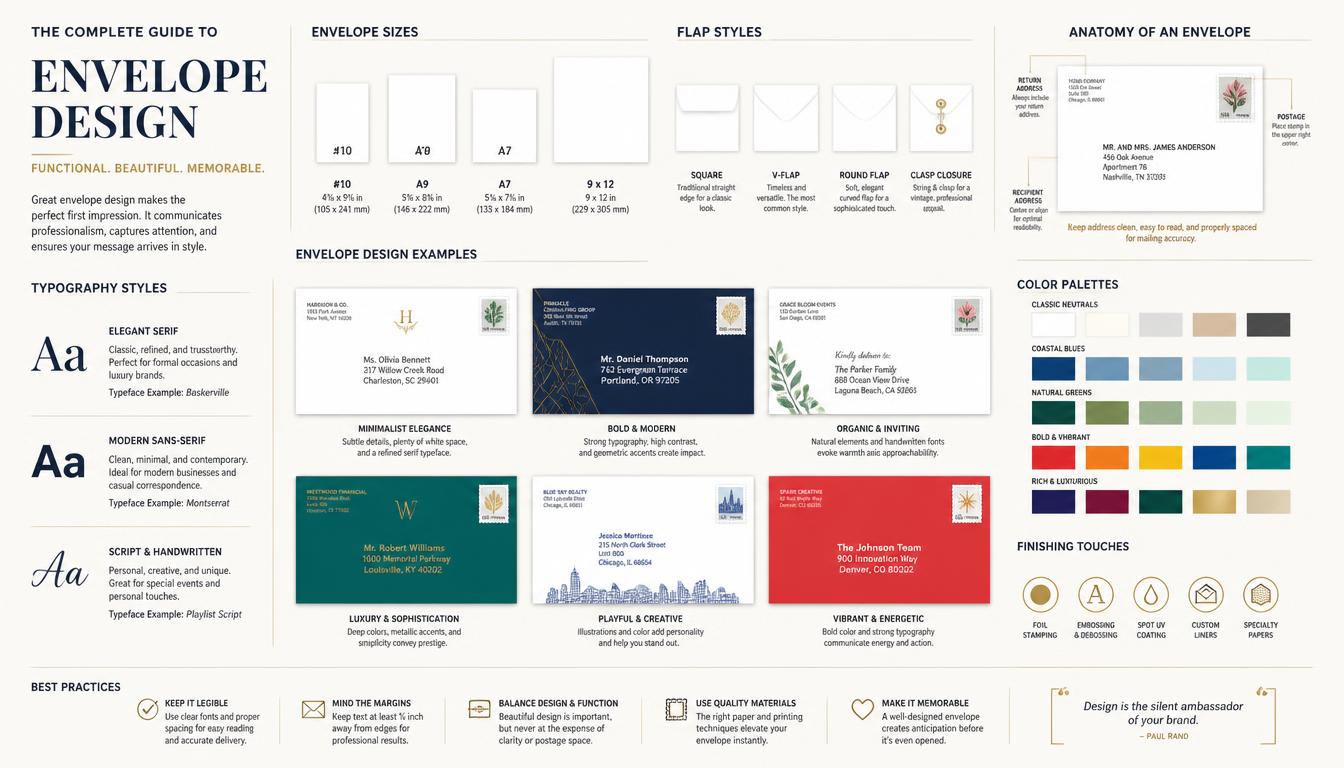
An envelope can look like a very small thing, almost like the quiet part of a letter, but it often speaks before the letter ever gets opened. A wedding invitation arriving in a carefully designed envelope feels different from an ordinary bill, and a baby announcement can carry a little burst of happiness before the recipient even reads the first word.
That is why good envelope design is not only about decoration; it is about creating a first impression that feels right, and sometimes that tiny first impression matters more than we expect.
Whether you are preparing business correspondence, a formal invitation, a greeting card, or a sweet announcement for a newborn baby girl, the envelope has a job to do.
It needs to look attractive, hold the contents properly, survive handling, and still make the recipient address easy for the mail carrier to read. A beautiful envelope that cannot travel properly is, well, beautiful but not very useful.
| Element | Key Point |
|---|---|
| Envelope Size | Choose a size that fits the contents properly. |
| Paper Stock | Select paper based on quality, weight, and purpose. |
| Layout | Keep addresses and design elements clear and balanced. |
| Typography | Use readable fonts with good contrast. |
| Color Scheme | Match colors to the occasion or brand. |
| Personalization | Add names, logos, monograms, or illustrations. |
| Printing | Test-print before producing the full batch. |
| Mailing | Follow postal guidelines for address and postage placement. |
What Makes Good Envelope Design?
Good design begins with purpose, not with picking the prettiest font you can find. Before opening a design program, think about what is going inside, who will receive it, how it will be mailed, and what mood you want the envelope to create.
A birthday card and a corporate invoice may both fit inside an envelope, but asking them to share the same design would be a slightly strange idea.
The basic relationship can be remembered simply: envelope design = size + material + typography + layout + visual details + mailing requirements. When these pieces work together, the result feels intentional rather than decorated just for the sake of decoration.
For a personalized envelope, you might use a monogram, floral graphics, handwriting-style typography, or a custom illustration. For a business envelope, a logo, brand colors, and a restrained professional layout can make the mail instantly recognizable without shouting for attention.
Choosing the Right Envelope Size
One of the first decisions in an envelope design guide is selecting the correct size. An envelope should fit the document or card comfortably, because forcing a thick invitation into a tiny envelope can damage both the paper and your patience. On the other hand, using an oversized envelope for a single small card may make the contents move around during delivery.
There are several standard envelope sizes, although naming and availability can differ between the US, UK, and Europe. Your local stationery supplier or postal service should be checked for current sizing and mailing requirements, especially when a design is unusual.
Here are some common formats:
| Envelope | Common dimensions | Typical use |
|---|---|---|
| #10 envelope | 4.125 × 9.5 in | Business mail |
| DL envelope | 110 × 220 mm | A4 documents folded into thirds |
| A 2 envelope | 4.375 × 5.75 in | Greeting cards |
| C6 envelope | 114 × 162 mm | Personal correspondence |
| C5 envelope | Varies by standard | Larger folded documents |
| C4 envelope | Varies by standard | Unfolded A4 documents |
| Booklet envelope | Various | Thick documents and booklets |
| Catalog envelope | Various | Catalogs and larger documents |
A #10 envelope is especially common for business use in the United States, where it is frequently paired with letters, statements, and invoices. A DL envelope is widely associated with business correspondence in the UK and Europe because it works neatly with an A4 sheet folded into thirds.
Understanding Envelope Types

Not every envelope is a standard rectangle, even though that is probably the shape most people picture first. Envelope types can vary according to flap design, size, construction, and intended use, so choosing one is partly a practical decision and partly a design decision.
A standard rectangle envelope is versatile and generally easy to print and mail. A booklet envelope provides more room for thick documents, while a catalog envelope is useful when papers need to remain relatively flat instead of being folded into a tiny package.
For invitations and personal mail, a contour flap envelope can add a softer and more distinctive appearance. The flap itself becomes part of the design, particularly when paired with calligraphy, a monogram, or a small decorative illustration.
Envelope Paper and Material Choices
The material underneath your design changes how the finished envelope feels in the hand. A simple design printed on good paper stock can sometimes look more sophisticated than an elaborate design printed on flimsy material, which is a lesson worth remembering.
For everyday correspondence, ordinary 24 lb paper may be suitable depending on the envelope format and printer. 28 lb paper and 32-lb paper offer a heavier feel, though the exact suitability depends on the envelope construction and printing equipment. Heavier stock can create a premium impression, but very heavy materials may need special handling or printing equipment.
For invitations, textured paper can give the envelope a tactile quality that plain stock does not have. Glossy paper creates a more polished visual effect, while recycled paper can give a natural appearance and support an eco-conscious design.
If sustainability matters to your project, look for FSC certified materials or other responsibly sourced paper options. Eco friendly envelopes are especially useful for organizations and individuals who want the physical mail piece to reflect their environmental values, though certification claims should always be checked from the supplier rather than assumed.
Building an Effective Envelope Layout
An envelope layout should have a clear visual hierarchy. The recipient needs to understand where the address is, while decorative elements should support the design rather than interfere with essential mailing information.
Think of the front of the envelope as a small canvas with a few important zones. The recipient address placement is the most important area, followed by postage and, where appropriate, the return address.
Decorative elements can then be positioned around these areas without making the envelope difficult to process.
For a business envelope, the logo may sit in the upper-left area with the return address. For a personal invitation, the design may place a monogram or floral detail in a tasteful corner. The exact placement should always respect the mailing requirements of the destination country.
A strong layout also leaves enough breathing room. Empty space is not wasted space; it gives the important information somewhere to stand, which is rather helpful when everything else is trying to get attention.
Typography and Envelope Readability

Typography can make an envelope elegant, modern, traditional, playful, or completely confusing. The best envelope typography is attractive while remaining easy to read, particularly for addresses.
When choosing envelope fonts, consider legibility before personality. Decorative calligraphic elements can work beautifully for a name or short heading, but a long street address written in an extremely elaborate script may cause unnecessary trouble.
Use high-contrast text against the background, especially when addresses are printed. A dark text color on a light background is generally easier to recognize than pale lettering over a complicated illustration. Your font choice, text color, and background color should cooperate instead of arguing with each other.
Handwritten addresses can feel warm and personal, particularly for wedding invitations or letters, but readable writing remains essential. If handwriting is difficult to read, consider combining handwritten names with a clear printed address.
Color Schemes That Actually Work
A thoughtful envelope color scheme can transform a plain envelope without requiring dozens of graphic elements. You do not need every color in the palette; sometimes two well-matched colors are enough to make the whole piece feel finished.
A blue and white color scheme, for example, can create a clean and calm appearance. Soft neutral backgrounds paired with dark typography can feel understated, while stronger brand colors can make business mail instantly recognizable.
For a baby announcement, gentle colors, small illustrations, stars, flowers, or a simple monogram can create a welcoming mood. The design does not need to rely on stereotypical colors either; the goal is to make the envelope feel joyful and personal to the family.
The same principle works for wedding invitations. A muted background, elegant typography, and a small crest or floral detail can create a cohesive look without overwhelming the recipient.
Personalization Makes Envelopes Memorable
A personalized envelope design is often memorable because it feels made for a person rather than produced for a crowd. Even one small detail can change the experience, such as the recipient’s name in a carefully chosen font, a family monogram, or a custom illustration.
For a wedding, try monogrammed envelopes, a small crest, or floral graphics that match the invitation itself. For a baby announcement, a tiny illustration connected to the announcement can make the envelope feel like part of the celebration rather than merely packaging.
Personalization can also be subtle. A small envelope monogram may be enough, and there is no rule saying every available corner needs to be filled. In fact, leaving some areas quiet can make the personal detail stand out better.
Envelope Design for Business Branding

Businesses have a different goal: the envelope should communicate professionalism and strengthen brand identity while remaining practical for mailing. A well designed business envelope can make routine mail feel organized and trustworthy.
A company might use its company logo, brand colors, return address, and a consistent typography system across its envelopes, letters, invoices, and statements. This creates recognizable corporate branding and makes different pieces of business mail feel like they belong to the same organization.
For larger mailings, consistency becomes even more important. Custom business envelopes should ideally follow the organization’s established visual identity, because changing fonts and colors randomly from one mailing to another can make the brand look less polished.
Envelope Design for Weddings and Invitations
Wedding stationery gives designers much more room to explore personality. Wedding invitation envelopes can include calligraphy, floral patterns, monograms, decorative borders, wax-seal-inspired graphics, or other elements that echo the invitation itself.
The envelope should complement the invitation instead of competing with it. If the invitation already contains an elaborate illustration, the envelope might use only a small matching motif. If the invitation is minimalist, the envelope can carry more of the visual character.
The same idea applies to birthday parties, anniversary celebrations, charity events, holidays, and other invitations. A cohesive design helps the entire stationery set feel connected, even before the recipient opens it.
Designing Baby Announcement Envelopes
Few envelopes carry quite the same emotional weight as a baby announcement envelope. The contents may simply announce the arrival of a daughter, but the envelope can become the first little hello from the new family member.
A parent might choose a soft illustration, a family monogram, a tiny floral graphic, or a simple name treatment. Grandparents may appreciate something more traditional, while friends might enjoy a playful design. There is no single correct style, and that is part of the fun.
A sweet message on the envelope can also be effective, but keep the main mailing information clear. The decoration should create curiosity, not hide the destination.
Envelope Design Software and Templates
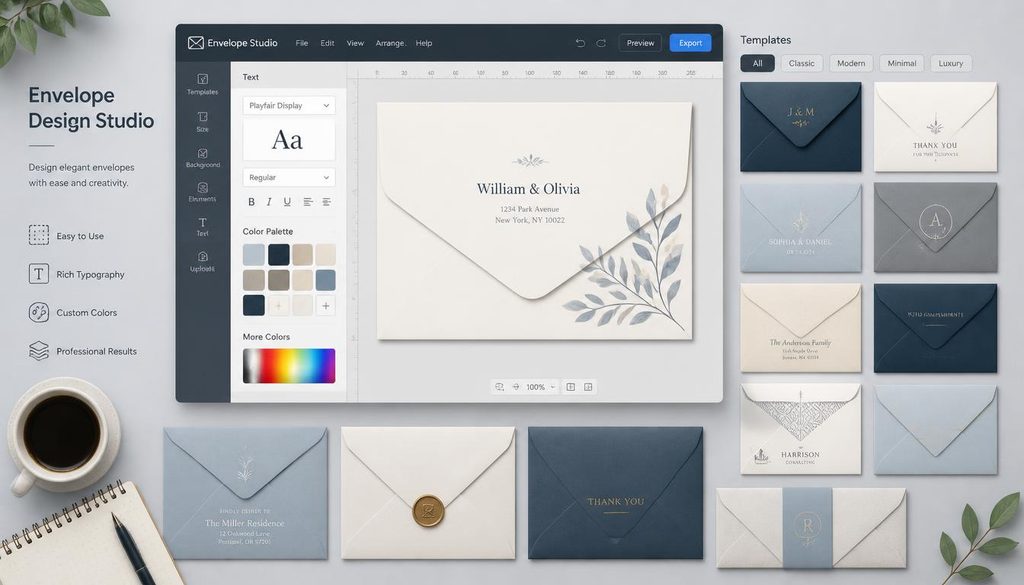
Modern design software makes envelope creation much easier than it once was. A beginner does not necessarily need advanced graphic-design knowledge to create a clean result, especially when using templates.
Swift Publisher, for example, is a software tool that can help users work with layouts, typography, graphic elements, and printable designs. Tools with a drag and drop interface can be particularly useful when experimenting with logos, illustrations, text blocks, and decorative details.
Before printing, always check the template against the physical envelope. A digital canvas may look perfect on screen but print differently when the envelope is loaded into a particular printer. Checking margins and text placement first can save a surprising amount of paper.
Printing Envelopes at Home
If you only need a few envelopes, a home printer may be the most convenient option. However, printers vary considerably in how they handle envelopes, so check the printer’s instructions before loading a stack and hoping for the best.
Use an appropriate envelope printer setting when available, and test one envelope before printing the complete batch. This helps you check alignment, ink coverage, and whether the envelope feeds correctly.
For small-batch envelope printing, testing is especially valuable because even a small shift can change how an address or logo sits on the finished piece. A simple test print is boring for about thirty seconds and saves frustration later, which is a pretty good trade.
Professional Envelope Printing
For hundreds or thousands of envelopes, professional envelope printing may provide more consistent results. Printing services can handle larger quantities, specialty materials, and production requirements that are difficult to manage with a home printer.
Professional printing is particularly useful for branded envelopes, event invitations, corporate mailings, and designs using unusual paper stock. Ask the printer about acceptable file formats, print quality, paper weights, envelope dimensions, and finishing options before sending the final artwork.
For bulk envelope printing, consistency matters. The goal is for the first envelope and the last envelope to look like members of the same family, not distant cousins who met at a wedding.
Address Placement, Return Address, and Postage

A beautiful envelope still has to travel through a postal system. That means postal regulations, addressing standards, and local requirements should be considered before production.
The recipient address placement should be clear and easy for automated systems and the mail carrier to recognize. The return address placement should also follow the relevant postal guidance for the destination.
Postage placement is another practical detail. Do not simply place a stamp wherever there happens to be an attractive empty space. Different postal systems have rules and preferred zones, and following them helps reduce the possibility of processing problems or delivery delays.
Because requirements can change, consult your local postal service or mail carrier’s official guidance before sending unusual envelopes, international mail, oversized pieces, or specialty formats.
Envelope Assembly and Finishing
Once the design is printed, there is still the physical work of envelope assembly. Depending on the type of envelope, this may involve folding, inserting documents, securing the flap, and sealing the finished piece.
For handmade or specialty projects, tools such as double-sided tape or glue sticks may be useful, although the appropriate adhesive depends on the material and construction. A properly aligned scored line helps create clean folds, while the flap closure should remain secure without damaging the contents.
If you are assembling a large number of invitations, create a simple workflow: prepare the inserts, fold the documents, insert them, seal the envelopes, and then check addresses and postage. Doing everything in random order sounds exciting until you discover twenty envelopes without cards inside them.
Common Envelope Design Mistakes
One common mistake is choosing style over readability. A decorative font may look beautiful in a design preview but become difficult to read once printed at a small size. Another problem is poor contrast, especially when light text is placed over a patterned background.
Using the wrong envelope size is another avoidable issue. Always compare the document dimensions with the envelope before designing the final layout. A folded A4 sheet, a greeting card, and a thick booklet all have different space requirements.
Overcrowding is also common. Logos, patterns, illustrations, borders, slogans, and decorative typography may each look attractive separately, but putting all of them together can make the envelope feel busy. A good designer knows when to stop adding things, which is honestly one of the harder design skills.
A Simple Process for How to Design an Envelope

If you are wondering how to design an envelope, start by writing down the practical requirements. Identify the contents, choose the correct envelope size, confirm the mailing destination, and check the applicable postal guidance.
Next, select the paper or envelope stock, establish the color scheme, and decide where the recipient address, return address, postage, logo, and decorative elements will appear. Then choose typography that fits the occasion while keeping all essential information readable.
Create the design using an envelope template or your preferred design software. Print a test copy, place it on the actual envelope if possible, and inspect the alignment from a normal reading distance.
Finally, review everything before printing the entire batch. Check spelling, addresses, colors, margins, and postage areas. It sounds overly careful, but correcting one test envelope is much nicer than correcting two hundred finished envelopes.
Creative Envelope Design Ideas
There are endless envelope design ideas, but the best ones usually have a clear reason behind them. A wedding invitation might use a monogram that also appears on the invitation, while a business envelope may repeat the company’s brand colors.
For personal correspondence, consider a subtle illustration, handwritten-style name, or small seasonal graphic. For a holiday, you could use a simple motif around the border. For an anniversary celebration, a date or monogram can provide a meaningful detail without turning the envelope into a poster.
For a charity event, the envelope can use the organization’s identity and a small campaign graphic. For a company commemoration, a historical logo treatment or anniversary mark can create a sense of occasion while keeping the envelope professional.
Making Your Envelope Feel Truly Personal
The strongest custom envelope design does not necessarily have the most decoration. It has details that mean something. A family crest, a flower connected to a wedding bouquet, a baby’s initial, or a company’s recognizable logo can all tell a story in a very small amount of space.
Think about what the recipient will feel when they first see it. A formal letter might benefit from restraint. A party invitation can be cheerful. A baby announcement can feel tender and celebratory. A business mailing should inspire confidence and clarity.
That little emotional decision can guide everything else, from paper weight to typography and color. Once the purpose is clear, the design choices become much easier.
Frequently Asked Questions
envelope design rules
Envelope design rules include keeping the layout clean, using readable text, and leaving enough space for addresses, stamps, and branding.
envelope sizing
Envelope sizing depends on the document or items you need to mail. Choose a size that fits the contents comfortably without excessive folding.
envelopes size
Common envelope sizes include A4, A5, DL, and square formats. The right envelopes size depends on the paper size and mailing purpose.
envelope designer
An envelope designer helps you create professional envelopes with custom text, logos, colors, and layouts for personal or business use.
envelope guide
An envelope guide explains standard sizes, design rules, addressing placement, and printing tips to help you create the right envelope for your needs.
Read This Blog: https://tevoqix.com/useful-articles-envelope-styles-and-sizes/
Final Thoughts on Envelope Design
An envelope is more than a container for paper. It is a meeting point between design and communication, where practical requirements sit beside personality.
A thoughtful envelope design guide therefore needs to consider everything from envelope sizes and paper stock to typography, branding, printing, personalization, and postal requirements.
Whether you are making a custom envelope for a wedding, preparing professional envelopes for business correspondence, or creating a charming envelope for a baby announcement, begin with the same simple idea: make it useful, make it readable, and then make it yours.
The finest designs often contain one small detail that makes someone pause before opening the envelope.
Maybe it is a beautiful monogram, a familiar brand color, a handwritten name, or a tiny illustration that hints at the happy news inside. Those details are small, but small things have a funny habit of becoming the part people remember.
