

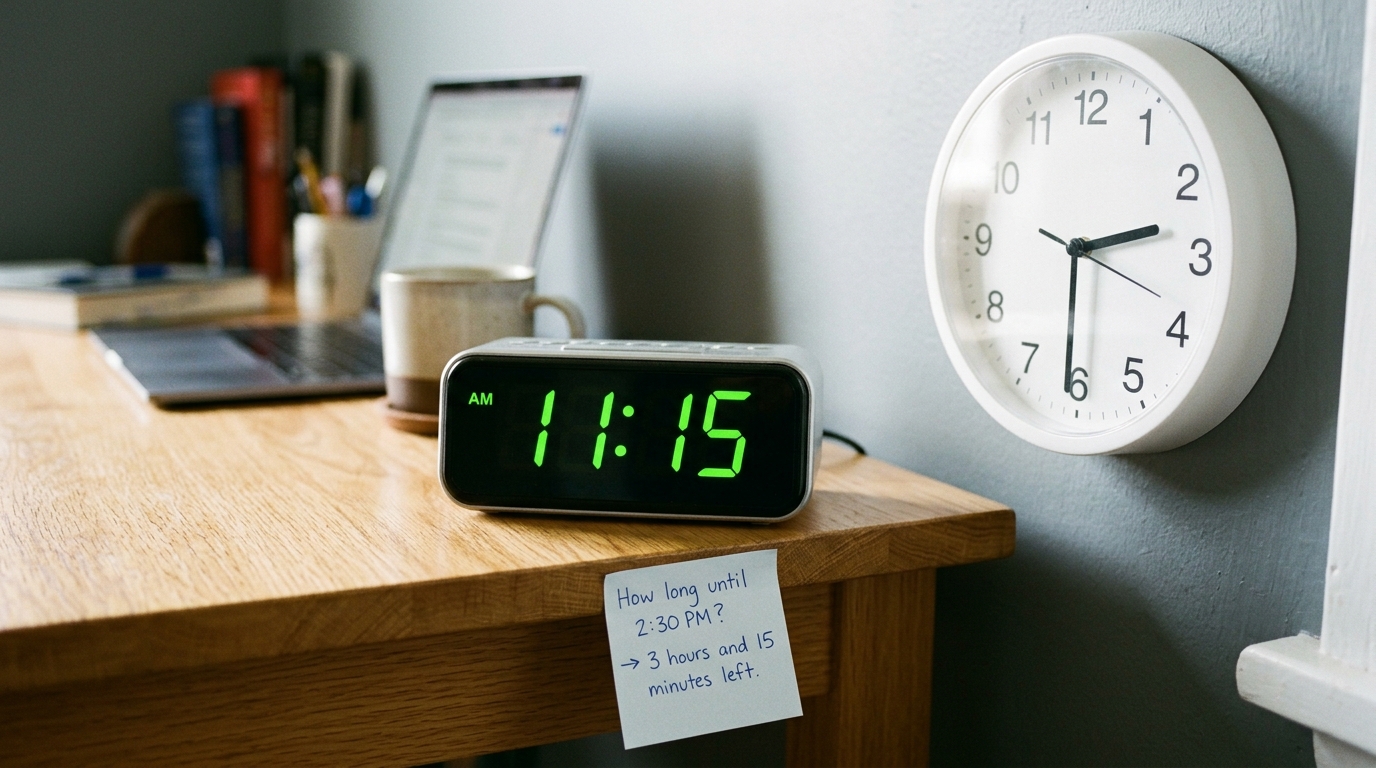
There is something strangely specific about waiting for 2:30 PM. It is not exactly lunchtime, not quite evening, and yet a surprising number of plans seem to gather around this little afternoon landmark.
Maybe a meeting starts then, a class finishes at that time, the school bus arrives, a doctor’s appointment begins, or somebody has promised, “I’ll call you at 2:30.” Suddenly the clock becomes the main character of the afternoon.
If you have ever looked at your phone and thought, “How long until 2:30 PM?”, the answer depends on your Current Time. The basic idea is beautifully simple: take the Target Time, subtract the current time, and the result is your Time Difference or Remaining Time.
For example, if it is 1:00 PM, there are 90 minutes until 2:30 PM. If it is 2:00 PM, only 30 minutes remain. And if the clock has already passed 2:30 PM, then today’s target has gone by and you would need to calculate the interval until 2:30 PM tomorrow.
That tiny calculation can be useful in far more situations than it first appears. Let’s unpack it properly, without making the clock feel like a mathematics teacher staring over your shoulder.
| Item | Time |
|---|---|
| Target Time | 2:30 PM |
| Current Time | 9:53 AM |
| Time Until 2:30 PM | 4 hours 37 minutes |
| Total Minutes | 277 minutes |
How Long Until 2:30 PM From Different Times?
The easiest way to understand How Long Until 2:30 PM is to look at several starting points. The Time Until 2:30 PM changes continuously, so even five minutes can make the answer different.
Here are some common examples:
- At 12:00 PM, there are 2.5 hours, or 150 minutes, until 2:30 PM.
- At 1:00 PM, there are 1.5 hours, or 90 minutes, remaining.
- At 1:30 PM, exactly 1 hour remains.
- At 2:00 PM, there are 30 minutes left.
- At 2:15 PM, only 15 minutes remain.
- At 2:20 PM, there are 10 minutes left.
- At 2:25 PM, just 5 minutes remain.
- At 2:29 PM, approximately 1 minute remains.
- At 2:30 PM, the Remaining Time is zero because the target has arrived.
This is where people sometimes get tripped up. They know the two clock times, but their brain starts doing weird little gymnastics with them. Writing the times down first usually makes the Time Calculation much easier.
Time Until 2:30 PM: The Basic Calculation
The simplest formula is:
Remaining Time = Target Time − Current Time
So, if the Current Time is 1:45 PM and the Target Time is 2:30 PM:
2:30 PM − 1:45 PM = 45 minutes
Easy enough.
But suppose it is 11:50 AM. You cannot just subtract 50 from 30 and announce “20 minutes,” because the hour changes. Instead, count from 11:50 AM to 12:00 PM, then from 12:00 PM to 2:30 PM.
That gives:
- 11:50 AM → 12:00 PM = 10 minutes
- 12:00 PM → 2:00 PM = 120 minutes
- 2:00 PM → 2:30 PM = 30 minutes
Total = 160 minutes, or 2 hours and 40 minutes.
It looks slightly longer when written down, but the logic is actually quite friendly.
How Much Time Until 2:30 PM Today?

People searching how much time until 2:30 PM or how long till 2:30 PM today usually want an answer based on their current clock, not a general explanation.
Because the answer changes every second, there is no single permanent number that works for everyone. Someone checking at 10:00 AM has much more waiting ahead than someone checking at 2:15 PM.
For an exact result, use your local Current Time and compare it with 2:30 PM in the same time zone. This matters especially when people are traveling, working remotely, or coordinating across countries.
A person in Lahore and someone in London might both say “2:30 PM,” but those times do not necessarily occur simultaneously. The clock needs a location attached to it when precision really matters.
Countdown to 2:30 PM
A Countdown to 2:30 PM turns an ordinary time calculation into something you can watch in real time. Instead of calculating once, a countdown continuously updates the Hours, Minutes, and Seconds remaining.
Imagine it is 1:58 PM.
You have:
- 32 minutes until 2:30 PM
- 1,920 seconds until 2:30 PM
At 2:00 PM, the number becomes 30 minutes.
At 2:15 PM, it becomes 15 minutes.
At 2:29 PM, there is only about 1 minute left.
Then, suddenly, the countdown reaches zero. The afternoon has quietly crossed its little finish line.
A 2:30 PM countdown can be particularly useful for meetings, appointments, school schedules, cooking, exercise sessions, online events, and personal reminders.
Time Remaining Until 2:30 PM in Hours, Minutes, and Seconds
Sometimes people don’t want a rough answer such as “about an hour.” They want the exact time until 2:30 PM.
For example, imagine the current time is 1:47:30 PM.
The difference is:
43 minutes and 30 seconds
Or, expressed differently:
- 43.5 minutes
- 0.725 hours
- 2,610 seconds
This shows why Time Conversion can be useful. The same Time Duration can be represented in hours, minutes, or seconds depending on what you’re doing.
A baker might care about minutes. A programmer might care about seconds. A person planning a long trip may only care that “about 2 hours” remain. Same interval, different language.
How Long Till 2:30 PM After Lunch?

For many people, 2:30 PM occupies a funny place in the Afternoon. Lunch may have just finished, energy levels can dip, and the next break seems to be hiding somewhere behind the clock.
Office workers may be waiting for an afternoon meeting. Students might be waiting for a lecture to end. Tea lovers in South Asia may already be mentally preparing the cup before the actual Afternoon tea arrives.
This is why how much longer until 2:30 is sometimes less about mathematics and more about emotional geography. You know the answer, but you still want somebody to tell you.
At 1:30 PM, an hour can feel manageable.
At 2:15 PM, fifteen minutes feels almost laughably close.
At 2:29 PM, one minute suddenly becomes very important.
The clock hasn’t changed its rules. Our Perception of Time has changed.
Why Does Time Feel Slow When You Are Waiting?
The psychology of waiting is one reason a short interval can feel enormous. When people are bored or anticipating something important, they often pay more attention to time itself.
This creates a kind of loop:
You wonder how long remains.
You check the clock.
You discover that only three minutes have passed.
You check again.
Somehow, another three minutes have become emotionally equivalent to an entire geological era.
This is connected with Time Perception, Psychological Time, and Time Awareness. When attention is strongly focused on passing time, every small movement of the clock can become noticeable.
By contrast, when you are deeply involved in a conversation, game, project, or interesting task, 30 minutes can disappear with suspicious speed.
Waiting creates Anticipation. Anticipation creates attention. Attention makes the passage of time feel louder.
Waiting for 2:30 PM at Work
For Office workers, 2:30 PM can represent a meeting, deadline, appointment, or simply the point when the workday begins feeling less endless.
Suppose you have a meeting at 2:30 PM and it is currently 1:40 PM. You have 50 minutes.
Instead of watching the Digital Clock every four minutes, divide those 50 minutes into useful pieces:
- 20 minutes for the most important task
- 10 minutes to answer messages
- 10 minutes to prepare for the meeting
- 5 minutes to organize notes
- 5 minutes to breathe and arrive mentally
Suddenly the Remaining Time is not merely something you are waiting through. It has become usable time.
That is one of the nicer tricks of Time Management: you don’t always need more time. Sometimes you need to stop treating the available time as one giant block.
Students and the 2:30 PM Countdown

For South Asian students, afternoon schedules can be particularly varied. One student may be leaving school at 2:30 PM, another may be attending tuition, while somebody else is waiting for a university lecture to finish.
The phrase how many minutes until 2:30 PM today can therefore have very different emotional meanings.
For one student, 2:30 PM means freedom.
For another, it means an exam.
For another, it means the start of a cricket match.
And for someone else, it simply means tea.
The calculation is identical in every case. The emotional meaning isn’t.
South Asian Afternoons and Cultural Time Perception
In parts of South Asia, including cities such as Lahore, afternoon routines can carry their own rhythm. Lunch, prayer, school schedules, office hours, travel, family routines, and tea breaks may all influence how people experience a particular hour.
Cultural time perception also affects how strictly people treat scheduled times. In some environments, “2:30” means precisely 2:30. In others, the phrase may function more like an approximate window.
That doesn’t change the mathematical Time Difference, of course. A clock remains wonderfully indifferent to cultural habits.
Still, human beings aren’t clocks. We interpret schedules through social expectations, routines, and circumstances.
How to Calculate Time Until 2:30 PM Manually
You don’t need an app for a simple Time Measurement problem.
Suppose the current time is 12:40 PM.
First, find the time until 1:00 PM:
20 minutes.
Then:
1:00 PM → 2:00 PM = 60 minutes
2:00 PM → 2:30 PM = 30 minutes
Now add them:
20 + 60 + 30 = 110 minutes
So the answer is 1 hour and 50 minutes.
This method works especially well when the minutes on the starting clock are awkward. It breaks the problem into friendly pieces instead of asking your brain to perform subtraction while it is already thinking about lunch.
Using a Time Until Calculator
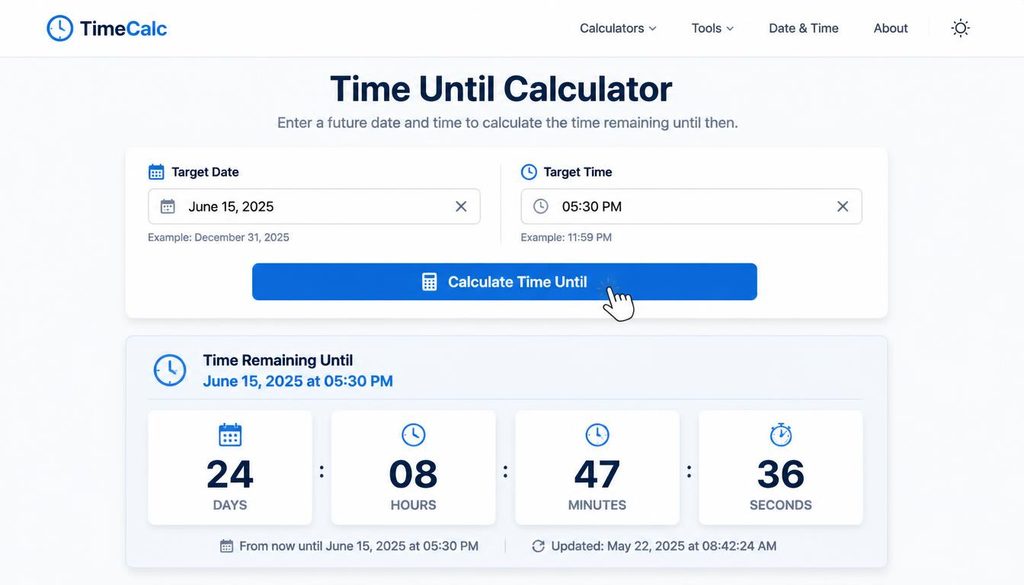
A Time Until Calculator can handle these calculations automatically. You enter the current time and the target time, and the tool calculates the interval.
Related tools include:
- Countdown Calculator
- Time Difference Calculator
- Time Interval Calculator
- Time Duration Calculator
- Future Time Calculator
- Online Time Calculator
These tools are useful when the calculation involves seconds, different dates, or longer intervals where manual counting becomes annoying.
A Countdown Calculator is especially convenient when you want the answer to keep updating rather than calculating it once.
Online Countdown Timer for 2:30 PM
An Online countdown timer is basically a clock with a destination. Rather than merely telling you what time it is, it tells you how far away a chosen event is.
A good Browser-Based Countdown Timer can display:
- Hours
- Minutes
- Seconds
- Target time
- Remaining duration
- Real-time updates
Some tools also offer a Fullscreen Timer, which can be useful in classrooms, offices, presentations, kitchens, gyms, or event spaces.
A Digital Timer can be more practical than repeatedly asking, “How long till 2:30?” because it quietly handles the arithmetic while you get on with your life.
What If It Is Already After 2:30 PM?
This is an important little detail.
If your current time is 2:35 PM, then today’s 2:30 PM has already passed. You cannot say there are negative five minutes until the event in ordinary conversation, unless you’re doing mathematical notation.
Instead, if you’re asking when the next 2:30 PM occurs, you need to look toward tomorrow.
From 2:35 PM today to 2:30 PM tomorrow is:
23 hours and 55 minutes.
This distinction matters when using a Countdown System. A timer needs to know whether you mean the next occurrence of 2:30 PM or today’s occurrence.
How Technology Tracks the Countdown
Modern devices make Real-Time Tracking feel almost invisible. Your phone, computer, smartwatch, or browser can continuously compare the present moment against the target.
A Real-Time Countdown repeatedly updates the difference between now and the target. The underlying principle is still the same old idea:
Current Time → Target Time → Time Difference → Remaining Time
The technology simply performs that calculation over and over, often down to the second.
Apps can also combine this with calendars, reminders, alarms, and Time Tracking Tools, making countdowns useful for much more than curiosity.
When 2:30 PM Becomes a Productivity Marker
Instead of treating 2:30 PM as something you have to wait for, you can make it a small checkpoint.
For example:
“Before 2:30 PM, I will finish this email.”
“Before 2:30 PM, I will complete two pages.”
“Before 2:30 PM, I will take a short break.”
This turns Time Until 2:30 PM into a productivity boundary.
The trick is not to fill every second with work. That’s how afternoons become unpleasant little machines. Instead, give the target time a purpose, then let the remaining minutes do their job.
How Long Until 2:35 PM or 2:20 PM?
Sometimes the target isn’t exactly 2:30 PM.
You may search how long until 2:35 PM because an event starts five minutes later. Or you may need how long until 2:20 PM because that’s when you must leave.
The same calculation applies.
If it is 2:00 PM:
- Until 2:20 PM = 20 minutes
- Until 2:30 PM = 30 minutes
- Until 2:35 PM = 35 minutes
This is why a Time Difference Calculator can be useful for multiple appointments. Once you understand the principle, changing the target time is all you need to do.
Time Anxiety and Repeated Clock Watching
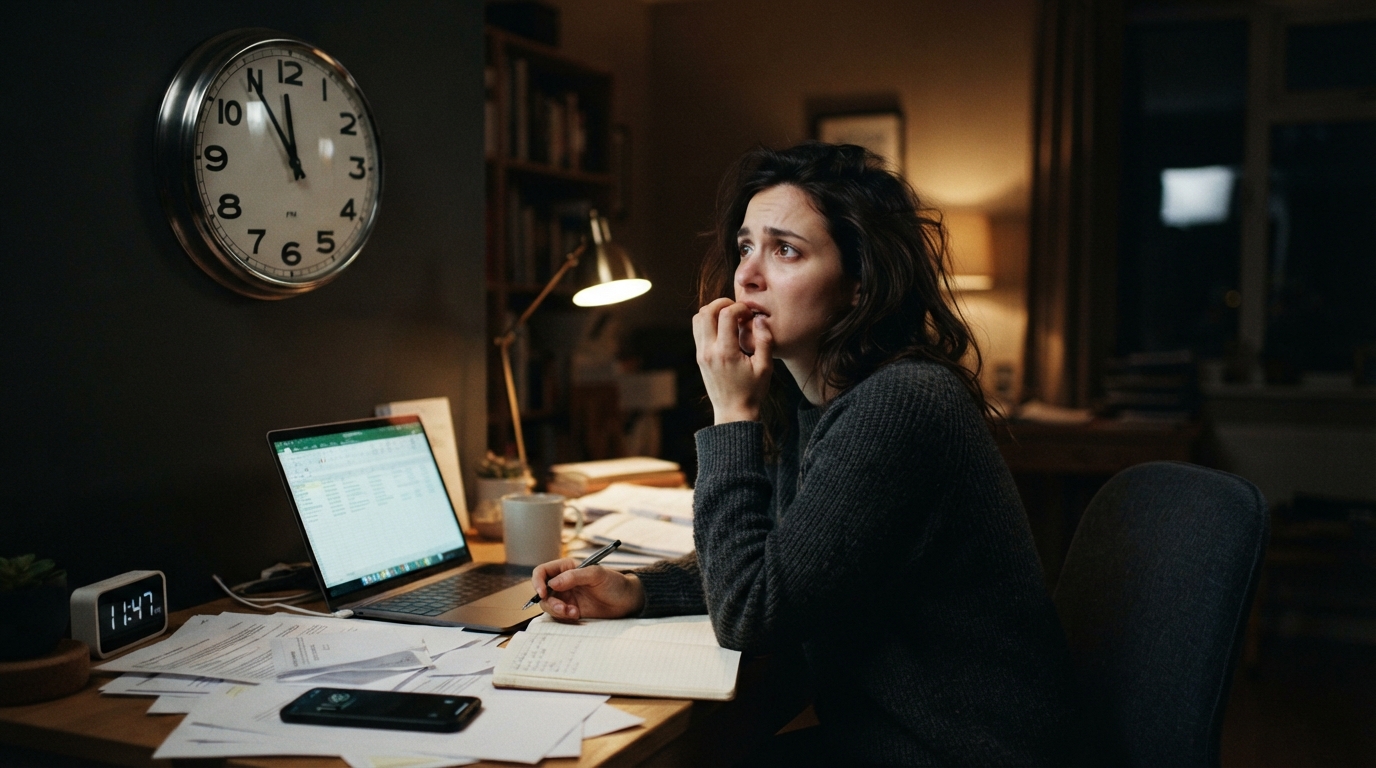
There is a difference between being curious about the time and becoming anxious about it.
If someone repeatedly asks how long till 2:30 PM, checks the clock every few minutes, and feels increasingly frustrated because the event seems impossibly far away, the issue may not be the calculation at all.
It may be Time Anxiety.
A practical response is to stop checking the clock constantly. Set a reminder for the target time, put the clock away, and focus on another activity.
This reduces Clock Watching and gives the brain fewer opportunities to turn every passing minute into a dramatic event.
Sometimes the best Countdown is the one you don’t watch.
Why a Countdown Can Make Waiting Easier
A visible countdown gives uncertainty a shape. Instead of thinking, “I have no idea how long this is going to take,” you can see that 27 minutes remain.
That small amount of information can reduce mental effort.
A countdown also creates a clear endpoint. Waiting becomes a defined Time Interval rather than a vague stretch of afternoon.
Of course, if you stare at the countdown every ten seconds, you’ve created a new problem. The timer didn’t cause it, but you certainly recruited it.
Use countdowns as tools, not as tiny digital prisons.
Quick Reference: Time Until 2:30 PM
Here is a simple reference table for common starting times:
| Current Time | Time Until 2:30 PM |
|---|---|
| 12:00 PM | 2 hours 30 minutes |
| 12:30 PM | 2 hours |
| 1:00 PM | 1 hour 30 minutes |
| 1:30 PM | 1 hour |
| 2:00 PM | 30 minutes |
| 2:10 PM | 20 minutes |
| 2:15 PM | 15 minutes |
| 2:20 PM | 10 minutes |
| 2:25 PM | 5 minutes |
| 2:29 PM | 1 minute |
| 2:30 PM | 0 minutes |
The table is simple, but that’s actually its charm. When somebody asks what time is left until 2:30 PM, you can often answer without opening an app at all.
Practical Ways to Make Waiting Feel Shorter
If you are waiting for 2:30 PM, don’t spend the entire interval negotiating with the clock.
Try one of these instead:
- Finish a small task that takes less than 15 minutes.
- Make tea or coffee and enjoy it without rushing.
- Read a few pages of something interesting.
- Prepare your notes for the upcoming meeting.
- Take a short walk.
- Organize your desk.
- Listen to a song or podcast.
- Send one useful message you’ve been postponing.
- Practice a few minutes of breathing or quiet reflection.
- Set an alarm and stop checking the time manually.
These activities give your attention somewhere else to go. Once your brain stops measuring every second, the Time Experience often changes with it.
Frequently Asked Questions
How long until 2:30 PM?
The time until 2:30 PM depends on your current time and can be calculated in hours and minutes.
What time is 2:30 PM?
2:30 PM is in the afternoon, exactly 30 minutes after 2:00 PM.
How many hours until 2:30 PM?
Subtract the current time from 2:30 PM to find the exact number of hours and minutes remaining.
Is 2:30 PM afternoon or evening?
2:30 PM is considered afternoon, not evening.
How can I calculate the time until 2:30 PM?
Compare your current time with 2:30 PM and subtract the earlier time from the target time.
Read This Blog:https://tevoqix.com/fahrenheit175-degrees-celsius-in-fahrenheit/
Final Thoughts on How Long Until 2:30 PM
So, How Long Until 2:30 PM?
There isn’t one universal answer. It depends entirely on your Current Time, your location and, when necessary, the time zone you’re using. The basic relationship is simple: compare the present moment with the Target Time, calculate the Time Difference, and express the Remaining Time in hours, minutes, or seconds.
At 1:00 PM, you have 90 minutes.
At 1:30 PM, you have 60 minutes.
At 2:00 PM, you have 30 minutes.
At 2:15 PM, you have 15 minutes.
At 2:25 PM, you have 5 minutes.
At 2:30 PM, you’re there.
But the more interesting part is what happens inside our heads while those minutes pass. Waiting, Anticipation, Boredom, Excitement, and Time Perception can make exactly the same 30 minutes feel completely different on different days.
A Countdown Timer, Time Until Calculator, or Digital Clock can tell you the numerical answer, and tools such as an Online Countdown Timer make the process effortless. Yet no calculator can decide what those minutes mean to you.
Maybe 2:30 PM is a meeting.
Maybe it’s the end of class.
Maybe it’s tea time.
Maybe it’s the moment you finally leave work.
Or maybe you’re simply wondering because the afternoon has become one of those strange days where every minute seems to be walking instead of running.
Whatever the reason, once you know the Time Remaining Until 2:30 PM, you can stop fighting the clock and start using the time you actually have. After all, the clock will reach 2:30 whether we’re watching it or not. Might as well do something nice while it gets there.
