


Time has a funny way of slipping past us. One moment you’re checking your phone before breakfast, and the next you’re wondering when a message arrived, when a meeting ended, or what the clock showed nine hours earlier.
It’s a simple question, really, but when the day changes or AM turns into PM, the answer can become a little confusing.
If you’ve searched for What Time Was It 9 Hours Ago, you’re probably looking for a quick, accurate answer without doing mental gymnastics.
The good news is that subtracting nine hours is straightforward once you understand the basic calculation. You can work it out manually or use a 9 hours ago time calculator to find the result in seconds.
This guide explains the exact example from our reference calculation, how to subtract hours correctly, how dates change when you cross midnight, and how to convert nine hours into minutes, seconds, and milliseconds.
Whether you’re checking an old text message, reviewing a schedule, or simply curious about the clock, you’ll find the answer here.
| Time Now | Hours Ago | Time 9 Hours Ago |
|---|---|---|
| 7:00 AM | 9 hours | 10:00 PM (previous day) |
| 10:00 AM | 9 hours | 1:00 AM |
| 12:00 PM | 9 hours | 3:00 AM |
| 3:00 PM | 9 hours | 6:00 AM |
| 6:00 PM | 9 hours | 9:00 AM |
| 9:00 PM | 9 hours | 12:00 PM |
What Time Was It 9 Hours Ago?
The answer depends on your current local time and time zone. For this example, we’ll use the reference time of 7:32 AM PDT on Sunday, October 11, 2026.
REFERENCE CALCULATION
10:32 PM
Saturday, October 10, 2026
Current reference time
7:32 AM PDT · October 11, 2026
Subtract
9 hours, or 540 minutes
Nine hours before 7:32 AM is 10:32 PM on the previous calendar day. The minutes remain the same because we’re subtracting whole hours, and the calculation crosses midnight into Saturday evening.
Remember, 10:32 PM on Saturday, October 10, 2026, is the answer for this particular reference time. It isn’t a permanent answer for every person or every day.
How to Calculate the Time 9 Hours Ago
You don’t need a complicated formula to calculate time 9 hours ago. All you need is the current time and a little subtraction. The important part is knowing whether your answer stays on the same day or moves into the previous one.
Here’s the easiest method to follow.
- Check the current time on your phone, computer, or watch.
- Subtract 9 from the hour shown on the clock.
- Keep the minutes unchanged when subtracting whole hours.
- If the calculation moves past midnight, adjust the date to the previous day.
- Check whether the final result should be written in AM or PM.
For example, if the current time is 7:32 AM, subtracting nine hours gives 10:32 PM on the previous day. The clock moves backward through midnight, so the date changes even though the minutes remain at 32.
This basic time calculation works for most everyday situations. Once you’ve done it a few times, you can usually find a past time without opening a calculator.
Understanding the Current Time Minus 9 Hours
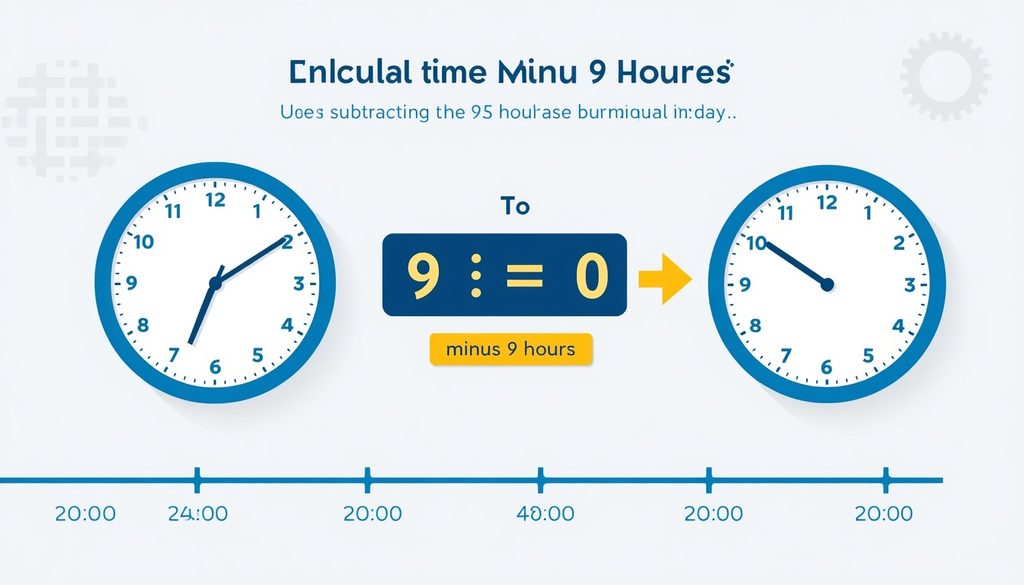
The phrase current time minus 9 hours simply means moving nine hours backward from a specific moment. Think of the clock as a circular path rather than a straight line. After 11:59 PM comes 12:00 AM, and the calendar moves to a new day.
Let’s use a few examples to make the process easier to understand.
| Current time | Time 9 hours ago | Date change |
|---|---|---|
| 7:32 AM Sunday | 10:32 PM Saturday | Previous day |
| 9:00 AM Monday | 12:00 AM Monday | Same day |
| 12:00 PM Tuesday | 3:00 AM Tuesday | Same day |
| 6:00 PM Wednesday | 9:00 AM Wednesday | Same day |
| 11:00 PM Thursday | 2:00 PM Thursday | Same day |
Notice that the date doesn’t always change when you subtract nine hours. It changes only when the calculation crosses midnight into the previous calendar day.
Also, the examples above use whole-hour times for simplicity. When you subtract nine hours from a time such as 7:32 AM, the minutes remain 32.
What Is 9 Hours Ago From Now?
If you want to know 9 hours ago from now, you must use the actual current time where you are. The answer can differ between people living in different time zones, even when they check at approximately the same moment.
For example, imagine you’re checking your phone at 4:15 PM.
- Current time: 4:15 PM
- Subtract nine hours: 4:15 − 9 hours
- Result: 7:15 AM on the same day
Now imagine checking at 5:15 AM instead.
- Current time: 5:15 AM
- Subtract nine hours: 5:15 − 9 hours
- Result: 8:15 PM on the previous day
Both calculations are correct. The difference is simply the starting time.
If you need an exact answer for an appointment, online activity, or message timestamp, make sure you use the correct local time and date. A small difference in the starting time can change the final answer, especially near midnight.
How Many Minutes, Seconds, and Milliseconds Are in 9 Hours?
Nine hours might sound like a single block of time, but it can also be expressed in smaller units. These conversions are useful when working with schedules, digital timers, software logs, and elapsed-time calculations.
Hours
9 hours
Minutes
540 minutes
Seconds
32,400 seconds
Milliseconds
32,400,000 milliseconds
The calculations are simple:
- Hours to minutes: \(9 \times 60 = 540\) minutes.
- Hours to seconds: \(9 \times 60 \times 60 = 32{,}400\) seconds.
- Hours to milliseconds: \(9 \times 60 \times 60 \times 1{,}000 = 32{,}400{,}000\) milliseconds.
There are 60 minutes in an hour, 60 seconds in a minute, and 1,000 milliseconds in a second. These standard conversions make it easy to express the same duration in different ways.
How to Calculate Time When Subtracting Hours Crosses Midnight
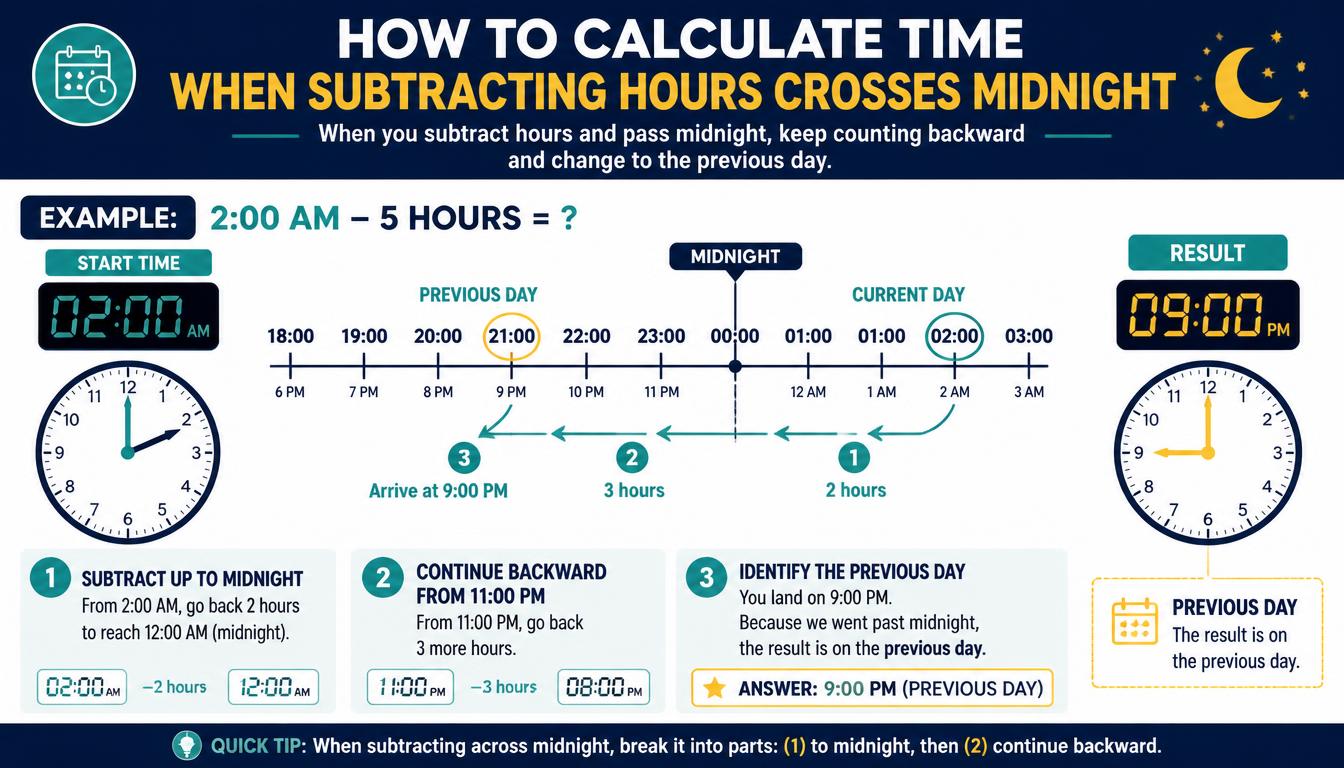
Crossing midnight is probably the most confusing part of finding a past time. The clock resets at midnight, but time itself continues moving smoothly. You simply need to account for the change in the calendar date.
Suppose the current time is 5:20 AM on Sunday. You want to find the time nine hours earlier.
First, subtract five hours to reach midnight. You still have four hours left to subtract. Moving four more hours backward takes you to 8:20 PM on Saturday.
The answer is therefore 8:20 PM on the previous day.
Here’s another way to think about it:
- Start at 5:20 AM Sunday.
- Move backward five hours to 12:20 AM Sunday.
- Move backward another 20 minutes to midnight, then account for the remaining duration as needed.
- The final result after nine full hours is 8:20 PM Saturday.
The easiest mental shortcut is to add 12 hours to the early-morning clock time, then subtract the remaining difference appropriately. However, the most reliable approach is to count backward from the actual starting time.
For digital calculations, a time subtraction calculator can handle this automatically. It is especially helpful when you’re calculating dates across several days or working with minutes as well as hours.
Using a 9 Hours Ago Time Calculator
A 9 hours ago time calculator takes the current time and subtracts the requested duration. Depending on the tool, it may also calculate the previous date, show the result in a selected time zone, or allow you to enter a custom starting time.
A typical hours ago calculator is useful when you don’t want to calculate everything manually.
Common reasons to use one include:
- Checking when a message was sent.
- Working out the start time of an activity.
- Reviewing a work shift or study session.
- Calculating the time an event occurred.
- Finding a previous date and time for a schedule.
- Comparing timestamps across different tasks.
A basic time calculator may also allow you to add or subtract minutes, hours, and days. More advanced tools can calculate the difference between two timestamps or convert a duration into seconds and milliseconds.
For the best result, check whether the tool uses your device’s local time or a time zone you select manually. This matters when you’re travelling, coordinating with someone overseas, or reviewing records created in another region.
Difference Between a Time Calculator and an Hours From Now Calculator
These two calculator types sound similar, but they perform opposite operations.
A past-time calculator moves backward from a starting point. An hours from now calculator moves forward.
| Calculator type | Operation | Example from 7:32 AM |
|---|---|---|
| Past time calculator | Subtract 9 hours | 10:32 PM previous day |
| Hours from now calculator | Add 9 hours | 4:32 PM same day |
| Time difference calculator | Compare two times | Finds the elapsed duration |
| Time and date calculator | Calculates time and calendar changes | Finds a date and time in the past or future |
This distinction is useful when planning events. If someone says a meeting happened nine hours ago, you move backward. If they say a meeting will happen nine hours from now, you move forward.
A past and future time calculator may offer both functions in one place, allowing you to switch between adding and subtracting time without performing the arithmetic yourself.
Why Time Zones Matter When Finding a Past Time

The answer to what was the time 9 hours ago depends on the reference moment. If you use the wrong time zone, your calculation may be mathematically correct but still give you the wrong local answer.
For example, Pacific Daylight Time (PDT) is used in parts of North America during daylight saving time. Pakistan Standard Time (PKT) follows a different UTC offset, so a timestamp expressed in PDT cannot automatically be treated as a Pakistan local timestamp.
To avoid confusion, follow these guidelines:
- Use the time zone associated with the original event.
- Check whether daylight saving time applies to the date.
- Distinguish between local time and Coordinated Universal Time (UTC).
- Convert the timestamp to the desired time zone before comparing local clock readings.
- Remember that crossing midnight may change the calendar date.
A time zone and local time check becomes especially important when working with international meetings, travel bookings, online transactions, and server logs.
For ordinary everyday calculations, your device’s local clock is usually enough. For historical timestamps, however, the original time zone can make a meaningful difference.
Everyday Situations Where Calculating Nine Hours Back Helps
Knowing how to find the time 9 hours ago isn’t just useful for answering a search query. It can help with all sorts of small tasks that come up during an ordinary day.
Checking messages and notifications
You might see a message labelled as having arrived nine hours earlier and want to work out when it was sent. Subtracting nine hours gives you a useful estimate, provided the displayed duration is accurate and the app’s time zone settings are understood.
Planning work and study sessions
If you’re tracking how long you’ve been working, a previous-time calculation can help establish when a session began. For instance, if a task finished at 6:00 PM after nine hours, the starting time was 9:00 AM.
Reviewing travel schedules
Flight bookings, train tickets, and international appointments often use different time zones. A time calculator helps with arithmetic, but you should also verify the local time printed on the booking.
Understanding online activity
Digital platforms may display relative timestamps such as “9 hours ago.” If you need an exact time, calculate backward from the reference moment displayed by the platform rather than assuming the label is perfectly synchronized with your own clock.
Organizing personal routines
Perhaps you want to estimate when you started studying, cooking, reading, or working on a project. Subtracting a fixed duration is a simple way to reconstruct a timeline.
In each case, the same principle applies: establish the correct starting time, subtract the duration, and check whether the date changes.
Frequently Asked Questions
9 hours ago
9 hours ago was the time exactly nine hours before the current time. The date may be the previous day if midnight has passed.
what time was it 9 hours ago
To find what time it was 9 hours ago, subtract 9 hours from the current time. This helps you quickly calculate the past time.
how long ago was 6 hours
6 hours ago means six hours before the present time. Subtract 6 hours from the current time to find the exact result.
what time was 9 hours ago
The time 9 hours ago depends on your current local time. Subtract nine hours to determine the exact time.
9 hours ago from now
9 hours ago from now refers to the time nine hours before this moment. If the calculation crosses midnight, the result falls on the previous day.
Read This Blog:https://tevoqix.com/weeks-from-4-weeks-from-today/
Conclusion
Finding What Time Was It 9 Hours Ago is much easier once you understand the basic rule: subtract nine hours from the correct starting time, preserve the minutes, and adjust the date if you cross midnight.
In our example, the reference time of 7:32 AM on Sunday, October 11, 2026, gives a result of 10:32 PM on Saturday, October 10, 2026. Nine hours also equals 540 minutes, 32,400 seconds, or 32,400,000 milliseconds.
You can work out the answer by hand, use a time calculator, or choose an hours from now calculator when you need to calculate a future time instead. Just remember to check the relevant date and time zone whenever accuracy matters.
Time calculations don’t need to be complicated. With a simple subtraction method and a little attention to the calendar, you can find a previous time confidently and get on with whatever you were trying to figure out in the first place.
