

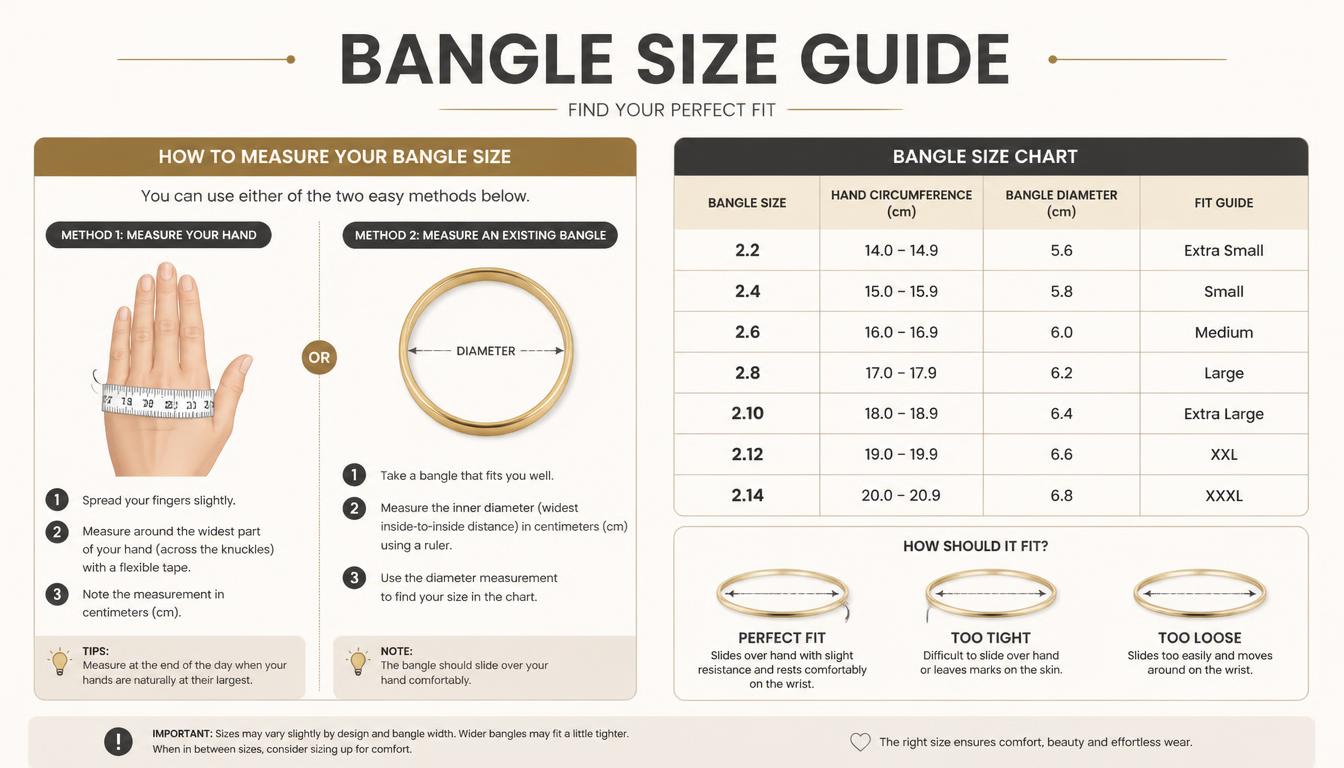
There is a funny little moment when you find a bangle you absolutely love, only to realize that your hand has suddenly become the most complicated object in the room.
The bangle looks perfect, the shine is right, the design is calling your name, and then comes the question: Will it actually fit? This is exactly where a good Bangle Size Guide earns its keep, because a beautiful piece of jewellery isn’t much fun when you are wrestling with it at the knuckles.
Unlike many bracelets, a traditional Bangle is often a rigid circle with no clasp to open. That means the jewellery must pass over the widest part of your hand before it can rest around the wrist. So, strangely enough, your wrist isn’t always the most important measurement.
Your hand size, knuckles, thumb knuckle and the widest part of your hand can decide whether the bangle slips on smoothly or refuses to cooperate. A tiny difference in Bangle sizing can change the whole experience, and this is where measuring carefully saves a surprising amount of trouble.
Whether you are buying women’s bangles online, choosing a precious bangle as a gift, or simply trying to understand why one bracelet fits beautifully while another seems determined to escape, the ideas below will help.
There isn’t one magical number that works for everyone, and honestly, that is rather the point.
| Bangle Size | Approx. Inner Diameter |
|---|---|
| 2.2 | 5.6 cm |
| 2.4 | 6.1 cm |
| 2.6 | 6.6 cm |
| 2.8 | 7.0 cm |
| 2.10 | 7.6 cm |
Why Getting the Correct Bangle Size Matters
The Correct bangle size isn’t necessarily the smallest size you can squeeze over your hand. A proper Bangle fit should feel comfortable
when you move, but it shouldn’t be so loose that the jewellery constantly slides off or bumps awkwardly against everything nearby. On the other hand, a tight bangle that gets stuck around the knuckles is no one’s idea of fine jewelry enjoyment.
Traditional closed bangles are particularly dependent on hand measurement. You need enough room for the bangle to slide over the knuckles, yet not so much room that it becomes a runaway little metal wheel on your arm.
A comfortable fit usually allows natural movement without painful pressure, while the preferred amount of looseness depends on the wearer’s style.
For some people, a snug fit feels elegant and secure. Others love a loose fit, especially when wearing several layered bangles together. There is also a standard fit somewhere between those two, where the jewellery moves gently but won’t fall off easily.
Your personal preference matters more than many generic charts admit, which is worth remembering before clicking “buy” on a size that looks authoritative.
Bangle Size Guide: The Measurements You Actually Need
The first rule of this bangle size guide is simple: don’t measure the wrong place. A wrist measurement and a hand measurement are not interchangeable, even though both sound like they should tell you your size.
For a closed bangle, measure around the widest part of the hand, generally with the thumb tucked across the palm as you would position it when sliding on a rigid bangle. The measurement should pass around the knuckles and broadest hand area. This tells you whether the circular jewellery can actually pass over the hand.
For an open bangle, wrist cuff, or adjustable design, wrist measurement becomes much more useful because the piece does not have to travel over the entire hand.
Here are the main measurements worth knowing:
- Hand circumference: The distance around the widest part of your hand, including the knuckles.
- Wrist circumference: The distance around your wrist, usually measured near the wrist bone.
- Bangle diameter: The straight-line distance from one inside edge of a bangle to the opposite inside edge.
- Internal diameter: Another term for the inside measurement across a circular bangle.
- Bangle circumference: The distance around the inside of the bangle.
- Hand width: The width across the broadest portion of the hand, which can be useful as an additional reference.
- Bangle width: The thickness or visible width of the jewellery itself, which can influence how it feels but doesn’t normally determine the opening size.
Don’t measure around the outside of a chunky bangle and assume you’ve found the internal circumference. That little shortcut can produce a very confident, very wrong result.
How to Measure Bangle Size at Home

Learning How to measure bangle size doesn’t require specialist jewellery equipment. A flexible measuring tape is ideal, but a piece of string, ribbon, or even a narrow strip of paper can work perfectly well if you handle it carefully.
For a traditional rigid bangle, follow these steps:
- Bring your thumb across your palm and gather your fingers together, as though you are preparing to slide on a closed bangle.
- Wrap a flexible measuring tape around the widest part of your hand.
- Keep the tape comfortably close to the skin without squeezing it.
- Record the hand circumference in millimetres, centimetres, or inches.
- If using string or ribbon, mark the point where it overlaps.
- Lay the string flat beside a straight ruler and record its length.
- Repeat the measurement once or twice, because hands are remarkably uncooperative measuring subjects.
- Compare the result with the seller’s bangle size chart rather than assuming every brand uses identical sizing.
If you are measuring your wrist for a cuff or hinged style, place the tape around the wrist bone instead. Don’t pull it extremely tight unless the manufacturer specifically asks for a tight wrist measurement. A relaxed measurement usually gives a better starting point for a comfortable fit.
How to Measure Your Hand for a Bangle
A common question is, “How do I measure my hand for a bangle?” The answer is slightly different from measuring for an ordinary bracelet. Your hand has to fit through the opening, so the knuckles and thumb matter enormously.
Cup your hand into the shape it naturally makes when putting on a rigid bangle. Bring your thumb toward the little finger or across the palm, then measure around the widest part. This creates a practical approximation of the hand circumference that the bangle must accommodate.
The widest part of hand measurement is especially useful for closed designs because the opening cannot change. If your knuckles are prominent, don’t use a measurement taken around the palm alone.
The bangle doesn’t care how slim your wrist is if it cannot get over your knuckles in the first place, which is a slightly rude fact of jewellery sizing.
Suppose your hand circumference is 18 cm / 7 in. You can use that as your principal reference when consulting a sizing chart.
A hand circumference of 19 cm / 7.5 in may correspond to a common standard circumference reference, while 20 cm / 7.9 in may indicate a larger standard size. These are useful reference points, not universal laws carved into jewellery stone.
How to Measure Wrist for a Bangle
When someone asks, “How do I measure my wrist?”, the process is thankfully much less dramatic. Place the measuring tape around the wrist where you expect the jewellery to sit, usually close to the wrist bone.
For a flexible open bangle, cuff bracelet, or hinged design, this measurement can be more important than hand circumference. Record the number without adding extra room at first. The amount of space you need depends on whether you want a snug fit, standard fit, or relaxed fit.
A wrist circumference of 5 5.5 inches / 13 14 cm is a useful small-wrist reference range. A wrist of 5.5 7 inches / 14 17.7 cm covers a broad middle range, while 7 8 inches / 17.7 20.3 cm represents a larger wrist range. Another reference point sometimes encountered in sizing information is 8.5 9 inches / 21.5 22.6 cm.
These numbers should never replace a seller’s own sizing information, because brands may use different internal measurements. In other words, two bangles labelled “medium” can sometimes behave like distant cousins who don’t quite agree on family traditions.
Bangle Size Chart: Diameter and Circumference References

A Bangle size chart can look confusing because some retailers describe sizes by diameter while others use circumference. The useful trick is learning how the two relate.
The basic formula is:
Circumference = 3.14 × Diameter
And, working backwards:
Diameter = Circumference ÷ 3.14
So if an internal diameter is 60 mm, the approximate internal circumference is 60 × 3.14, or about 188.4 mm. This is why understanding diameter-to-circumference conversion can be handy when shopping from different sellers.
Here are some practical reference ranges:
| Wrist reference | Bangle circumference | Approx. diameter |
|---|---|---|
| 5 5.5 in / 13 14 cm | 5.7 6.1 in / 14.5 15.5 cm | 1.8 2 in / 48 51 mm |
| 5.5 7 in / 14 17.7 cm | 6.5 6.9 in / 16.5 17.5 cm | 2.13 2.25 in / 54 57 mm |
| 7 8 in / 17.7 20.3 cm | 7.2 7.7 in / 18.5 19.5 cm | 2.38 2.50 in / 60 64 mm |
| 8.5 9 in / 21.5 22.6 cm | 8.2 in / 20.9 cm | 2.63 in / 67 mm |
Treat this bangle measurement chart as a reference rather than an absolute promise. Different brands can have different size increments, and non-standard designs may not correspond neatly to conventional charts.
Bangle Size Conversion: Inches, Centimetres, and Millimetres
Online jewellery shopping becomes much easier when you can move between units without staring at the screen like it has personally betrayed you. Bangle size in cm, bangle size in inches, and bangle size in mm are simply different ways of describing the same physical measurement.
Remember that approximately 1 inch = 2.5 cm. For greater precision, one inch is 2.54 cm, but 2.5 cm is often sufficient for a quick jewellery-sizing estimate.
For example:
- 18 cm is approximately 7 inches.
- 19 cm is approximately 7.5 inches.
- 20 cm is approximately 7.9 inches.
- 60 mm equals 6 cm.
- 65 mm equals 6.5 cm.
- 70 mm equals 7 cm.
Some traditional references describe a small bangle as approximately 6 cm / 2.4 in in diameter, a medium bangle around 6.5 cm / 2.6 in, and a large bangle around 7 cm / 2.8 in. Again, the actual usable opening depends on whether those measurements are internal and on the bangle’s construction.
Measuring an Existing Bangle
Already own a bangle that fits beautifully? Excellent. It may be the easiest measuring tool you have, although technically it is still a bangle.
To measure an existing bangle, place it flat on a table. Use a ruler to measure across the inside of bangle, passing through the middle from one internal edge to the opposite internal edge. This is the internal diameter.
Do not measure from the outside edge. Decorative metal, stones, raised edges, and unusual shapes can add several millimetres that don’t represent the space available for your hand.
If your existing bangle has an internal diameter of 60 63.7 mm, that measurement may be especially useful when looking for a similar hinged bangle diameter. Write the measurement down in both mm and cm, because online listings seem to enjoy changing units just when you’re feeling confident.
For an oval or rigid ellipse shape, measure the longest and shortest internal dimensions. A circular bangle and an elliptical bangle may have the same approximate width but feel very different when worn.
Bangle Fit: Snug, Standard, or Loose?
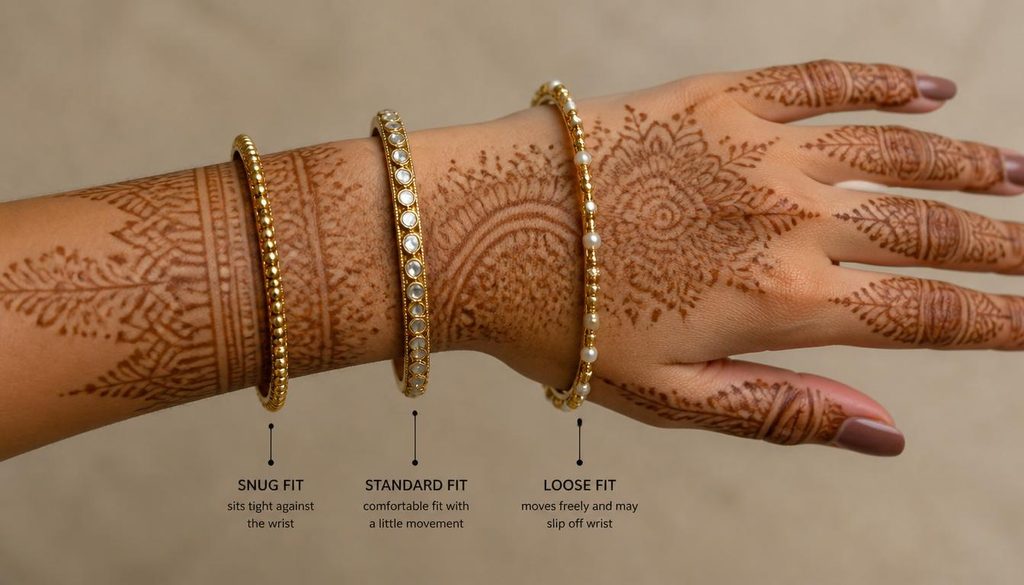
The best bangle fit is partly mathematical and partly personal. Jewellery isn’t a refrigerator that either fits the cabinet or doesn’t. Movement, comfort, design, and personal preference all matter.
A snug fit stays fairly close to the wrist and moves less dramatically. This can look polished and restrained, especially with a single delicate piece.
A standard fit gives the bangle some movement without making it feel unstable. For everyday jewellery, many people find this balance comfortable.
A loose fit allows the bangle to slide farther along the wrist and can create the familiar sound and movement associated with wearing several bangles together. It is especially popular for traditional jewellery styling, though someone who dislikes movement may find it annoying.
A good general test is simple: the jewellery should feel comfortable, shouldn’t pinch, and shouldn’t threaten to fall over the hand during normal movement. If a rigid bangle is slightly difficult to push over knuckles, it may be too small, particularly if you have to force it.
Closed Bangle Size: Why Hand Measurement Wins
A closed bangle is perhaps the clearest example of why bangle size by hand measurement matters. There is no hinge, clasp, or opening mechanism to rescue you if the inner opening is too small.
For this style, measure around the hand rather than relying only on wrist circumference. Your thumb, knuckles, and palm shape can all affect the result.
If you fall between two sizes, consider how the jewellery is designed. A plain, lightweight circular bangle might work well in the smaller size if it passes comfortably over the hand. A wider or heavily decorated piece may require a larger opening because it has less flexibility during movement.
Some people intentionally choose one size larger for a more relaxed traditional look. Others prefer the smallest size that passes comfortably over the hand. Neither preference is automatically wrong.
Open Bangle Size: A Different Sizing Game
An open bangle or open-ended bangle doesn’t need to travel over the whole hand in exactly the same way as a rigid circle. That changes the sizing approach quite a bit.
Many open designs are adjustable bangles, semi-adjustable bangles, or have a deliberate gap in the circumference. They may therefore be selected according to wrist measurement rather than full hand circumference.
For a snug fit, measure your wrist circumference and check the manufacturer’s recommended allowance. Avoid aggressively bending a decorative open bangle unless the jeweller says it is designed for adjustment. Repeated bending can weaken certain metals or disturb stones, and nobody wants their favourite jewellery developing a personality of its own.
Hinged Bangle Size: Convenience With a Measurement Catch

A hinged bangle uses a hinge and clasp or lock, allowing the jewellery to open rather than sliding over the entire hand. This makes it particularly gift-friendly because wrist measurement can be more useful than hand circumference.
A reference range of 60 63.7 mm hinged bangle diameter can appear in jewellery sizing information, but don’t assume that every hinged style uses the same dimensions. The internal opening, hinge placement, thickness, and clasp mechanism all affect the final fit.
For a hinged design, measure the wrist circumference and compare it with the actual internal dimensions provided by the seller. The goal is a secure fit that closes comfortably without squeezing the wrist.
The advantage is obvious: no knuckle negotiations. The bangle opens, you place it around the wrist, and the clasp does the rest. It is one of those tiny jewellery inventions that makes you wonder why every rigid bangle didn’t get the memo.
Choosing the Right Size for Wrist Cuffs and Wide Designs
A wrist cuff, cuff bracelet, or statement cuff usually follows different sizing logic from a narrow rigid bangle. A wide cuff can feel tighter because more material contacts the wrist, even when the circumference technically seems correct.
Measure around the wrist and check whether the manufacturer specifies a wrist range or internal circumference. If the cuff is adjustable, look for a stated size range rather than relying on generic women’s bangle sizes.
For broad cuffs, also consider your forearm. A wide cuff may fit comfortably around the wrist but become restrictive farther up the arm. This is why a cuff style with an adjustable opening can be preferable for gift giving.
If the piece is a statement item with a large surface area, prioritise comfort over an ultra-snug appearance. A beautiful cuff that pinches every time you bend your wrist isn’t exactly a success story.
How B size bangle do I need?” sounds simple until you put five differentangle Style Changes the Size You Need
The phrase “What size bangle do I need?” sounds simple until you put five different bangle styles on the table. A slim bangle, wide cuff, gem-studded bangle, hinged bracelet, and chunky statement piece can all behave differently.
Consider these broad guidelines:
- Slim bangle: A conventional fit is usually comfortable because the piece is lightweight and narrow.
- Wide bangle: You may prefer slightly more room because the additional surface area changes how it sits.
- Layered bangles: A little extra movement can make stacking more comfortable.
- Gem-studded bangle: Check the internal opening carefully, especially if the stones or setting create a rigid structure.
- Hinged bangle: Prioritise wrist circumference and the manufacturer’s internal diameter.
- Open bangle: Look for adjustment instructions and recommended wrist size.
- Wrist cuff: Follow the stated wrist range and consider whether the cuff is adjustable.
- Clasp-style bangle: Measure the wrist and allow enough room for comfortable closure.
The same person may therefore own several jewellery sizes without anything being inconsistent. That is normal jewellery sizing, not evidence that your wrist has secretly changed its dimensions overnight.
What If You Are Between Two Sizes?

This is probably the moment when most sizing guides become frustratingly vague. If your measurement sits between two options, don’t panic and don’t automatically choose the larger size.
First, identify the style. For a closed bangle, make sure the smaller size can comfortably slide over your knuckles.
If it cannot, choose the larger size. A bangle that cannot pass over your hand isn’t going to become more cooperative later fit. If you like a secure, close-fitting style, the smaller suitable option may work. If you prefer movement or have a wider wrist bone.
For a hinged or open design, look at the wrist measurement and the intended fit. If you like a secure, close-fitting style, the smaller suitable option may work. If you prefer movement or have a wider wrist bone, the larger size could be more comfortable.
Your fit preferences matter here. Someone who loves a relaxed fit may deliberately choose the next half-size or larger size, while another wearer might prefer a secure fit that barely moves.
Neither choice is universally “correct,” which is why the word perfect can be a little misleading in jewellery sizing.
Common Bangle Sizing Mistakes
Most sizing disasters are surprisingly ordinary. People measure the wrist for a closed bangle, measure the outside diameter instead of the internal diameter, or trust a generic chart without checking the brand’s instructions. The jewellery industry has many traditions, but apparently none of them include making every size label identical.
Avoid these common mistakes:
- Measuring only the wrist for a rigid closed bangle.
- Forgetting to account for the knuckles.
- Measuring the outside diameter instead of the inside.
- Pulling a measuring tape too tightly.
- Assuming “medium” means the same thing everywhere.
- Ignoring whether the bangle is circular or oval.
- Choosing based only on a photograph.
- Forgetting that a wide bangle can feel different from a slim one.
- Assuming an adjustable piece can be bent repeatedly without consequences.
- Failing to check the retailer’s return, exchange, or resize policy.
A retailer offering a 30 day exchange or 30-day resize policy can provide useful peace of mind, particularly when buying online. Always confirm the actual policy before purchasing because terms vary by seller and product.
Bangle Size Calculator: Do You Really Need One?
A bangle size calculator can be useful when you have a measurement but aren’t sure how to interpret it. In practice, however, the calculation itself is not particularly mysterious.
If you know the internal diameter:
Circumference = 3.14 × Diameter
If you know the internal circumference:
Diameter = Circumference ÷ 3.14
The tricky part isn’t the arithmetic. It is knowing whether your original measurement was taken correctly and whether the bangle’s shape is truly circular.
An online converter can help with inches, centimetres, and millimetres, but it cannot fix an incorrectly measured hand. Technology is clever, but it has not yet developed the ability to stand beside your kitchen table and say, “No, move the tape two millimetres to the left.”
Buying Bangle Gifts Without Knowing the Size

Bangle gifts are lovely because they can carry emotional meaning without requiring a long speech. But buying one secretly can become difficult if you don’t know the recipient’s size.
If possible, discreetly measure an existing bangle that belongs to the recipient. This is often much more reliable than guessing from age, height, or wrist appearance.
For a gift, adjustable designs are generally more forgiving. Open bangles, hinged pieces, and adjustable cuffs can offer more flexibility than rigid circular bangles. If you’re buying a precious bangle, check whether resizing or exchange is available before making the purchase.
You might also borrow a bangle “for comparison” and measure its internal diameter. It sounds slightly suspicious when written down like that, but in real life it can be an impressively effective gift-sizing mission.
A Quick Reference for Finding Your Size
If you want the short version after all those measurements, remember this:
- For a closed bangle, measure around the hand at its widest point, including the knuckles.
- For a hinged or open style, measure around the wrist.
- For an existing bangle, measure the internal diameter across the middle.
- Use Circumference = 3.14 × Diameter when converting measurements.
- Use Diameter = Circumference ÷ 3.14 when working backwards.
- Compare your result with the specific brand’s bangle sizing chart.
- If between sizes, consider both style and personal fit preference.
- Choose a larger size if the smaller option cannot comfortably pass over the knuckles.
- Check return, exchange, and resize terms before buying online.
These simple rules cover most everyday sizing situations, though unusual shapes and elaborate jewellery may require more specific guidance.
Frquently Asked Questions
2.8 bangle size in cm
A 2.8 bangle size is approximately 7.0 cm in inner diameter. Check the sizing system used by the seller before ordering.
how to know bangle size
Measure the widest part of your hand or an existing comfortable bangle. Compare the measurement with a bangle size chart to find the closest fit.
chudi size
Chudi size refers to the inner diameter of a bangle or set of bangles. Common sizes vary by measurement system and brand.
bangle measurement chart
A bangle measurement chart matches bangle sizes with their approximate inner diameter. Use it to select a comfortable size before purchasing.
how to measure bangle size in cm
Measure the inner diameter of a bangle across the center in centimeters. You can also measure your hand at its widest point and compare it with a size chart.
Read this Blog:https://tevoqix.com/useful-articles-how-to-design-an-envelope-on-a-mac/
Final Thoughts: Let the Bangle Fit You, Not the Other Way Around
Finding the correct bangle size is less about chasing a perfect universal number and more about understanding how the jewellery is constructed and how your own hand and wrist behave.
A closed bangle asks your hand to do the hard work, while an open bangle, hinged bangle, or cuff gives you considerably more flexibility. Once you understand that distinction, bangle sizing becomes much less mysterious.
Take your time with the bangle measurement, use the inside dimensions whenever possible, and don’t be shy about checking the seller’s own chart. A measurement of 60 mm means something useful; a vague promise that “medium usually fits” doesn’t quite have the same authority.
Most importantly, remember that comfort is part of beauty. The right bangle fit should let you move your hand, enjoy the jewellery, and forget about the sizing altogether.
That’s really the best outcome. You shouldn’t spend an afternoon admiring a beautiful piece while secretly wondering whether it is planning to escape over your knuckles.
Whether you are choosing a slim everyday bangle, stacking colourful bangles for a celebration, buying a gem-studded piece as a meaningful gift, or selecting fine jewellery for a special occasion, a few careful minutes with a measuring tape can make the whole experience smoother.
Measure the hand when the design requires it, measure the wrist when the style calls for it, compare diameter and circumference intelligently, and let your preferred fit have a voice too.
After all, jewellery is meant to be worn, not merely admired from the safe distance of a shopping cart. And when that new bangle finally slips on with just the right amount of ease, sits comfortably around the wrist, and somehow looks as though it was made specifically for you, that tiny moment feels pretty wonderful.
