

There is something quietly lovely about an envelope. It arrives before the message does, sitting in the hand like a tiny promise that says, open me, something matters inside. A wedding invitation, a business letter, a birthday card, or the announcement of a baby girl can all begin with that little folded piece of paper.
Funny thing is, we often choose the envelope last, even though it is the first part of the message most people actually see.
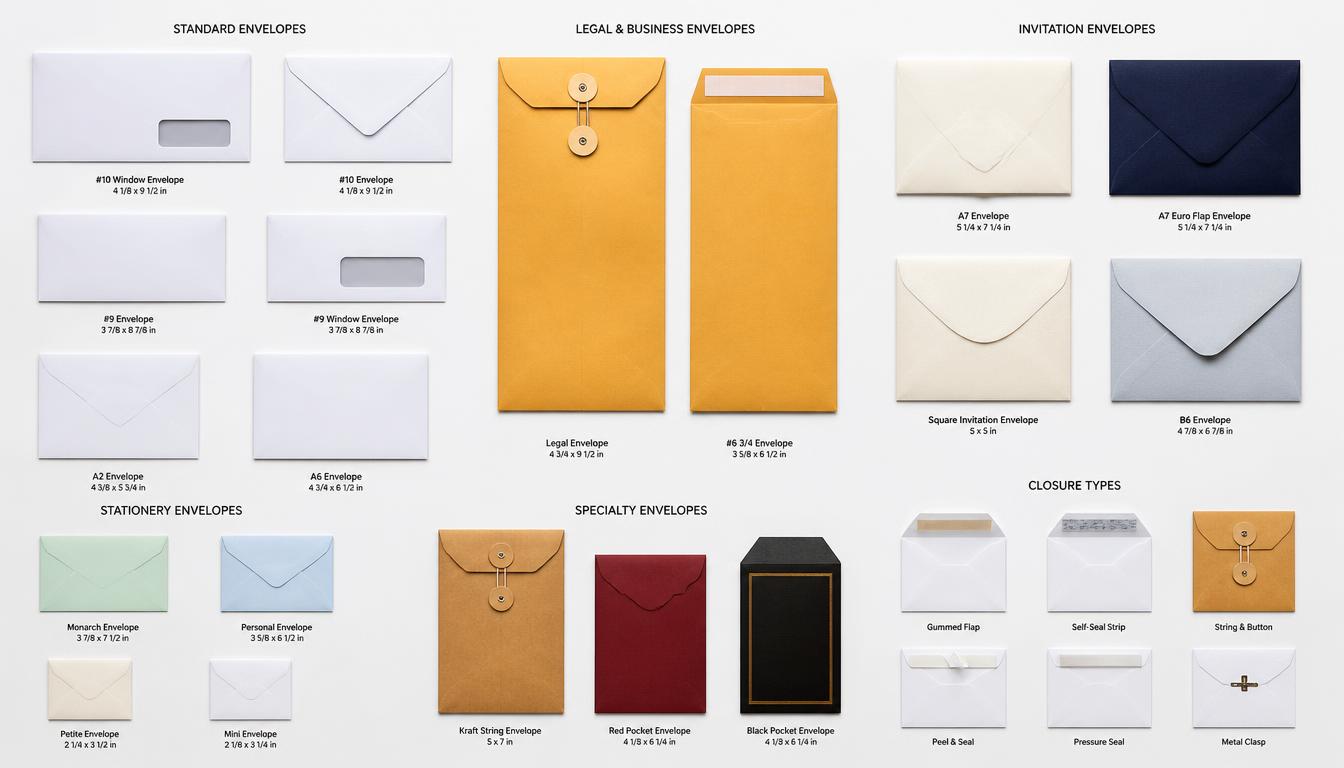
Choosing among envelope styles, envelope sizes, and envelope types can feel more complicated than it should. There are commercial envelopes for everyday business mail, announcement envelopes for invitations and cards, booklet and catalog envelopes for larger papers, and window envelopes designed around practical mailing needs.
Then come flap shapes, openings, paper compatibility, postal rules and printing concerns, which can make the whole thing a bit of a rabbit hole.
The good news is that you don’t need to become an envelope historian to choose correctly. You mainly need to understand how the Envelope dimensions, opening, flap, paper format, window and intended use work together.
Once those pieces click into place, selecting the right envelope becomes surprisingly straightforward, and a little fun too.
| Envelope Type/Style | Common Size | Best For |
|---|---|---|
| #10 | 4.125 × 9.5 in | Business letters |
| A4 | 4.5 × 6.4 in | Documents |
| A5 | 5.8 × 8.3 in | Letters & cards |
| A7 | 5.25 × 7.25 in | Invitations |
| A2 | 4.375 × 5.75 in | Small cards |
| Square | Various | Invitations & special mail |
Why Envelope Styles and Sizes Matter More Than You Think
An envelope is not merely a paper pocket. Its proportions determine whether your document slides in comfortably, whether a printer can feed it, whether an automatic inserter can handle it, and whether the finished mail piece looks polished.
A beautifully designed invitation can lose some of its charm when crammed into an envelope that is just a little too small.
For a business, the stakes can be even higher. Business correspondence, invoices, checks, statements and letterheads usually need practical standard envelopes that move smoothly through mail processing.
A fancy envelope might look impressive, but if it jams equipment or makes the address difficult for optical character recognition (OCR), the romance disappears pretty quick.
For personal stationery, though, style gets more room to breathe. An announcement about welcoming a daughter may suit a pointed flap and soft paper, while a stack of invoices probably shouldn’t be dressed like a royal wedding invitation. That’s where understanding different envelope styles becomes genuinely useful.
Understanding the Basic Envelope Anatomy
Before comparing sizes, it helps to know what you’re actually measuring. An Envelope generally has a front panel, a back panel, an opening flap, a seal flap, seams and sometimes a Window. The flap may fold from the short dimension or long dimension, depending on the design.
An Open End envelope has its opening on the short dimension, while an Open Side envelope opens along the long dimension. This sounds like a small distinction, but it affects how papers are inserted and how the envelope behaves in automatic insertion equipment.
The Flap itself comes in several forms. A Commercial flap is commonly associated with business envelopes and tends to look practical and slightly angular. A Pointed flap creates a more traditional or formal appearance, while a Flat flap has a simpler, contemporary feel.
The famous Monarch pointed flap, for example, has a distinctly elegant silhouette and often appears on correspondence and social stationery.
There are also differences in flap styles based on how the envelope is manufactured and sealed. A seal flap might use adhesive, while some envelopes are designed for peel-and-seal closures.
None of this is terribly glamorous, admittedly, but it becomes important when you’re sending hundreds or thousands of pieces.
Standard Envelope Sizes in the United States

The United States has a broad family of commonly recognized US envelope sizes, particularly within commercial, announcement, booklet and catalog categories. The measurements may vary slightly between manufacturers, so always check the actual product specification before placing a large order.
Commercial Envelopes
Commercial envelopes are the workhorses of the mailing world. They’re commonly used for business mail, invoices, statements, checks, correspondence and everyday office stationery.
Popular commercial sizes include 6 ¼, 6 ¾, 7 ¾, 8 ⅝, 9, 10, 11, 12 and 14, along with the Monarch format. Among them, the #10 is probably the envelope most people recognize immediately, especially in offices where it spends half its life carrying invoices and the other half carrying things nobody wants to open.
A rough reference for several familiar formats is:
- #6 ¼ approximately 3 1/2 × 6 inches
- #6 ¾ approximately 3 5/8 × 6 1/2 inches
- #7 ¾ approximately 3 7/8 × 7 1/2 inches
- #8 ⅝ approximately 3 5/8 × 8 5/8 inches
- #9 approximately 3 7/8 × 8 7/8 inches
- #10 approximately 4 1/8 × 9 1/2 inches
- #11 approximately 4 1/2 × 10 3/8 inches
- #12 approximately 4 3/4 × 11 inches
- #14 approximately 5 × 11 1/2 inches
These are useful starting points for an envelope size chart, but manufacturers can differ a little. A half-inch here or there becomes rather important when you’re feeding thick stationery into a machine.
Announcement Envelopes for Invitations and Special Moments
Some envelopes seem to understand that the thing inside is important. Announcement envelopes are made for announcements, invitations, cards, small booklets, brochures and promotional pieces where appearance matters almost as much as function.
Common announcement envelope sizes include A 2, A 6, A 7, A 8 A 10 and Slim formats. The A-series is particularly popular for greeting cards and invitations because it offers proportions that feel naturally suited to folded cards.
For a newborn announcement, for instance, an A 7 envelope gives a generous canvas for a folded card featuring a photograph and a short note. A soft cream envelope with a simple printed name can make the whole announcement feel personal without becoming overly decorative. Sometimes the quiet choices are the ones people remember.
Here are a few short message ideas that can accompany a baby-girl announcement:
- “A tiny daughter has arrived, and somehow the whole house feels brighter already.”
- “Our little girl has entered the world, bringing more love than we knew could fit in one home.”
- “Pink isn’t required, but joy certainly is. Welcome, sweet baby girl.”
- “Her first hello was tiny. The happiness it created was anything but.”
- “A daughter, a new beginning, and a lifetime of beautiful ordinary days ahead.”
- “Our family has gained two tiny feet and one enormous reason to smile.”
- “She arrived quietly, then completely rearranged our hearts.”
Each of these can be adapted for grandparents, friends, colleagues or extended family, and the wording can be made more playful if that’s your family’s style.
Baronial Envelopes and the Beauty of the Pointed Flap
If commercial envelopes are the sensible shoes of stationery, Baronial envelopes are the dress shoes. They traditionally feature a deeper body and a pointed flap, giving them a formal appearance that works beautifully with invitations and refined announcements.
Common US Baronial sizes include 2, 4, 5, 5 ¼, 5 ½, 5 ¾ and 6. Exact dimensions differ according to the manufacturer and style, so treat the number as a category rather than assuming every supplier cuts it identically.
Baronial designs are especially attractive for wedding invitations, formal envelopes, greeting cards and special family announcements. They also work beautifully when the paper itself has texture. Cotton stock, handmade paper and subtle colors can turn a simple envelope into something that feels almost heirloom-ish.
For a baby-girl celebration, a pointed flap can give a printed announcement a more ceremonial character. You don’t need glitter, ribbons and seven shades of pink. A restrained envelope, elegant typography and a thoughtful card inside can do plenty.
Booklet and Catalog Envelope Sizes

When your documents become larger, the small social envelopes aren’t going to save you. Booklet envelopes are intended for catalogs, folders, larger documents and booklet mailings, generally opening along the long dimension in many common configurations.
US booklet envelope sizes include 3, 5, 6, 6 ½, 7, 7 ½, 9, 9 ½, 10 and 13, among others. Catalog formats extend further, with sizes such as 1, 1 ¾, 2, 3, 6, 7, 8, 9 ½, 9 ¾, 10 ½, 12 ½, 13 ½, 14 ¼ and 14 ½.
Catalog envelopes are particularly useful for magazines, reports, catalogs and large-format documents. They are built for materials that don’t want to be folded, and frankly, some documents have enough personality already without being folded into quarters.
When selecting between booklet and catalog formats, think about the document’s thickness as well as its length and width. Paper can be sneaky. Ten sheets fit nicely; fifty sheets suddenly behave like a small brick.
ISO Envelope Standards and the Metric System
Outside the US, the picture becomes more standardized around the ISO envelope standards and the ISO metric system. The most useful families are the C series and B series, which are designed to work logically with standard paper formats.
The familiar ISO formats include C3, C4, C5, C6, C7, C7/6, B4, B5, B6, DL and C6/C5. Their dimensions are specified in millimeters, rather than inches, making them particularly common throughout Europe and many other countries.
A C4 envelope is designed to accommodate an unfolded A4 sheet. A C5 envelope suits A5 paper or an A4 sheet folded once. A C6 envelope works well for A6 paper and smaller folded formats. The DL envelope is widely used for A4 paper folded into thirds.
This relationship between paper and envelope sizes is one of the cleverest parts of the metric system. Instead of memorizing dozens of unrelated measurements, you can think about what paper format you have and how many times you want to fold it.
Paper Compatibility: A4, A5 and Folding Choices
Paper compatibility should be one of the first things you consider when choosing an envelope. The question isn’t simply, “What size envelope looks nice?” It’s, “What paper format needs to live inside it?”
For example:
- A C4 envelope accommodates an unfolded A4 sheet.
- A C5 envelope accommodates A5 paper or A4 folded once.
- A C6 envelope works with A6 stationery and smaller folded sheets.
- A DL envelope is commonly suited to A4 folded in thirds.
- A C6/C5 envelope can accommodate an A4 sheet folded in half twice in the appropriate orientation.
Other useful combinations involve an A3 sheet, A5 sheet, A4 folded in quarters, A5 folded in half lengthwise, and various tri-fold configurations. The trick is to consider the final paper dimensions after folding, not the original sheet size.
If you are designing invitations, make a mock-up using scrap paper first. It sounds almost embarrassingly simple, but it can prevent an expensive order of perfectly printed envelopes that don’t quite fit your cards.
Window Envelopes: Practicality Meets Postal Processing
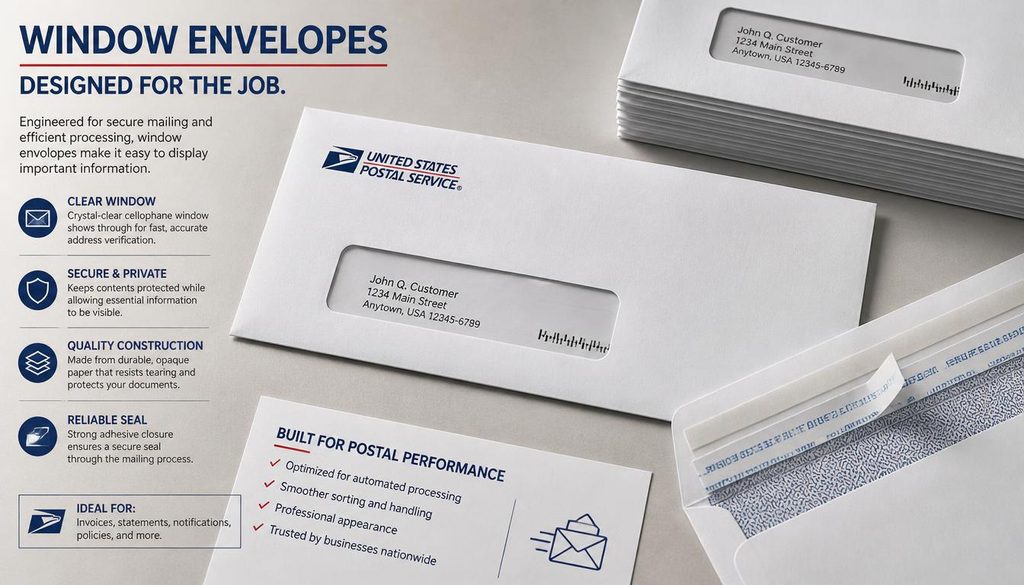
A Window envelope has a transparent section that allows an address or other printed information on the enclosed document to show through. Window envelopes US suppliers commonly offer single-window envelope and double-window envelope configurations.
The window material is often translucent plastic, though manufacturers increasingly offer alternative materials and environmentally conscious choices.
The window’s size and location matter because postal systems expect addresses to appear within particular areas for reliable processing.
A single-window envelope is commonly used for the recipient’s address, while a double window envelope may display both recipient and return information. These are especially useful for bills, checks, invoices and marketing mail.
But don’t assume that a window is universal. Window envelope standards can differ between countries. Germany, the United Kingdom, Canada and other regions may have different expectations for window placement, dimensions and address positioning.
A UK DL envelope, for example, should be designed around local postal conventions rather than simply copying an American layout.
Envelope Addressing: Where the Address Should Go
Good envelope addressing is partly about aesthetics and partly about helping machines understand your mail. A clear postal address, properly arranged with the ZIP code or postal code, gives both people and sorting equipment a much easier job.
The exact rules vary by country and postal service, but the basic principle is remarkably consistent: keep the address in the recognized address zone, use clear contrast, and avoid putting decorative graphics directly around important addressing information.
For ordinary US mail, the recipient’s address generally appears on the front of the envelope, with the ZIP code forming the final part of the address.
In other countries, postal conventions can differ, so international mail deserves a quick check before you print five hundred pieces. A tiny mistake repeated five hundred times stops being tiny.
Address labels can work perfectly well for many mailing situations, although direct printing often creates a cleaner appearance. For high volume mail, OCR equipment, automatic mail sorting, barcodes and other machine-processing technologies make consistent placement particularly important.
Envelope Printing at Home or in the Office
Envelope printing can be surprisingly easy once your printer and envelope agree with each other, which they don’t always do on their first date.
Both an Inkjet printer and Laser printer can handle many envelopes, but you should check the printer manufacturer’s specifications. Some envelopes have coatings, textures, adhesive areas or thicknesses that don’t behave well with particular machines.
With inkjet printing, moisture can occasionally cause ink to spread or appear blurred, especially on absorbent paper. Laser printing uses heat, so envelopes with heat sensitive materials or unusual adhesives deserve extra caution. The printer’s heating element can affect materials in ways that aren’t obvious until the envelope comes out looking slightly haunted.
For home projects, simple fonts such as Arial or Helvetica are generally easier to read than highly decorative typefaces. A font around 12-point is often a comfortable starting point for addresses, though the actual size should depend on the design and postal requirements.
Software such as Swift Publisher and other printing software can help position addresses, graphics and barcodes more accurately. Always run a test on one envelope before committing to a full batch. This is one of those boring pieces of advice that becomes very exciting after it saves an entire box of stationery.
Choosing Envelope Styles for Different Situations

The best envelope is the one that suits both the contents and the occasion.
For business correspondence, commercial formats such as #10 are practical, familiar and widely supported. They are excellent for invoices, checks, statements and letterheads.
For invitations, announcement formats and Baronial styles offer more visual personality. A pointed flap can make a formal invitation feel special, while a simple A-series envelope can feel modern and friendly.
For catalogs, magazines and reports, larger catalog mailing envelopes are more appropriate. If the material is bulky or rigid, don’t choose based only on width and height; consider thickness and construction as well.
For special family stationery, you have more freedom. A baby-girl announcement might look lovely in an A-7 envelope, while a formal naming ceremony invitation could suit a Baronial style. The envelope doesn’t need to shout. Sometimes it just needs to whisper, “this was chosen carefully.”
A Simple Envelope Size Guide Before You Buy
If all these categories are beginning to blur together, use this quick envelope size guide as a decision shortcut:
- Choose a commercial envelope for routine business mail and office correspondence.
- Choose an announcement envelope for cards, invitations and social stationery.
- Choose a Baronial envelope when a formal, pointed-flap appearance is desirable.
- Choose a booklet envelope for larger documents, folders and booklet mailings.
- Choose a catalog envelope for magazines, reports and larger unbound materials.
- Choose a window envelope when the address needs to show through from the enclosed document.
- Choose an ISO C-series envelope when working with metric paper formats such as A4 and A5.
- Choose a DL envelope when an A4 sheet needs to be folded into thirds.
- Choose a C4 envelope when an A4 sheet should remain unfolded.
- Choose a C5 envelope when using A5 paper or an A4 sheet folded once.
That little list covers a surprisingly large portion of everyday envelope decisions. The rest is usually about thickness, paper, appearance, printing and postal requirements.
How to Address and Print an Envelope Without Trouble

Before printing, confirm the envelope’s short dimension, long dimension, flap orientation and printer feed direction. Different printers load envelopes differently, and there is no universal “right side up” that works for every machine.
Keep the address clear and away from decorative borders. If you’re using a window, make sure the printed address lands correctly behind the translucent window. Test alignment with an inexpensive sheet of paper first, because printers have a strange talent for being confident and wrong.
If you’re sending a large batch, consider whether the mail needs a barcode, specific postal markings or special machine-readable formatting. Businesses relying on automatic sorting should pay particular attention to postal service requirements rather than treating envelope design as purely decorative.
And please check the envelope itself for moisture or damaged adhesive before printing. Printer ink, paper moisture and adhesive don’t always make a happy little family.
How to Make a Baby Girl Announcement Feel Personal
Although envelopes are practical objects, they can also carry enormous emotional weight. A newborn announcement is one of those pieces of mail people sometimes keep for years, tucked into a drawer beside old photographs and cards.
A personal message doesn’t need to be elaborate. Mention the baby’s name, arrival date, a funny family detail or something you noticed during those first sleepy days. “She already has Grandpa wrapped around one tiny finger” tells a story in a way that “Congratulations on our new arrival” simply can’t.
You can also match the message to the relationship. A grandparent’s envelope might include a sentimental line, while a colleague could receive something warmer but more restrained. Friends might appreciate humor. The envelope and message together become a tiny portrait of the family.
Across cultures, the arrival of a daughter may be marked through naming ceremonies, family gatherings, religious blessings, gifts, photographs and shared meals. The traditions vary widely, but the underlying idea is wonderfully familiar: a new person has joined the circle, and everybody wants to say, in their own way, we’re glad you’re here.
Frequently Asked Questions
types of envelopes
Common types of envelopes include business, booklet, catalog, square, and invitation envelopes. Each type is designed for different documents and mailing needs.
common envelope sizes
Common envelope sizes include #10, A4, A5, and A7. The right size depends on the paper, card, or document you need to enclose.
what are the different envelope sizes
Envelope sizes vary from small invitation envelopes to larger document and catalog envelopes. Standard sizes are available for letters, cards, brochures, and paperwork.
envelope styles
Popular envelope styles include standard, square flap, pointed flap, booklet, catalog, and self-seal envelopes. Styles can be chosen based on appearance and purpose.
list of envelope sizes
A list of common envelope sizes includes #10, A2, A6, A7, A9, A10, A4, and A5. Each size suits different papers, cards, and mailing requirements.
Read this Blog: https://tevoqix.com/pages-size-guide-necklaces/
Final Thoughts on Choosing the Right Envelope
There is no single perfect envelope. There is only the envelope that makes sense for the paper, purpose, postal system and personality of the sender.
Understanding envelope dimensions, envelope measurements, flap configurations, windows, paper compatibility and envelope standards gives you the practical foundation.
Knowing the difference between commercial, announcement, Baronial, booklet and catalog formats gives you the vocabulary to shop intelligently. And learning a few basics about envelope printing and addressing keeps the final result from becoming an expensive experiment.
When you’re buying envelopes, always check the manufacturer’s exact dimensions, especially for large orders. Standards provide useful guidance, but products can vary in flap depth, paper thickness, construction and usable interior space.
Most of all, don’t underestimate the emotional side of stationery. A business envelope may carry a routine invoice, while another envelope might contain the first photograph of someone’s daughter. Same basic object, completely different universe.
So choose the practical #10 when practicality is what the job needs. Choose a C4 when your A4 document deserves to breathe. Choose a pointed Baronial flap when the occasion calls for something graceful.
And when you’re announcing a baby girl, choose something that feels like your family, because that tiny envelope may become one of those ordinary-looking things that nobody has the heart to throw away.
If you have a favorite envelope style, a clever way of addressing invitations, or a memorable story about receiving a special announcement in the mail, share it. Those small stationery traditions are often where the best stories are hiding, quietly folded up and waiting to be opened.
