


Choosing earrings sounds like one of those tiny decisions that should take about thirty seconds. Then you open a jewelry page and suddenly there are 8mm, 10mm, 12mm, 25mm, 40mm, 60mm and even 100mm options staring back at you.
A little confusing, honestly. The right earring size can completely change how an earring looks, feels, and sits on your ear, so knowing a few basic earring measurements makes shopping much easier.
A good pair of hoop earrings can become that one piece of jewelry you reach for without thinking. Meanwhile, huggie earrings are tiny, close-fitting pieces that work beautifully when you want something subtle.
Neither style is automatically better. It really comes down to your piercing location, preferred earring fit, personal style, and how much visual attention you want your ears to get.
This hoop earrings size guide and huggie earring size guide will walk through diameters, measurements, common sizes, piercing placement, and styling ideas.
Think of it as the friend who quietly pulls out a ruler before you accidentally buy earrings that look nothing like you imagined.
| Earring Size | Approx. Diameter | Best For |
|---|---|---|
| Huggies | 6 10 mm | Close fit |
| Small Hoops | 15 25 mm | Everyday wear |
| Medium Hoops | 30 50 mm | Versatile style |
| Large Hoops | 60 80 mm | Statement look |
| Extra Large | 90+ mm | Bold style |
Understanding Hoop and Huggie Earring Sizes
Before choosing a size, it helps to understand what the numbers actually mean. Hoop size is generally described by the diameter of the hoop, while huggie size often refers to the hoop’s diameter or the space inside the hoop.
Different jewelry brands can measure their products slightly differently, so checking the individual product’s measurement is always a smart move.
For hoop earrings, the diameter usually tells you how wide the circular earring appears when viewed from the front. A 25mm hoop, for example, is considerably smaller than a 50mm hoop. The difference may only be a few centimeters on paper, but on an earlobe, it can look very different.
Huggies are designed to sit close to the ear. Their huggie diameter and inner diameter are particularly important because the actual wearable space can be smaller than the total outside measurement. That’s why two earrings with seemingly similar dimensions can have very different earring fit.
Hoop Earrings Size Guide: Common Sizes Explained
The easiest way to understand hoop earrings is to group them into broad size categories. There isn’t one universal rule that says exactly where small ends and medium begins, but the following ranges are useful for shopping.
Small Hoop Earrings
Small hoops are often around 10mm to 25mm, although some brands use slightly different ranges. A 25mm hoop is about 2.5cm or roughly 1 inch across, making it a popular everyday choice for many people.
These hoops create a neat appearance without becoming the main feature of your outfit. They work especially well with casual clothing, office outfits, and simple everyday earrings. If you have multiple piercings, small hoops can also sit nicely beside studs or tiny huggies.
Medium Hoop Earrings
Medium hoops commonly fall around 30mm to 50mm. A 30mm hoop measures 3cm, while a 40mm hoop measures 4cm across. A 50mm hoop is 5cm, giving you a more noticeable circular shape.
Medium hoops are a sweet spot for people who want something visible but not dramatically oversized. They can move from daytime errands to dinner without feeling like you changed your entire personality, which is rather convenient.
Large Hoop Earrings
Large hoops often begin around 60mm and can extend much further. A 60mm hoop is 6cm, while a 100mm hoop reaches 10cm or about 4 inches.
Large hoops are more expressive and can work beautifully as statement earrings. They tend to draw attention toward the face, especially when hair is pulled back. For a bold appearance, large hoops can be paired with simple clothing so the earrings get their little moment.
X-Large Hoop Earrings
X large hoops are generally oversized pieces, often 80mm, 100mm or beyond. A 100mm hoop is approximately 4 inches in diameter, so this is definitely not a subtle earring choice.
These are better suited to special occasions, fashion-forward outfits, performances, parties, or anyone who simply loves a dramatic look. They may look glamorous, but comfort should still be considered before wearing very large hoops for long periods.
Huggie Earrings Size Guide: From Tiny to Comfortable

Huggies are different because the goal is usually a close, snug appearance. The huggie size you need depends heavily on the thickness of your earlobe, the piercing location, and whether you want the earring to sit tightly or leave a little space.
Small Huggies
Small huggies commonly include sizes such as 8mm huggies, 10mm huggies, and 12mm huggies. These are among the most popular options for a discreet look.
An 8mm huggie is about 0.8cm, while a 10mm huggie is 1cm. A 12mm huggie measures 1.2cm. These little differences matter when the earring is meant to sit close against the ear.
Small huggies are excellent for daily-wear earrings, second piercings, and minimalist styling. They can also be mixed with other earrings when creating a multi-piercing arrangement.
Huggie Earring Size Guide in Millimeters
If you’re wondering, “what is the huggie earring size guide in mm?”, the answer is easier than it sounds. Huggie measurements are commonly expressed in millimetres because the earrings are relatively small and a few millimetres can affect the fit.
| Huggie Size | Centimeters | Approx. Inches | General Fit |
|---|---|---|---|
| 8mm | 0.8cm | 0.31 inch | Very small |
| 10mm | 1cm | 0.39 inch | Small |
| 12mm | 1.2cm | 0.47 inch | Small medium |
| 15mm | 1.5cm | 0.59 inch | Medium |
| 20mm | 2cm | 0.79 inch | Larger huggie |
Remember, these measurements describe size, not necessarily the exact amount of room available for your ear. The inner diameter measurement is often more useful when you’re trying to determine whether an earring will comfortably close around a piercing.
How to Measure Hoop Earrings
Learning how to measure hoop earrings is surprisingly simple. You mainly need a ruler with clear millimetre markings and a flat surface.
Place the hoop on the ruler and measure straight across its widest point. This gives you the approximate outer diameter. If you want to know the space available inside the hoop, measure across the open area from one inner edge to the opposite inner edge. That’s the inner diameter.
The distinction is important because the outer edge includes the metal itself. A thick hoop may have a noticeably smaller inner opening than a slim hoop with exactly the same outer diameter. So when shopping, don’t only look at the headline number.
Inner Diameter vs Outer Diameter

The outer diameter measures the full width of the hoop from outside edge to outside edge. The inner diameter measures the open space inside the hoop.
For example, imagine two hoops that both have an outer diameter of 20mm. If one has a thick, wide construction and the other is extremely slim, their inner openings won’t be identical. The earrings technically have the same outside dimension, but their earring dimensions differ.
This is especially important for huggies and cartilage earrings, where the available space between the piercing and surrounding ear tissue may be limited. A ruler can help, but the product’s stated inner diameter is usually the more useful number.
What Size Hoop Earrings Should I Choose?
If you’re asking what size hoop earrings should I choose, start by thinking about where you want them to sit and how noticeable you want them to be.
For a simple, everyday look, 20mm to 30mm hoops are a useful starting point. Around 40mm to 50mm creates a more visible style, while 60mm and above becomes increasingly bold.
There is no magic “perfect hoop size” because ears, piercings, outfits, and personal preferences are all different.
Your hairstyle can matter too. Pulled-back hair, ponytails, and an updo can make hoops much more visible. With medium to long hair worn down, smaller hoops may sometimes disappear behind the hair, while larger hoops can remain visible.
Hoop Earrings in MM and Inches
People often switch between millimetres, centimetres, and inches when shopping. Having a quick mental reference helps.
| Hoop Diameter | Centimeters | Approx. Inches | Style Impression |
|---|---|---|---|
| 25mm | 2.5cm | 1 inch | Small/classic |
| 30mm | 3cm | 1.2 inches | Small medium |
| 40mm | 4cm | 1.6 inches | Medium |
| 50mm | 5cm | 2 inches | Medium large |
| 60mm | 6cm | 2.4 inches | Large |
| 100mm | 10cm | 4 inches | X-large |
The chart is only a practical reference, not a strict jewelry industry standard. Some manufacturers measure slightly differently, so always check the seller’s own hoop size chart before ordering.
Different Hoop Earring Styles and Their Measurements
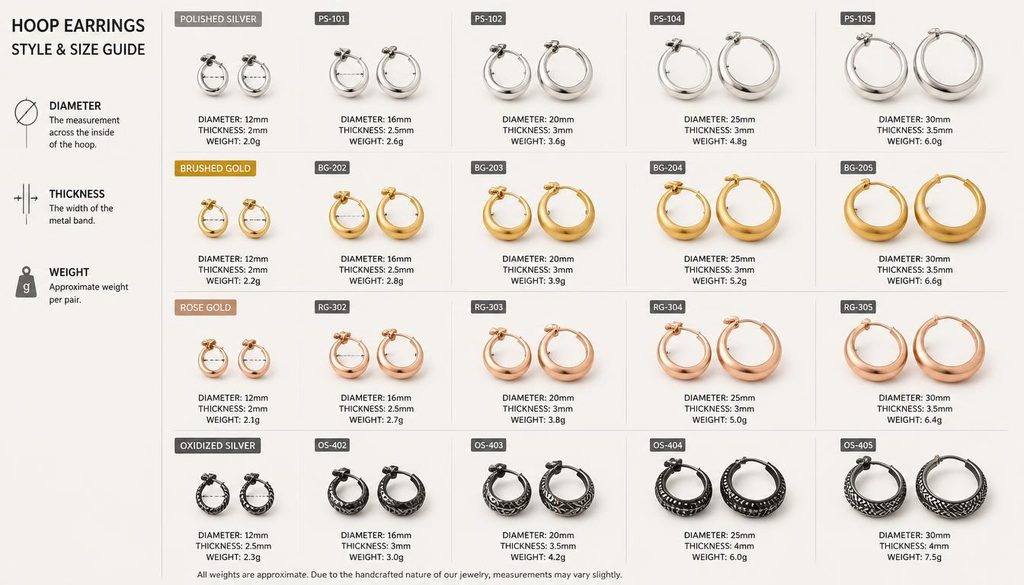
Not every hoop is a perfect circle. Traditional circular earrings are easy to understand because their diameter is straightforward, but modern designs come in plenty of shapes.
Elongated hoops create a longer silhouette, while J-shaped hoops, C shaped hoops, and open-ended hoops can have different measurements because they don’t form a complete circle. Creole hoops may also feature distinctive curves or twists that change how their size appears when worn.
There are also half-hoops, hooplets, and hoops decorated with hoop charms. Plain hoops tend to look smaller and lighter, while textured hoops, beaded hoops, and gemstone hoops can appear visually larger even when their physical diameter is identical. Jewelry has a funny habit of doing that.
Choosing Between Slim and Wide Hoops
The hoop width is separate from the diameter. Diameter tells you how large the hoop is across, while width describes how thick the actual metal looks.
Slim hoops usually create a delicate, elegant appearance. They’re ideal if you prefer subtle ear adornment or want to combine several earrings together. Wide hoops have more visual weight and can look bolder without necessarily increasing the diameter.
This distinction is useful when comparing two earrings that both measure 40mm. One might be delicate and barely noticeable, while another could be chunky and dramatic. Same diameter, very different personality.
Earrings for Multiple Piercings
A multi piercing setup gives you even more opportunities to experiment with size. Your first lobe piercing might carry a medium hoop, while the second piercing holds a tiny huggie or stud.
For a third piercing, smaller jewelry is often visually easier to combine. The goal isn’t necessarily to make every earring the same size. Mixing small huggies, hoops, and studs can create a layered earring style that feels intentional rather than crowded.
Think of your ear almost like a tiny gallery wall. Each piece needs enough breathing room, otherwise everything starts shouting at once.
Choosing Earrings for Cartilage Piercings

Cartilage placements require more attention to measurements because the available space can be limited. Common locations include the helix, conch, and tragus.
For a helix piercing, people often look for small hoops or huggies that follow the edge of the ear. The exact size depends on your anatomy and the placement of the piercing hole.
A conch piercing sits farther inside the ear, so the required diameter can differ from a helix. Conch earrings may use small hoops with enough inner space to sit comfortably.
A tragus piercing has even less room for many designs. Small jewelry is usually considered when selecting earrings for tragus piercing, but the appropriate fit depends on the individual’s ear anatomy and the jewelry construction.
If a piercing is new, tender, swollen, or still healing, sizing should be discussed with a qualified professional piercer rather than guessed from a chart. Comfort and safe healing come before fashion, every time.
Hoop Size and Face Shape
Jewelry styling is personal, but face shape can offer a few useful ideas. People with an angular face may enjoy the softness of round hoops, while elongated hoop shapes can add vertical movement.
For a wider face, longer or slightly elongated earrings may create a different visual balance. People with an elongated face may prefer wider circular hoops that add horizontal emphasis.
Still, these are styling suggestions, not rules. Your face doesn’t need to fit a jewelry formula. If you love a particular pair, that is a pretty good reason to wear it.
Everyday Earrings vs Statement Earrings
For everyday hoop earrings, comfort should be one of your first priorities. Lightweight metal earrings in the 20mm to 40mm range can offer visibility without feeling overly dramatic.
For a special event, statement hoops may be more appropriate. Larger 50mm, 60mm, or even 100mm designs can create a glamorous look when paired with an outfit that leaves enough visual space around the face.
The best statement hoop earrings size depends on the occasion. A huge pair may look wonderful at a party but feel impractical during a long workday. Jewelry doesn’t have to work every shift of your life.
How to Measure Huggie Earrings
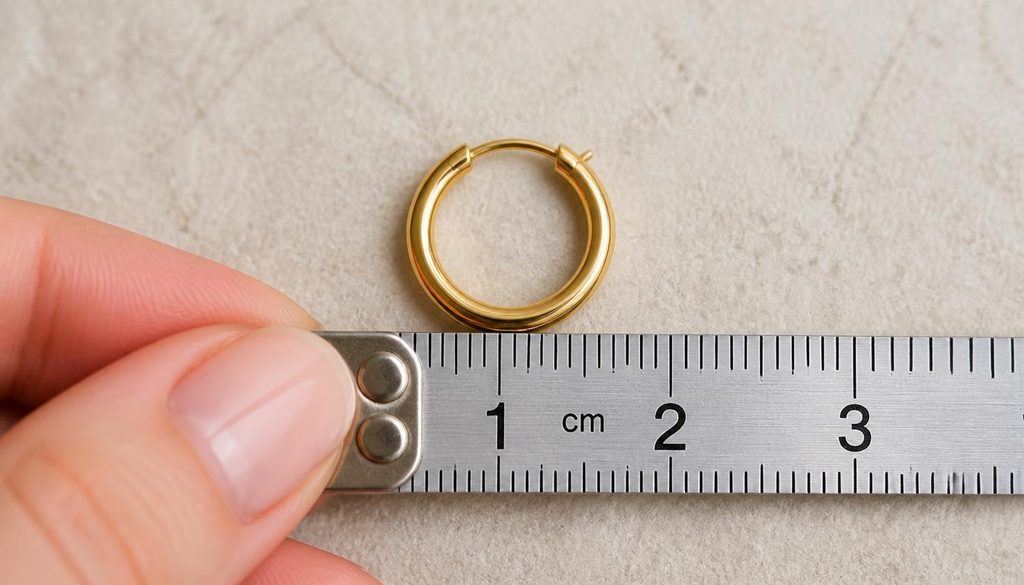
When learning how to measure huggie earrings, measure both the outside and inside dimensions whenever possible.
First, measure the total outside diameter. Then measure the opening inside the hoop. Also pay attention to the thickness of the metal and the length of the post or hinged section.
For hinged-back earrings, the closing mechanism can take up some of the internal space. This is why an earring advertised as 10mm may not provide 10mm of usable space around your piercing.
If you’re shopping for huggies for cartilage, compare the listed inner diameter with the distance between your piercing and the nearby edge of your ear. A precise measurement can save you from ordering a beautiful pair that simply doesn’t sit where you hoped.
Common Huggie and Hoop Conversions
A few common conversions are useful when reading international jewelry listings.
8mm huggies are approximately 0.8cm or 0.31 inch. 10mm huggies are 1cm or about 0.39 inch, while 12mm huggies are 1.2cm or roughly 0.47 inch.
For hoops, 25mm hoops equal 2.5cm or about 1 inch. 30mm hoops are 3cm, 40mm hoops are 4cm, 50mm hoops are 5cm, and 60mm hoops are 6cm.
A 100mm hoop is 10cm or about 4 inches. That’s a proper statement piece, not something that quietly hides in the background.
How Ear Anatomy Changes Earring Fit
Every ear has its own shape. The distance from the piercing location to the edge of ear, the thickness of the earlobe, and the curve of the inner rim can all influence fit.
This is why copying another person’s earring size doesn’t always work. Two people can wear the same 12mm huggie and have completely different results. One might get a snug fit while another needs a larger inner opening.
Understanding your own ear anatomy makes jewelry shopping far less frustrating. Take your time, measure the relevant area, and read the product dimensions instead of relying only on photos.
What Is the Difference Between Hoop and Huggie Size?

The biggest difference is how the earrings are intended to sit. Traditional hoops generally hang from the lobe and leave visible space between the jewelry and ear, while huggies are designed to sit much closer and almost “hug” the ear.
Therefore, a 15mm huggie isn’t necessarily equivalent in appearance to a 15mm traditional hoop. Their construction, thickness, closure, and inner diameter can all change the final look.
When comparing them, think about earring fit, not just diameter. The number tells part of the story, but the ear tells the rest.
Tips for Buying the Best Hoop or Huggie Size
Before purchasing, check the product dimensions rather than relying on words like “small” or “large.” One company’s small hoop can be another company’s medium, which is mildly annoying but very common.
Look for earring measurements in millimetres and check whether the listed measurement refers to the inner or outer diameter. If possible, compare those numbers with an earring you already own and like.
Also consider weight. Large statement jewelry can be visually impressive, but a lightweight construction may be more comfortable than a heavy solid-metal version. Your ears should not have to file a complaint by lunchtime.
Creating Your Own Earring Size Chart
You can make a simple personal earring size chart using earrings you already own. Measure each pair and write down the outer diameter, inner diameter, thickness, and how comfortable they feel.
Over time, you’ll notice patterns. Perhaps 25mm hoops are your everyday favorite, while 50mm hoops are your special-event choice. Maybe 10mm huggies work beautifully in your second piercing but 12mm fits better in your lobe.
This turns shopping into something much more predictable. Instead of asking, “Will these look right?”, you’ll have your own real-world measurement guide to compare against.
Frequently Asked Questions
how to measure hoop earrings
Measure the inside diameter of the hoop from one inner edge straight across to the opposite inner edge. Use a ruler or measuring tape for accuracy.
diameter of hoop earrings
The diameter of hoop earrings is the distance across the inside of the hoop. Common sizes range from small, close-fitting hoops to larger statement styles.
hoop earring size chart in inches
A hoop earring size chart in inches helps you compare hoop diameters quickly, making it easier to choose a size that suits your preferred look.
how to measure a hoop earring
Place the hoop flat and measure straight across its inside opening. Avoid measuring the metal thickness, as this can give you a larger measurement than the actual diameter.
hoop earring size chart inches
A hoop earring size chart in inches shows the diameter of different hoops, helping you select the right size for everyday wear or a bolder style.
Read This Blog:https://tevoqix.com/pages-size-guide-bangles/
Final Thoughts on Hoop and Huggie Sizing
Finding the right hoop earring size or huggie size doesn’t need to become a complicated project. Once you understand diameter, inner diameter, outer diameter, width, and piercing placement, the numbers become much easier to read.
For subtle daily styling, small huggies and small hoops are excellent choices. Medium hoops provide versatility, while large and X-large hoops offer a more glamorous or dramatic appearance. For cartilage placements, pay particular attention to the inner diameter and your individual piercing location.
Most importantly, don’t let a size chart decide your style for you. Use it as a tool. Your favorite Jewellery or Jewelry should feel comfortable, suit your lifestyle, and make you happy when you catch your reflection unexpectedly.
Whether you’re choosing classic plain hoops, sparkling gemstone hoops, tiny huggies, bold statement hoops, or a combination for multiple piercings, the best size is ultimately the one that fits your ear and feels like you. And honestly, that’s the nicest measurement of all.
